


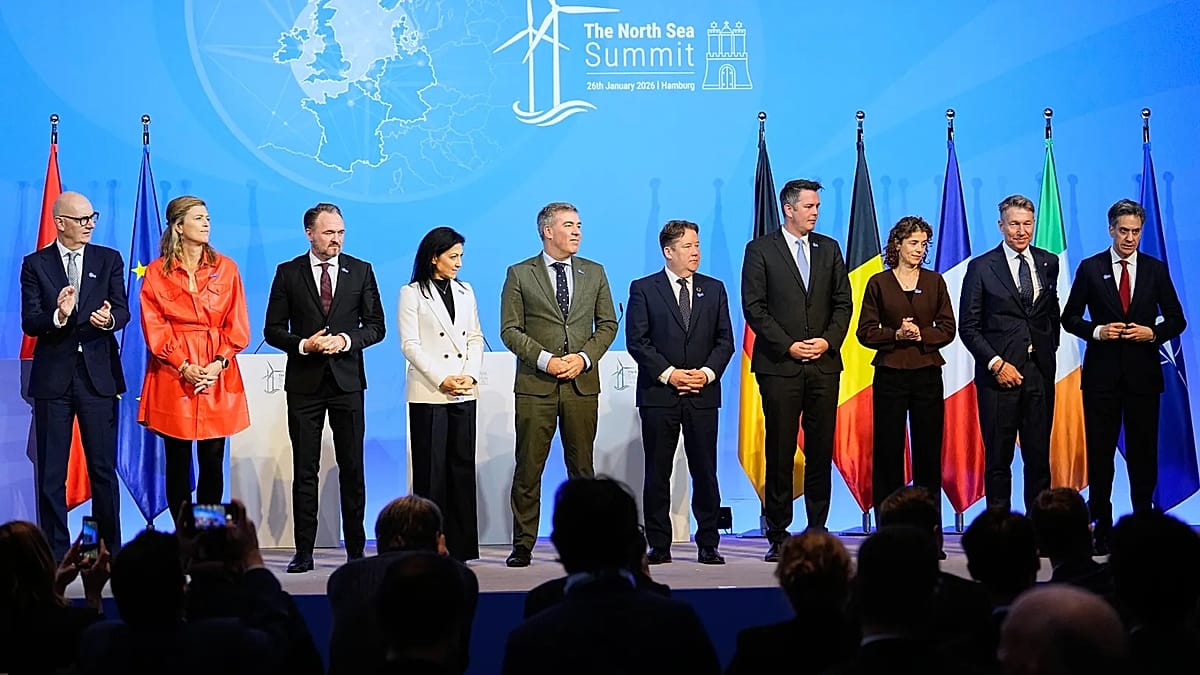
Several EU energy ministers gathered in Hamburg on Monday vowing to increase offshore wind capacity in the North Sea with a view to lowering energy prices.
Belgium, Denmark, France, Ireland, Luxembourg, the Netherlands, the United Kingdom, Norway, Iceland, and NATO all signed a declaration with wind industry leaders to increase offshore wind capacity to 100 GW as part of the shared goal of massively scaling up offshore wind by 2050 and lowering energy prices.
The signing comes days after US President Donald Trump criticised Europe’s climate and energy ambitions and the speed at which windmills are being deployed.
British Secretary of State for Energy Security and Net Zero Ed Miliband rejected Trump’s condemnation, saying that clean energy is “the right choice”.
“Our view on offshore wind energy is hard-headed, not soft-hearted,” he said. “I think offshore wind is for winners. Different countries will pursue their national interests, but we are very clear where our interests lie.”
Energy Commissioner Dan Jørgensen said renewables are cheaper than fossil fuels and can help lower energy prices for households and businesses. However, the Danish Commissioner told reporters that installing new wind farms currently “takes too long”, saying he hopes that the situation will improve if a Commission proposal tabled in December to speed up the permitting process is enacted.
Irish minister for climate and energy Darragh O’Brien stressed the urgency of having a “strong grid and interconnection capacity” to maximise the use of renewables in the EU’s energy mix, a key component in optimising the use of clean power.
The nine governments said they’re committed to accelerating offshore wind capacity through new business ventures and cross-border projects, aiming to reach 300 GW by 2050, as agreed by North Sea countries in 2023 in Ostend, following Russia’s invasion of Ukraine, which raised fears about Europe’s dependence on Russian gas.
EU ministers said the completion of these ambitions could drive down electricity costs by 30% by 2040, compared to 2025 prices.
Financing tools
The declaration signed on Monday says that the heads of signatory states have pledged to deliver an offshore financing framework for cross-border wind energy projects, as the goal requires “major private capital investment”.
“We have sharpened our criteria driven by the European framework but also by German legislation, and we are looking at every foreign direct investment and scrutinising it,” German Minister for Economic Affairs and Energy Katherina Reiche told reporters.
Industry and governments have agreed to use targeted mechanisms, such as two-sided contracts-for-difference and power purchase agreements (PPAs), including cross-border PPAs, instruments developed to guarantee developers that their projects will have a return on investment regardless of price volatility driven by marginal pricing.
German Chancellor Friedrich Merz stressed that collaboration in the North Sea is “critical” for Europe’s security and independence and that all participants are united around the goal of “developing the North Sea into the largest reservoir of clean energy in the world”.
Offshore wind energy falling behind
According to industry data, the EU27 currently has 236 GW of wind power capacity, with the vast majority being onshore. The North Sea summit could be instrumental in delivering the EU’s targets of 60 GW of offshore wind capacity by 2030, rising to 300 GW by 2050.
As things stand, the EU27 is falling behind its goals, with around 21 GW installed in 2025. According to the European Commission, the EU’s total installed offshore wind capacity in 2023 was 19.38 GW; industry figures for 2025 show that offshore wind power capacity has increased to 37 GW – the equivalent of Ireland’s long-term target by 2050.
More than 6,000 offshore turbines currently provide clean electricity in Europe, but deployment has been dragged down by poor auction design, higher capital costs, and limited supply chain visibility due to an uncertain project pipeline, according to industry analysts.
WindEurope interim CEO Malgosia Bartosik welcomed Europe’s commitment to double down on offshore wind.
“Government cooperation on offshore wind buildout can help crowd in €1 trillion of investments in the next decade,” she said. “This is the best possible response to those who doubt Europe. And our drive to deliver energy that is homegrown, secure and affordable.”
Read the full article here