


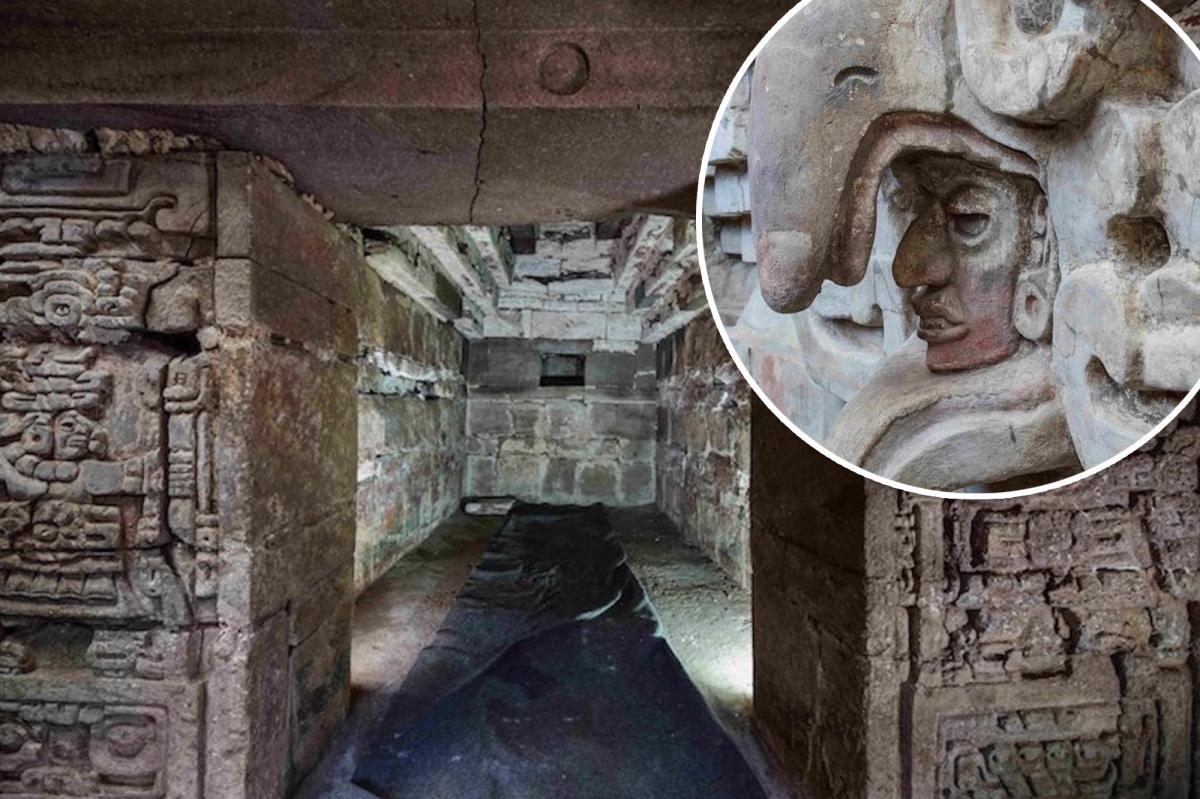
The mythical “Cloud People” have descended from legend — straight into real life.
Archaeologists in southern Mexico have uncovered a stunning 1,400-year-old tomb built by the ancient Zapotec civilization, a culture that believed its ancestors came from the clouds and returned to the heavens after death.
Lost to history for centuries, the stone structure has now been hailed as one of the most significant archaeological finds in years.
“It is the most important archaeological discovery of the last decade in Mexico due to its level of preservation and the information it provides,” Mexico’s president, Claudia Sheinbaum Pardo, said in a recent press conference.
The tomb, dug up in Oaxaca’s Central Valleys, is a visual feast of Zapotec flair: carved stone figures, vibrant ritual murals — and a massive owl at the entrance, its open beak revealing a lordly face.
In pre-Hispanic times, owls were symbols of night and death, hinting that this tomb honored a powerful ancestor whose spirit was believed to soar skyward.
The Zapotecs, aka Be’ena’a or “The Cloud People,” ruled the region for over 2,500 years, building one of Mesoamerica’s most impressive pre-Columbian civilizations at Monte Albán.
Their political clout faded around 900 AD, but the culture never disappeared — today, more than 400,000 Zapotecs still carry their ancestors’ legacy.
Mexico’s Secretary of Culture, Claudia Curiel de Icaza, called the find an “exceptional discovery,” pointing to how remarkably intact the site remains after more than a millennium underground.
“It is a compelling example of Mexico’s ancient grandeur, which is now being researched, protected, and shared with society,” she said.
Inside the burial chamber, archaeologists uncovered a striking mural showing a parade of figures hauling bundles of copal — the Zapotecs’ ceremonial incense — toward the tomb’s entrance, offering a rare peek at ancient funerary rituals.
But it’s delicate work: roots, insects and sudden swings in temperature and humidity are all putting the priceless artwork at risk.
An interdisciplinary team from Mexico’s National Institute of Anthropology and History (INAH) is now racing to stabilize and conserve the site while researchers analyze ceramics, symbols and human remains to better understand the tomb’s rituals and meaning.
The discovery is also part of a broader effort to map what lies beneath the region. Marco Vigato, founder of the ARX Project, which is leading underground surveys near the ancient Zapotec city of Mitla, revealed that the tomb may connect to a much larger subterranean world.
“Some of the tunnels and chambers extend to a considerable depth, in excess of 50 feet,” Vigato said.
Using advanced, non-invasive technology — including ground-penetrating radar and seismic noise analysis — researchers have detected underground cavities whose origins remain a mystery.
“Natural caves in the area of Mitla have been occupied and partially modified by humans for thousands of years,” Vigato said.
He added that the “earliest evidence of crop domestication in the area of Mitla dates back almost 10,000 years.”
Vigato says the age of the tunnels under the church — and the surrounding structures at Mitla — is still anyone’s guess.
“They may have been created by the Zapotecs, or they could be much older,” he said.
For now, the “Cloud People” are offering up more questions than answers — but one thing is clear: after 1,400 years, their secrets are finally seeing the light of day.
And that Oaxaca tomb isn’t the only ancient head-turner Mexico has revealed lately.
Archaeologists also uncovered a cube-shaped skull in Tamaulipas, offering rare insight into a 1,400-year-old Mesoamerican civilization’s social customs.
Unlike the cone-shaped skulls typically found in the area, this man’s head — likely shaped in infancy using a compression plane — was unusually “parallelepiped,” a sort of boxy formation.
Researchers say such cranial modifications often signaled elevated status or spiritual significance, and even influenced how the individual’s society decorated itself with distinct ornaments.
Tests on the skull’s bones and teeth confirmed the man likely spent his entire life in Tamaulipas, home over the centuries to the Olmec, Chichimec, and Huastec tribes.
Read the full article here