


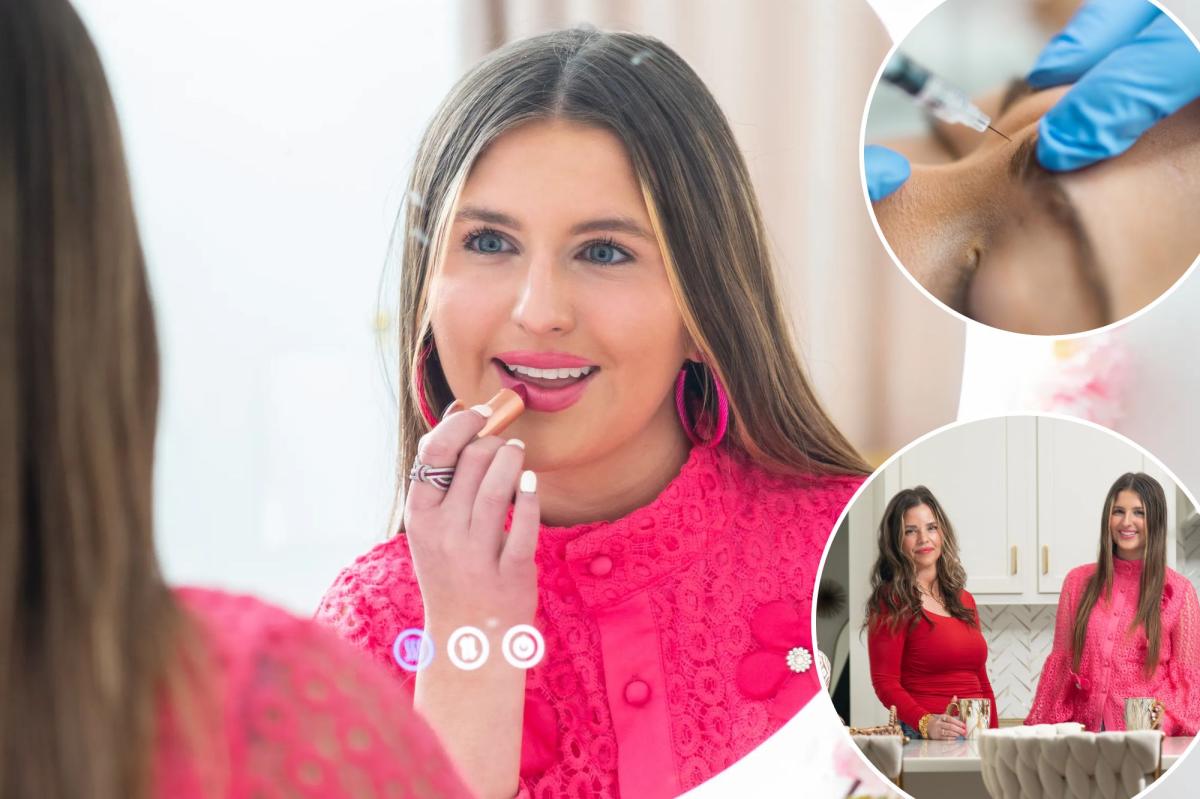
The needles didn’t sting as badly as Jazlyn Miller feared — just a quick pinch, exactly like her mom promised.
The 16-year-old Alabama teen had just gotten Botox for the first time, her esthetician injecting the neurotoxin into her jaw muscles to help ease chronic pain.
“It wasn’t that bad. Honestly, my jaw was feeling so much better,” Jazlyn told The Post. “About three months later, I was texting her and was like, ‘Well, I’ve already gotten Botox, so I might as well just go all in.’”
That choice would turn the Fayette teen into a lightning rod. A junior at the time, Jazlyn quickly became gossip fodder, with her classmates and their parents shocked, intrigued and unsettled by the idea that she was getting cosmetic treatments years before adulthood.
“It was definitely the talk of the town,” she said. “A lot of people were judgmental, like, ‘How dare you get Botox at 16?’”
But the harshest criticism wasn’t aimed at Jazlyn — it was directed at her mother.
“I’ve gotten a lot of backlash,” said Jessica Miller, noting much of the heat has come from other moms who feel her daughter isn’t old enough to be making such a decision.
But Jazlyn’s story isn’t an outlier. It’s part of a growing trend.
On TikTok and Instagram, teens and people in their early 20s are increasingly posting about getting Botox and other injectables, often calling it a “preventative” measure to avoid future lines and wrinkles.
Providers told The Post they’ve seen a steady uptick in young patients seeking out the treatment in recent years — a shift that has sparked a broader conversation about beauty, self-image and autonomy in a generation shaped by digital aesthetics.
“It wasn’t too bad, but I wanted to prevent it now. So when I’m 30, I’m going to be looking shawty.”
Jazlyn Miller, 16
“The focus on preventative skincare has become pretty explosive in this age group, and I think the advent of social media is probably influencing that,” said Dr. Claudia Kim, chief medical officer and lead cosmetic surgeon at New Look New Life.
“It’s not a fear of aging, but a negative connotation that’s been placed on looking older,” she explained. “I think that’s what’s driving these young individuals to seek out more invasive measures.”
How young is too young?
Jazlyn started considering cosmetic Botox after spotting faint lines around the corners of her eyes and a pair of marks between her brows, which she blamed on her expressive face.
“It wasn’t too bad, but I wanted to prevent it now,” she said. “So when I’m 30, I’m going to be looking shawty.”
Whether those injections will deliver that long-term payoff remains an open question.
“Twenty years ago, patients were coming to me in their 30s, 40s and 50s for Botox to smooth wrinkles — and it worked very well,” said Dr. Douglas Monasebian, a board-certified plastic surgeon and medical director at Park Avenue Plastic Surgery. “What it never took care of, though, is the reason we develop creases as we get older.”
Those creases form over years as facial muscles repeatedly contract and tug on the skin, creating lines that remain even when the face is relaxed.
Botox and similar neuromodulators work by temporarily blocking nerve signals to specific muscles, preventing them from fully contracting.
“You could make the argument that if you were starting Botox earlier — let’s say in your 20s or 30s — and the muscles have never had a chance to contract fully, then down the road you could have a smoother face,” Monasebian said.
But the science hasn’t fully caught up, Kim noted, and the existing data doesn’t always point in the same direction.
“It’s like putting on makeup or getting your hair done. That’s how I feel when I get my Botox.”
Jazlyn Miller, 16
“We have these very small group studies that have shown it can have some improvements in the way that the skin ages,” she said. “There are also studies that say it doesn’t really change much.”
Ultimately, Kim said, time is the missing piece.
“You really need time to evaluate these younger patients, and it just hasn’t been around long enough in this age group to be well studied,” she said. “We’ll have to wait and see how that evolves — but it’s exciting what we’re seeing so far.”
The cost of confidence
When Jazlyn first approached the esthetician at her local med spa about adding a few units around her eyes, the provider hesitated.
“I think she was a little nervous about doing a 16-year-old,” Jazlyn recalled.
Cosmetic Botox is FDA-approved for people 18 and older, meaning clinics typically won’t administer it to minors without parental consent.
But Jessica was at the appointment, giving the esthetician permission to treat her daughter.
“I wanted her to feel her best, and she was starting to feel insecure,” said Jessica, a trained esthetician herself. “I will do whatever it takes as her mother to make her feel like she is, the way that I see her in my eyes, the most beautiful person around.”
After discussing Jazlyn’s motivations and with Jessica’s blessing, the esthetician agreed — but not without warning.
“Are you sure you want to do this?” Jazlyn remembers her asking. “Are you positive?”
The teen was aware it came with risks, having watched hours of TikTok videos about how Botox treatments can go wrong.
Kim said short-term complications are uncommon. Pain, swelling and bruising at the injection site are the most typical issues, while more serious complications like toxin spread and botulism-like symptoms are rare.
“When it comes to long-term use, that’s where the questions arise,” she noted.
Repeatedly blocking muscle movement can weaken facial muscles, potentially leading to atrophy and fewer natural expressions. Some patients may also develop resistance to the medication over time.
“It’s not super common, but the belief is that your body forms antibodies against the active molecule,” Kim explained. “So when it’s used for a prolonged period of time and very frequently, it may not actually work later on when you do need it.”
There’s also the cost. Botox lasts three to four months, so a lifetime of treatments could add up quickly.
“I think the biggest problematic issue in this age group is that confidence is a sensitive thing,” Kim added. “Is this going to be detrimental to what they view as their self-image?”
And as Monasebian points out, Botox’s truly long-term effects remain largely unknown, especially for patients who start young. Its medical use only began in the 1970s, and it wasn’t approved for cosmetic use until 2002.
“There’s no long-term benefit that can’t wait until this person can make their own decisions.”
Dr. Douglas Monasebian
“It’s unlikely that something really bad will happen because these are very minute doses that wear off pretty quickly,” he said. “But you have to be careful.”
Asked whether those risks concerned her, Jazlyn didn’t hesitate.
“It absolutely does worry me,” she said. “But there’s always something that could happen. You could get into a car wreck, but that doesn’t stop you from getting in the car. I just feel like sometimes you have to do what you want to do.”
Before she knew it, Jessica was paying $275 for Jazlyn’s first cosmetic treatment, which involved several units of Botox around her eyes.
“After seeing it, I just felt like I was glowing,” Jazlyn said. “It makes me feel better about myself.”
Today, she goes in for cosmetic Botox every three months and has tried lip filler once.
“I don’t want to say it’s an addiction, but now it’s like, ‘Oh my gosh, I look forward to my next visit,’” Jazlyn said. “It feels like self-care.”
Tweaking teens
While Monasebian and Kim both expressed optimism about Botox’s potential preventive effects, neither fully endorsed the idea of minors getting the jab.
“For anyone under the age of 18, I wouldn’t recommend it,” Monasebian said. “There’s no long-term benefit that can’t wait until this person can make their own decisions. After 18, 19, 20, it’s on a case-by-case basis.”
Kim said younger patients focused on prevention may be better served by “baby Botox,” which involves using smaller doses for subtler results.
“It would give them some of the benefits of smoothing the skin and making it look dewy and glowy,” she explained, “without exposing them to higher doses that could add to long-term risk.”
As for Jazlyn — now a senior preparing to head off to college — Botox isn’t going anywhere.
“I just feel more confident,” she said. “It’s like putting on makeup or getting your hair done. That’s how I feel when I get my Botox.”
Read the full article here