


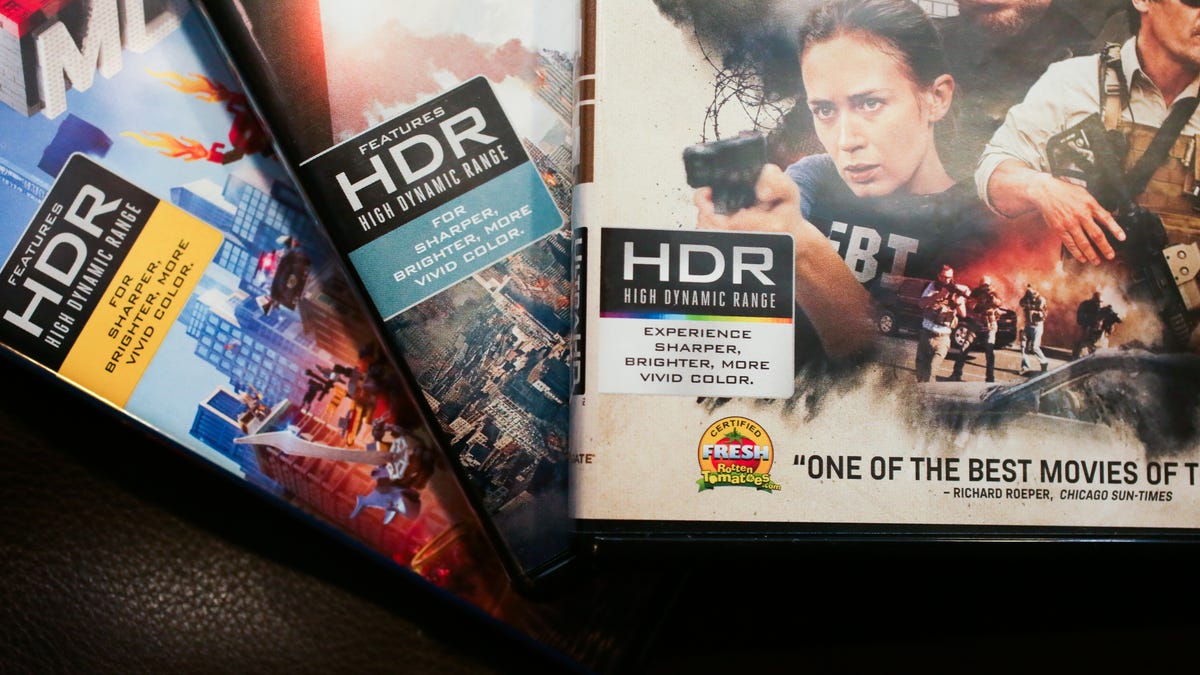
Nearly all modern TVs can decode and, to varying degrees of success, display high dynamic range content. The best TVs can make HDR shows, movies and even some videogames pop with color and contrast that non-HDR TVs could never accomplish. In addition to a TV that can display HDR, you also need HDR content. Most HDR content is available in multiple HDR formats and each format is slightly different. Confused yet? I hope not because even better, not every TV can decode every HDR format.
Right now the two main formats are HDR10 and Dolby Vision. There’s also hybrid log gamma, or HLG and HDR10+. The good news is that every HDR TV can decode at least HDR10 which is available with most HDR shows, movies and some games. There are several differences between the different formats, so they’re worth discussing in detail.
Image quality
Winner: Dolby Vision (and the upcoming Dolby Vision 2)
This is a broad generalization, and in many cases the best picture quality will come down to the specific content and the specific display. That said, Dolby Vision, and the upcoming Dolby Vision 2, can potentially look better for a few reasons. For one thing, unlike HDR10, DV has dynamic metadata. This means that the brightness levels of HDR content can vary on a scene-by-scene basis, giving filmmakers finer control over how the image looks. HDR10 (more on HDR10+ in a moment) has static metadata. This means the HDR “look” can only be determined per entire movie or show.
The other major reason DV could look better than HDR10 is Dolby itself. TV manufacturers must pay Dolby a fee for DV compatibility, but for that fee Dolby will also make sure the TV looks as perfect as possible with Dolby Vision content. It’s basically an end-to-end format, with Dolby ensuring all the steps look right, so the result at home looks as good as that content and that display possibly can.
HDR10 is an open format. Each manufacturer is left to their own devices, pun intended. This presumes that the manufacturer will have engineers that know enough about HDR and TVs to get the HDR looking correct on their TVs. This is a big presumption. Most manufacturers’ 4K Blu-ray players still have the chroma upsampling error, something that should have been solved in the DVDera (yes, that’s a link to an article from 2001 and yes it’s amazingly still relevant). So you’d hope that TVs would read the HDR data correctly and look great, but that’s not necessarily the case. For example, here are two HDR projectors running the same video. The right one isn’t processing the HDR data correctly:
Enlarge Image
Two projectors, side by side. Notice how there are three individual lights in the left image, but a single blob of light on the right.
Other factors, such as Dolby Vision being potentially 12-bit over HDR10’s 10-bit, is less of a factor and depends more on the content and display if you’d see any difference. Both formats have wide color gamut too, so that’s not an issue.
HDR10+ is a royalty-free HDR format developed by Samsung, Panasonic and Fox before it was Disney. It has dynamic metadata like Dolby Vision, but doesn’t require manufacturers to pay Dolby for the ability to play it back. From a picture quality standpoint, especially with streaming, it’s unlikely you’d see much of a difference between HDR10+ and Dolby Vision. There are some additional features of Dolby Vision that gives creators a bit more control over how their show/movie looks in your home (especially with 4K Blu-ray discs), but for the most part both formats will look good. While there are some additional differences, the main issue with HDR10+ we’ll address in the next section: availability. There’s less content and fewer TVs that support it.
Hybrid log gamma, the third HDR format, doesn’t have the capability to be as, for lack of a better word, dynamic as DV, HDR10+ and HDR10. However, it’s still HDR, still better than SDR, and has a big advantage we’ll discuss farther down.
Availability (gear)
Winner: HDR10
Because there are no licensing fees, far more companies have HDR10 support than Dolby Vision. Or to put it another way, if it’s HDR, it supports HDR10. Some HDR gear also supports Dolby Vision or HDR10+. As mentioned above, implementing DV is more than just settings or a badge on the side. Dolby is involved before the product is shipped to help ensure it all works as they specify.
HLG is available in some TVs, but not as many as the other formats. Theoretically HDR TVs could add HLG decoding, but don’t expect it.
Availability (content)
Fallout is available in HDR10+ and Dolby Vision on Amazon Prime Video.
Winner: HDR10
Just about everything that supports HDR supports HDR10. Big-budget movies and TV shows often support Dolby Vision. There are some big-name shows that support HDR10+ now as well. Generally, more popular shows and movies will have some option for dynamic metadata. Between the two options for dynamic metadata, DV has more content.
Most people will find it difficult to find HLG content, but more on that in the next section.
Backwards compatibility
Winner, by default: HLG
HLG is the only HDR format that’s backwards compatible with standard dynamic range TVs. An HLG signal can be read by SDR TVs and shown normally, and it can also be read by HLG-compatible TVs and shown as HDR. This is its contribution to the HDR world. It’s primarily intended for broadcast TV, which isn’t surprising when you consider it was co-developed by the BBC and Japan’s NHK.
Being a hybrid, it doesn’t quite have the range you can achieve with DV and HDR10, but that’s not really the point. The idea is to offer HDR where it was impossible to offer with the other formats. So the real competition, if you can call it that, is with standard dynamic range. And in that fight it handily wins.
No winner (or loser)
Thankfully, there is no HDR format war. If you have an HDR TV pretty much everything you might want to watch in HDR is probably already available in HDR, and your TV can show it as such. The gap is when it comes to the step-up image quality of Dolby Vision and HDR10+. For the most part TVs will support one or the other. Some, but not all, content will be available in both formats. You might find that a show or movie you want to watch is available in DV or HDR10+ and your TV doesn’t support it. In that case, you’ll get “just” HDR10. Keep in mind, though, HDR10 still looks great! Far better than non-HDR “SDR” content.
Since the best TVs look great with any HDR content, it’s probably not worth disregarding a model you’re considering just because it doesn’t support one of these formats. Most likely it will look fine either with the other dynamic metadata format, or just with HDR10.
Note: This guide was first published in 2017 but is updated regularly with new information about old and new HDR formats.
In addition to covering audio and display tech, Geoff does photo tours of cool museums and locations around the world, including nuclear submarines, aircraft carriers, medieval castles, epic 10,000-mile road trips and more.
Also, check out Budget Travel for Dummies, his book, and his bestselling sci-fi novel about city-size submarines. You can follow him on Instagram and YouTube.
Read the full article here