


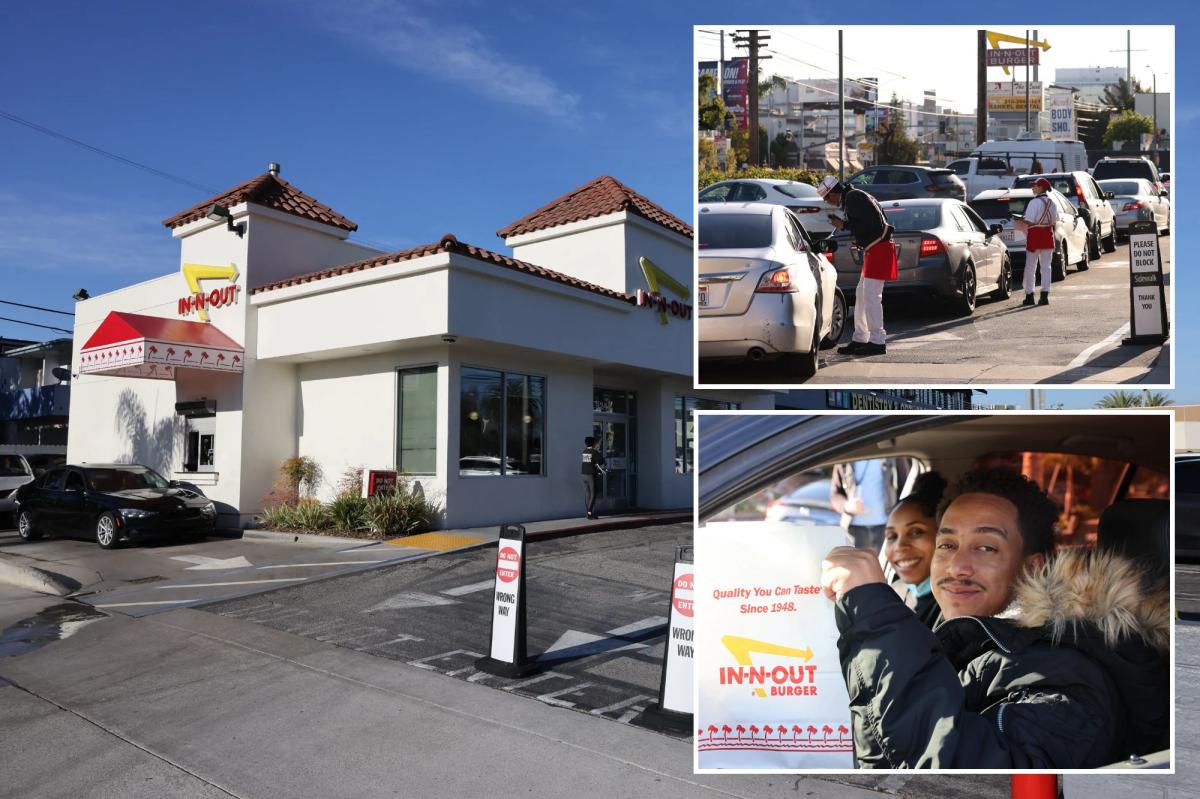
The drive-thru line at In-N-Out on Venice Boulevard in Culver City curls through the lot and toward the street — engines idling, brake lights glowing, no one peeling off.
No one seems tempted to bail. For many Angelenos, the delay isn’t a deal-breaker. It’s part of the tradition.
“Since I was a kid,” said Devante, 26, of Culver City, recalling how long he’s been coming to this location. “I think most [of it] is probably nostalgic… that’s probably the first burger I really remember, and then on top of that… it’s delicious. I love it. It’s good prices too.”
On an average Friday afternoon, customers at the busy outpost needed to wait for at least 20 minutes a Double-Double and Animal Style fries. It wasn’t even lunchtime.
But they are fine with it because of the burgers are consistently fresh, good value, and consistent given there’s a limited menu.
The service is also considered top notch and comes with a distinctly Southern California identity that competitors haven’t been able to replicate.
Industry drive-thru benchmarking shows what “normal” looks like at major chains.
A 2025 mystery-shopper study put the average fast-food drive-thru order at 5 minutes and 35 seconds, with McDonald’s at 6:03 and Chick-fil-A at 7:07.
In other words, the Culver City queue isn’t the typical fast-food baseline — and that’s exactly what makes it stand out.
“It’s always what I expect,” Devante said. “Always what you expect.”
That reliability runs throughout the brand’s appeal.
Despite the constant lines, In-N-Out’s footprint in Los Angeles is far smaller than its biggest rival.
The chain operates 85 locations across the LA area, compared with more than 300 McDonald’s restaurants in Los Angeles County.
Yet the smaller chain routinely outperforms competitors in customer loyalty.
A Nation’s Restaurant News survey ranked In-N-Out No. 1 in “True Loyalty,” with 63% of customers saying they chose it because of the brand itself rather than convenience, with 70% rating its service “best in class.”
The devotion isn’t just local.
Yelp’s 2025 rankings named In-N-Out America’s favorite burger chain based on more than 120,000 reviews — ahead of national heavyweights.
The chain consistently scores at or near the top in surveys measuring freshness, taste and food quality. Angelenos seem to confirm the data.
Ulises España, 26, of Los Angeles, said he’s been eating In-N-Out “since I was like six years old” and now goes “maybe twice a week.”
“It’s a simple burger that you can get for relatively good price, and I think that’s what keeps me coming back over here,” España said.
He said competitors’ burgers are ”too small for the prices the charge” and says In-N-Out has the ”best bang for your buck.”
That value claim has a real number behind it. Local reporting pegged a Double-Double meal — burger, fries and a drink — at $10.45 before tax in California, and $11.44 after tax in Los Angeles County.
A classic Big Mac Meal comes in at $12.38 after tax, but can cost up to $14, depending on the location.
Even with California’s higher-cost environment, In-N-Out’s price point stays close enough to fast-food norms to keep the “worth it” math working for loyal customers.
Would España ever walk away?
“There’s no reason for me to switch it up or not come here.”
Kristen Lawson, 20, of Inglewood, said she’s been eating there “since I was born… so I was raised on In-N-Out”. Her entire family are fans.
“I’m loyal to In-N-Out because it’s more of a healthier option and… I like the quality of the food better than other places,” she said, also pointing out the chain was “reasonably priced.”
For Sheena, who was also visiting the Culver City restaurant, the draw is straightforward.
“I like the ingredients are simple on my burger,” she said.
“I just like lettuce, tomato and onion… I always get the animal style fries. So that’s just been my go-to order.”
”This is like our family spot. The price is good… you get fries and a drink and a burger. So we’re not looking for anything more.”
That restraint — a tight menu, familiar flavors, modest pricing — underpins the chain’s staying power.
Ravi Sawhney, founder and CEO of RKS Design and a Southern California native, said the company’s pull stretches beyond what’s inside the wrapper.
“It is definitely a California cultural experience,” Sawhney said.
The brand also sells a tightly controlled production model. The company’s own store messaging emphasizes “only the freshest ingredients,” and says it uses no heat lamps, freezers or microwaves — choices that make the operation feel more “made to order,” but also keep production disciplined.
That same control has helped shape the chain’s limited footprint and consistency.
Industry reporting has described a distribution approach built around keeping restaurants within a day’s drive of production so food can move quickly and stay fresh.
Sawhney argued the brand’s business model taps into car culture and nostalgia that national rivals can’t duplicate.
“You get a bit of that nostalgic car culture,” he said, recalling cruising Van Nuys Boulevard in his youth. Standing in queue becomes part of the ritual.
“You basically are put on what I call a micro-hero’s journey.”
Unlike McDonald’s, which he described as focused on “consistency and speed,” In-N-Out delivers something more layered.
The extended queue only sharpens that contrast.
“It takes longer to get a burger, shake, and fries from In-N-Out than it does from McDonald’s,” he said. “And the quality is definitely better.”
The streamlined offerings reinforce the message, he added.
“They’ve got a limited menu, which conveys that we just do these things and we do them well, and we perfected them, and we do them consistently.”
To him, the moment feels intimate.
“It almost feels like your mom made it for you and your friends,” Sawhney said. “There’s a lot going on within that burger.”
While the chain doesn’t publicly break out local sales, national estimates show it generating outsized revenue for its size.
Privately held In-N-Out generated an estimated $1.8 billion in sales in 2022 and roughly $2.1 billion in 2023, despite operating only about 400 locations nationwide.
The company has deliberately limited expansion to eight states and refuses to franchise or go public — a controlled, family-owned model that analysts say has helped preserve its cult status.
Back in Culver City, the cars inch ahead.
Devante said only one thing could shake his devotion.
“Only if I found out like some crazy ingredient was in there… that would take me out,” he said. “Yeah, no.”
Until then, the vehicles will keep stacking up — and the faithful will keep waiting.
Read the full article here