


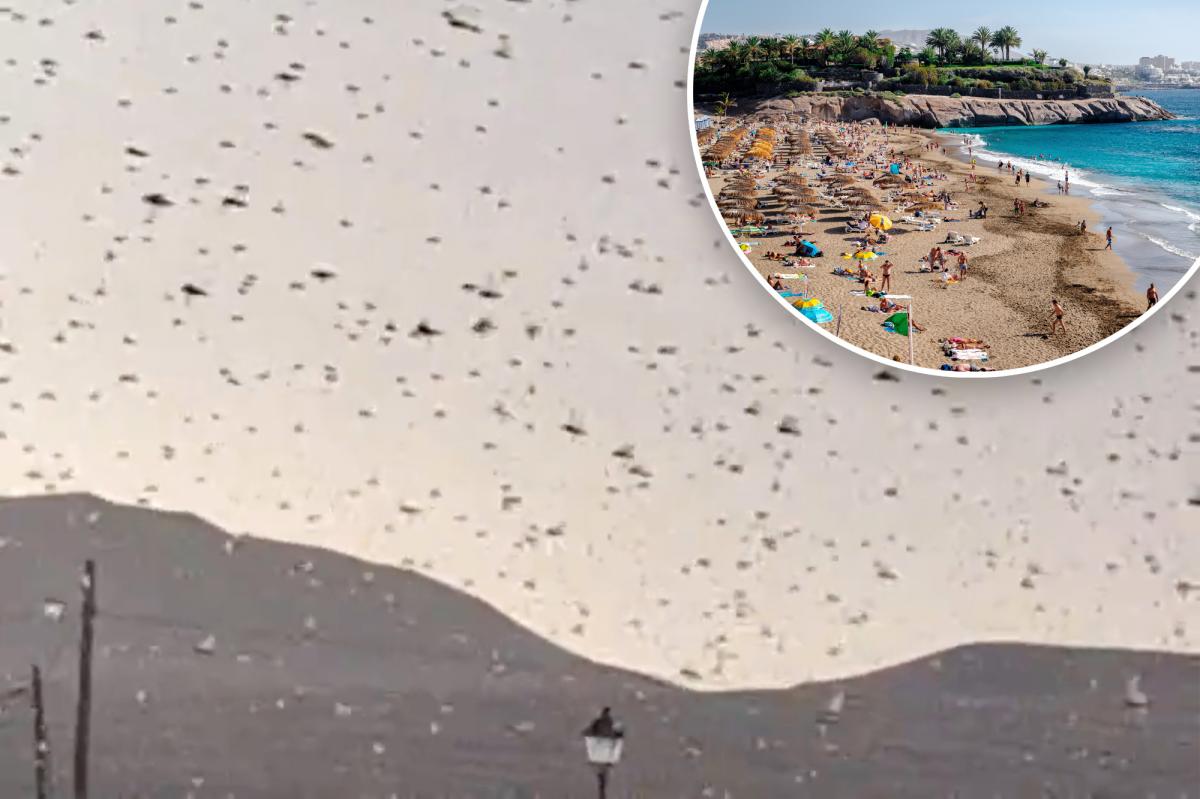
It was a pestilence of biblical proportions.
Officials in Spain’s Canary Islands are sounding alarm bells after an epic swarm of locusts descended upon the popular vacation destination, as seen in dramatic footage circulating on social media.
Over the past few days, the scenic islands of Lanzarote, Tenerife, Gran Canaria and Fuerteventura have been beset by the biblical plague of short-horned grasshoppers, the Express reported. Originally hailing from the Sahara Desert in Africa, the notorious crop pests were reportedly driven to the sunny Spanish isles by humid yet mild temperatures.
Lanzarote was particularly hard hit with the insects swarming the tourist hotspots of Arrecife, Costa Teguise, Famara, Uga and Tahíche.
Footage shows the bugs darkening the skies like something out of one of the “Mummy” movies.
While the locusts don’t pose a threat to people, they could potentially devastate the island’s agricultural industry, including vineyards, if the swarm snowballs into a full-blown infestation as it did years ago in the islands.
Borne aloft by Easterly winds and accompanied by airborne Sahara Desert dust, desert locusts are the “world’s most destructive migratory pest,” according to the Food and Agriculture Organization of the United Nations.
A 250-acre swarm of the critters — which can contain 80 million individuals — is capable of consuming what 35,000 humans eat in a day, meaning their feast could quickly become people’s famine.
In accordance, the government of Lanzarote has put its environmental sector on high alert for the next 48 hours.
However, they remain confident that the swam will not escalate into a full-on plague, the Daily Mail reported.
“The next two days are going to be key,” declared Francisco Fabelo, who oversees the Environment of the Cabildo. “If they are adult specimens that have arrived exhausted, they will die and nothing will happen.”
He added, “If we see copulations, that would mean that they are reproducing. We would have to see it between this afternoon and tomorrow.”
Meanwhile, Theo Hernando, secretary general of the Association of Farmers and Ranchers of the Canary Islands (Asaga) said wind-borne locust plagues from Africa are “common” and nothing to worry about in “isolated cases.”
‘They arrive very weakened, they are not in a position to settle or reproduce,” he assured. “Nature itself takes its course and many times they end up being preyed upon by birds.”
That being said, the Canary Islands are no strangers to devastating locust plagues. In a serious incident in October 1958, desert locusts from Africa pillaged the Canary Islands, especially the South of Tenerife, wreaking havoc on tomato and potato plantations.
In response, the Ministry of Agriculture dispatched planes to fumigate from the air, while residents and farmers tried to combat the grasshoppers from the ground using bonfires, noise and poisoned baits.
This reportedly followed a similar scourge that ravaged 10,000 hectares of crops in the region just four years earlier.
Read the full article here