


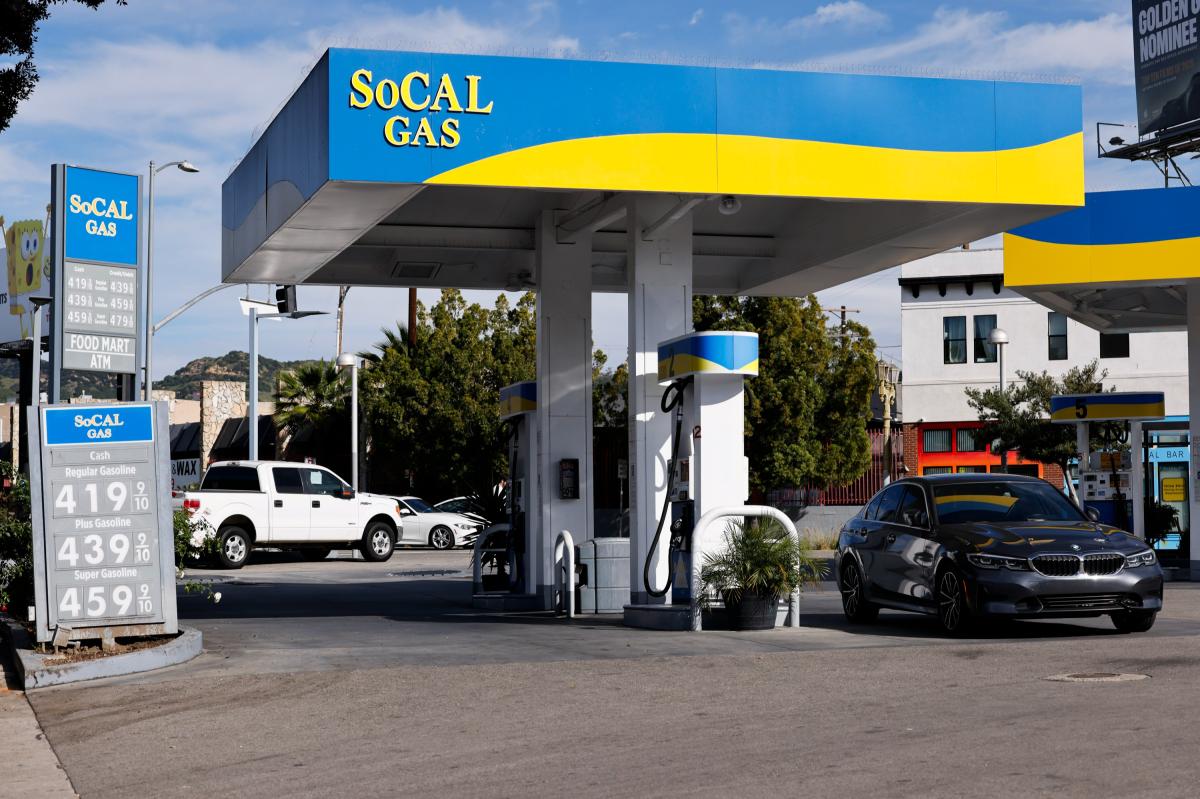
The impact of the US-Israeli airstrikes in Iran could lead to dramatic swings in global oil markets — potentially sending California’s steep gas prices even higher.
While markets were expected to remain stable Saturday and Sunday, next week could see major disruptions in Middle Eastern oil supplies as uncertainty remains in the wake of the deadly attacks.
Adding to the trouble for Golden State motorists are the recent closures of oil refineries in the state, reducing local fuel supplies and increasing dependence on foreign imports.
The average price of a gallon of regular gas stood at $4.643 as of Saturday, up from $4.610 a week prior and $4.260 a month ago, according to the American Automobile Association.
“Average gas prices in California have stayed below $5 for nearly two years,” California Gov. Gavin Newsom posted on X Saturday after the initial strikes in Iran. “Trump’s new war is already rattling markets.”
Newsom’s comments come on the heels of a proposed mileage tax backed by state Democrats that would replace the gas tax with a per-mile fee, potentially costing drivers an extra $228 to $1,026 a year.
Clayton Seigle of the Center for Strategic & International Studies explained that a broader conflict in Iran could push crude prices above $90 per barrel and U.S. gas prices well above $3 per gallon, reported FOX5.
If oil infrastructure or supplies are interrupted, prices could rise further and remain elevated for an extended period.
Concerns about conflict have already driven oil prices higher. On Friday, the international benchmark Brent crude reached a seven-month high, closing at $72.87.
Rystad Energy warns that targeted strikes on Iran’s nuclear sites and the Revolutionary Guard—an elite branch of the Iranian Armed Forces—without attempts at regime change or full-scale war, could raise crude oil prices by $5 to $10 a barrel from market fear alone.
Iran exports about 1.6 million barrels of oil each day, with most shipments going to China since U.S. sanctions prevent sales to other countries.
And while U.S. oil refineries do not rely directly on Iranian oil, they are strongly affected when prices change quickly or when the world’s oil supply is shook by rising tensions.
Read the full article here