


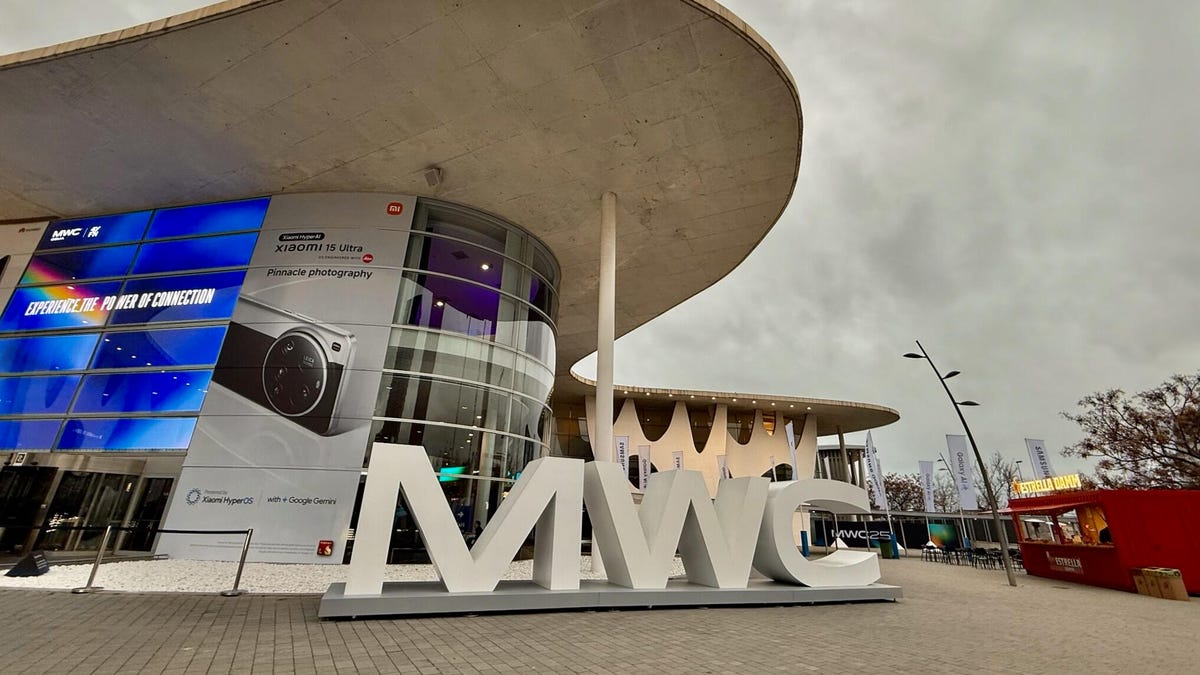
In the US, the tech events that typically get the most attention are CES, Samsung Unpacked, Google I/O and pretty much any time Apple puts on a show. But there’s also a major gathering in Barcelona each year that doesn’t draw as many eyes on this side of the Atlantic, despite attracting more than 100,000 people over four days. It’s Mobile World Congress, and it kicks off this week.
MWC is all about the telecommunications industry, which might sound dry if you don’t work for a telecom company. But now that most people carry smartphones every day, we’re all affected in some way by what happens at the event.
CNET has a full team of writers and editors in Barcelona looking for the products and technologies we’ll be talking about for the next year and longer. Keep up with what they find by staying tuned to our MWC 2026 live blog.
Why should you care about MWC?
There’s a good chance you’re reading this on a smartphone, using technologies that debuted at MWC. Features shown in Barcelona over the last two decades are like the cerulean colors of the fashion world, introduced with fanfare and then widely disseminated into phones like the one in your hand. (This year marks 20 years of MWC in Barcelona, but the show existed in other forms back in the early 1990s.)
CNET’s Tara Brown and Abrar Al-Heeti pose in front of an MWC sign in Barcelona in 2025. They’re both back for MWC 2026.
As smartphones have become nearly ubiquitous in modern life, MWC has become the showcase and early public testing ground for the technologies running them. For example, major phone carriers have spent billions of dollars upgrading their networks to support 5G, and it started with early concept demos in 2015 that showed off faster, more responsive wireless communication. It wasn’t until 2019 and 2020 that consumer phones with 5G arrived on the market.
This year, we expect to hear more about 6G (because this industry always needs more Gs), which has been in the works since at least 2019. In addition to faster data speeds, 6G is expected to plug us into an “always-sensing network.”
Notable products introduced at MWC
Any big event is a showcase for companies to announce new products, and MWC has seen its fair share.
The T-Mobile G1 (also known as the HTC Dream) was the first commercial phone with Google’s Android system.
The HTC Dream, also sold as the T-Mobile G1 in the US, was released as the first commercial phone running Google’s Android operating system in 2008. At the time, CNET writers were surprised to find that Google wasn’t interested in the hardware but focused instead on spreading its Android platform across as many types of devices as possible.
With a square shape that looked very different from the smooth curves of its sequel, the Galaxy S III, the Samsung Galaxy S II 4G’s back plastic plate could be more refined.
The Android market picked up speed from there, and Samsung became one of the biggest players. When it announced the Samsung Galaxy S II at MWC in 2011, the svelte “jumbo phone” was “as beautiful and premium as when we first laid eyes on it,” wrote Jessica Dolcourt when she reviewed it.
The Sony Ericsson Experia X1 had a full keyboard and wan Windows mobile.
Although the Android news was a big deal back in 2011, the Sony Ericsson Xperia X1 was “the unchallenged star of the show that year” wrote Kent German in a 2014 retrospective. Its screen face slid up to reveal a full QWERTY keyboard that ran Windows Mobile. However, it wasn’t offered by any of the carriers at the time, which meant it didn’t have the subsidized pricing that would have made its $800 price tag more affordable.
Windows Phone 7 looked like nothing past variations of Windows Mobile, which was a good thing.
Speaking of Microsoft, in 2010 the software behemoth unveiled Windows Phone 7 Series. It wasn’t the first Windows phone, but this system with the awkward name was a major revamp that had an interface still missed by a few of my friends. Although people expected one of the most successful tech companies to roll into the market and make as big of a splash as the iPhone, Windows phones never caught on in a substantial way and the system was retired in 2017.
The HTC One X was introduced in 2012.
It’s hard to believe now, but for a long time, HTC was one of the dominant smartphone makers on the market. The HTC One X introduced at MWC 2012 had a quad-core processor, Android 4.0, a 4.7-inch display and an 8-megapixel camera. In the US, AT&T chose to include 4G LTE networking in favor of the quad-core processor, but the phone still impressed with its sleek design and zippy performance.
Bluetooth in a toothbrush: In 2014, Oral-B launched a toothbrush that connected to an app.
A reminder that mobile doesn’t always refer to phones: In 2014, Oral-B launched the SmartSeries electric toothbrush with Bluetooth 4.0 to connect to a companion app.
The HTC Vive was fully immersive VR.
And in 2016, HTC brought the Vive VR, an immersive virtual reality headset that eclipsed other VR experiences… and required a powerful PC, lots of cables and separate mounted sensors that tracked your movements in a room-sized space.
One notable product not introduced at MWC was the iPhone, which Apple announced at Macworld Expo in 2007. However, the iPhone’s impact on the market took hold at MWC the next year, with touchscreen phones establishing what would become the dominant smartphone interface through to today.
These are just a few cherry-picked items from the long history of MWC, but I hope you get the idea that the conference has moved from a phone-centric show to one that incorporates technologies around the phone and beyond. We’re looking forward to what this week’s event will bring. Something tells me we’ll hear a lot about AI.
Watch this: A ‘Robot Phone,’ New Smart Glasses and 6G? Previewing MWC | Tech Today
Read the full article here