


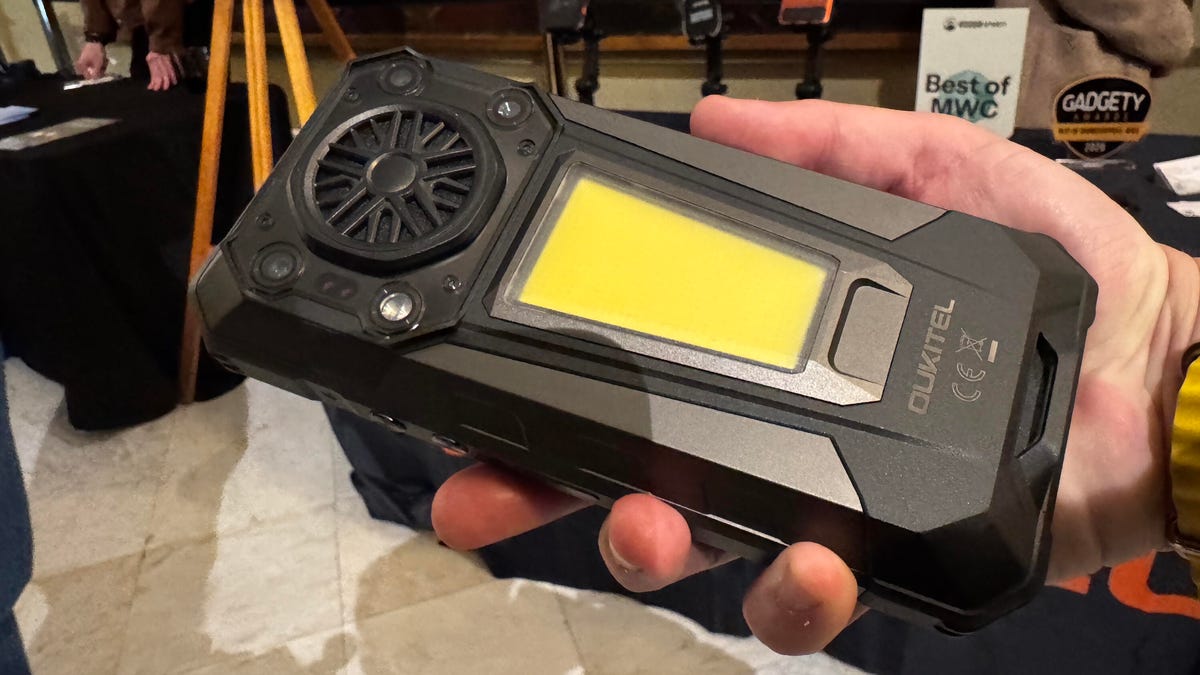
Have you ever wanted your phone to last for days in the wild — and light your campfire, too? At the Showstoppers press event for MWC 2026, I saw a new smartphone, from outdoor electronics company Oukitel, that aims to be an all-in-one device for the rugged digital nomad.
The Oukitel WP63 phone costs close to $399 in the US and 343 euros. It will be coming to “all countries” sometime in May, though release dates aren’t finalized yet. For someone who loves the outdoors like myself, the phone checks a lot of boxes. It’s got a 20,000-mAh battery — yes, twenty thousand milliamp hours — with an included USB-C plug that flips out to charge other devices. It can also use 18-watt reverse wireless charging, and refill its battery with 33-watt wired charging. It also powers a large audio speaker and LED lamp on the back, the latter of which can get so bright that a pop-up dialog warns you not to look directly at it to avoid eye damage.
While it may not quite measure up to the best phones we saw at MWC, you’re getting several campsite essentials on a device that runs Android and can take calls if you don’t mind basically holding a weighty external battery up to your ear.
The fire-starting tab on the Oukitel WP63 is on the top of the phone.
But the Oukitel WP63’s coolest feature by far is its capability to start a fire. You can activate that feature with a tab that pokes out of the top of the phone, though it’s surprisingly tricky to flip out. (That’s a nice protective element that keeps it from accidentally popping open in your pocket, though I struggled to intentionally open it.) Once deployed, an electric coil, similar to an old car dashboard cigarette lighter, activates via an app. There’s a setting to keep it lit for 4 to 10 minutes, in theory, to warm your surroundings.
I want to be honest that I didn’t see the phone light anything on fire — the preproduction unit at Showstoppers got too hot to demonstrate the lighter effect, and when I visited the Oukitel booth on the MWC show floor, the same demo unit still couldn’t light a spark. But I saw videos of it working, so I believe it could work. The big question is whether the final version will have this feature figured out. While the phone is functional without it, the novelty is undeniably part of the phone’s appeal.
Watch this: Xiaomi’s Wildest MWC Yet: From the Leica Leitzphone to Its New Concept Hypercar!
And yes, the phone is an actual smartphone, too. It runs Android 16 out of the box, with three years of promised software and security updates — an unfortunately limited span that’s far under the seven years guaranteed by Samsung and Google. It has a 6.7-inch Full HD (1,604×720-pixel) display, 8GB of RAM and 512GB of storage and a 64-megapixel rear camera, so it functioned like a regular smartphone as far as I could tell when I handled it.
But if you want to buy one when it starts going on sale in April, prepare your pockets: the WP63 is a massive 27mm thick. That’s almost equivalent to four of the new Samsung Galaxy S26 phones (7.2mm) stacked on top of each other.
Compared to other mid-range phones, WP63 is a mixed bag, with shorter software support and less resolution in its 720p display than the HD (1080p) sharpness present in competitors. But it does offer exactly what a lot of phone owners say they want: a massive onboard battery, easily four times the size of the 5,000mAh capacities on most premium handsets. Add in the very bright lights, the decent speaker and the ability to start a campfire, and it’s the phone I’d definitely want to bring with me into the outdoors.
Check Out the Galaxy S26 Ultra’s Sleek Design and Privacy Display
See all photos
Read the full article here