


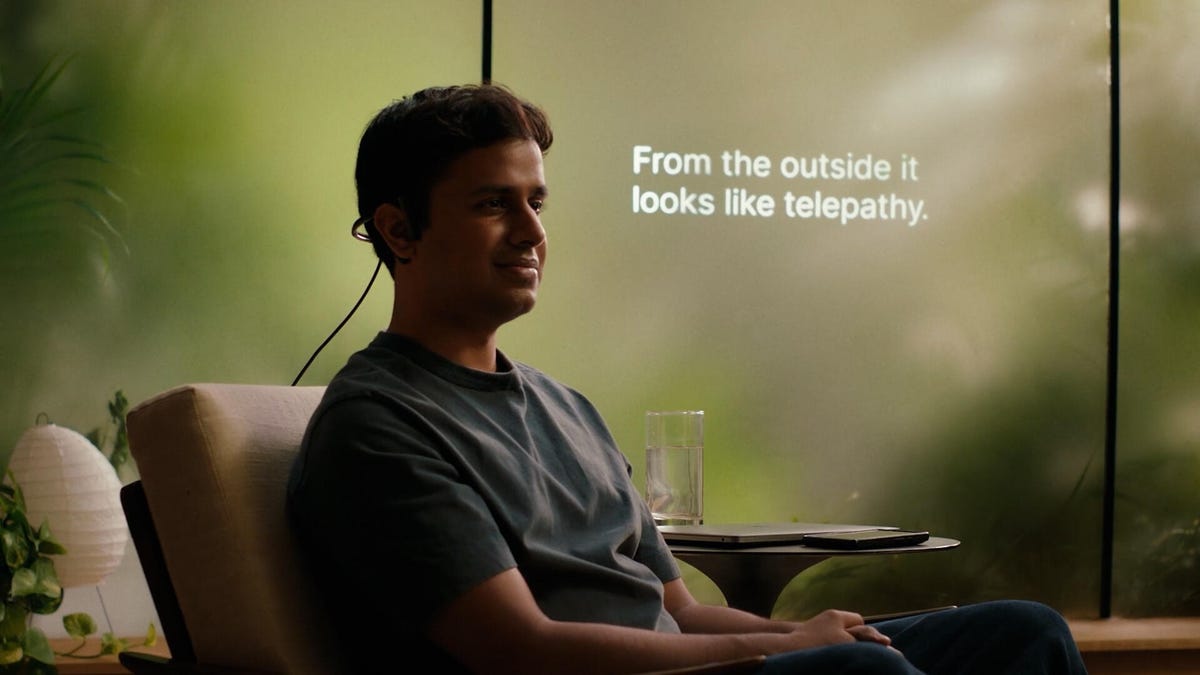
There’s a new wearable in town and it looks like telepathy in action. It’s called AlterEgo, and its secret isn’t magic or mind-reading.
Its makers say the hardware detects “silent speech,” including everything from mouthing words to vocalizing internally (think subtle internal movements).
AlterEgo’s demo features projections of the “silent speech” detected by the wearable.
This means many tasks normally done with your voice could now be done silently, including conversation, live translation between languages and controlling digital devices. The device itself is worn on your ears.
There’s a privacy benefit to not having to vocalize sensitive information in public, but there are also privacy concerns that naturally arise whenever a computer comes between two people communicating.
How it works
AlterEgo, a spinoff company from the original MIT Media Lab project of the same name, says the technology behind AlterEgo builds on what researchers call “silent speech,” a method for interpreting the subtle neuromuscular signals involved in speech before words are spoken aloud.
But AlterEgo’s system goes a step further. Its creators developed a system called Silent Sense that allows the device to detect multiple forms of speech activity — from normal speaking to silently mouthing words or even the faint muscle signals that appear when you intend to speak.
If that gives you pause and you’re wondering whether the device can read your thoughts, it can’t. Instead, it detects the signals produced when a person deliberately engages their speech system.
The future of accessibility?
AlterEgo has the potential to be one of the most interesting new wearable technologies in recent memory, but I still have many more questions. Will it be used as an accessibility tool like implantable BCIs from Synchron and Neuralink? How does AlterEgo differentiate between the intent to speak and actual thoughts? Could this technology be somehow repurposed to do the latter?
At the time of writing, AlterEgo had not responded to a request for comment. To see highlights from the demo, check the video in this article.
Read the full article here