


European Commission President Ursula von der Leyen has underlined the European Union’s “unwavering commitment” to international law and the multilateral system, two days after she invited controversy by declaring the 27-member bloc could “no longer be a custodian for the old-world order, for a world that has gone and will not return”.
That speech, delivered on Monday morning at the annual conference of ambassadors, met a mixed reception: von der Leyen’s defenders said it was a much-needed dose of realpolitik, but critics said it risked giving permission for Europeans to turn a blind eye to legal breaches.
The pushback was particularly intense in Spain, where the socialist government of Prime Minister Sánchez publicly rebuked the European Commission president.
Sánchez is already at odds with von der Leyen over the United States and Israel’s strikes on Iran, which the Spaniard has condemned as a blatant legal breach.
“The dilemma is not about an old order versus a new order, but an international order versus an international disorder,” Sánchez said in an interview with El Diario newspaper.
“The world is changing, but the EU’s values and principles should not change.”
‘We will always uphold those principles’
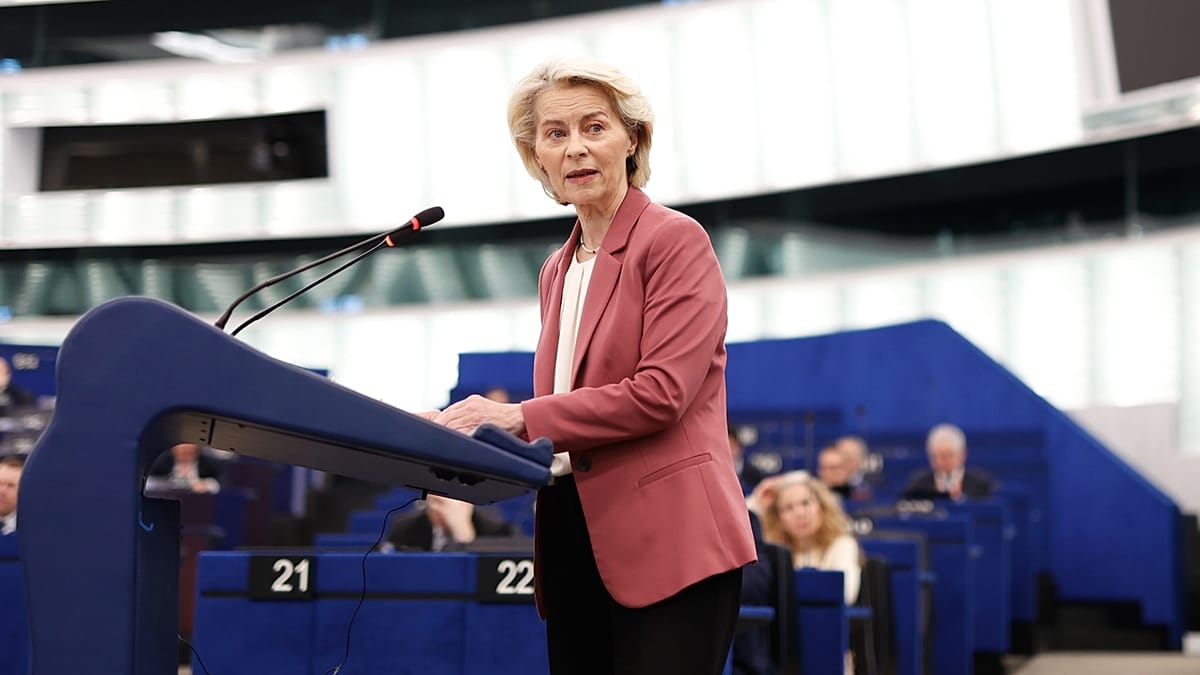
Amid the backlash, von der Leyen attempted to set the record straight on Wednesday morning as she addressed the European Parliament in Strasbourg. The discontent was palpable among the progressive ranks of the hemicycle, with some lawmakers pointing the finger at the Commission chief and echoing Sánchez’s position.
Von der Leyen maintained her matter-of-fact, hard-boiled view of the new world order, but noted her assessment would not weaken or alter the EU’s core mission.
“Allow me to make one important point. Seeing the world as it is in no way diminishes our determination to fight for the world as we want. The European Union was founded as a peace project,” von der Leyen told lawmakers.
“Our unwavering commitment to the pursuit of peace, to the principles of the UN Charter and to international law are as central today as they were at our creation. And we will always uphold these principles.”
Von der Leyen had already included that message in her speech on Monday, where she said: “Our support to the UN and its Charter is an essential part of who we are.”
“In a more conflictual world like ours, we need a rules-based global governance. Of course, the UN system also needs reform. And when traditional formats reach a standstill, we need to look for creative ways of addressing the most serious crises of our times,” she said towards the end of her intervention.
However, the political and media attention around that speech focused on one section at the start of her intervention, in which she declared that Europe could not afford to be the “custodian” of an “old world order” that has already disappeared.
The backdrop of the war in the Middle East, which has sharply split European capitals and fuelled accusations that von der Leyen’s diplomatic activities have seen her overstep her mandate, further amplified the uproar.
“We will always defend and uphold the rules-based system that we helped to build with our allies, but we can no longer rely on it as the only way to defend our interests or assume its rules will shelter us from the complex threats that we face,” she said.
Costa speaks up
Von der Leyen also called for a profound reflection on the bloc’s foreign policy, which is strictly bound by the principle of unanimity and therefore vulnerable to vetoes.
Brussels is currently struggling to lift Hungary’s veto on the €90 billion loan to Ukraine.
The EU should determine “whether the system that we built – with all of its well-intentioned attempts at consensus and compromise – is more a help or a hindrance to our credibility as a geopolitical actor,” von der Leyen said.
“The point is that, if we believe – as I do – that we need a more realistic and interest-driven foreign policy, then we need to be able to deliver on it. And this is at the heart of my message today,” she added.
On Tuesday, as von der Leyen’s speech continued to make headlines, António Costa, the president of the Euroepan Council, told ambassadors that a “multipolar world requires multilateral solutions”, a message seen as an implicit reproach to von der Leyen.
“We must defend the rules-based international order. We must uphold the principles enshrined in the United Nations Charter, as outlined in our Treaties,” Costa said.
“Violations of international law must not be accepted – whether in Ukraine, Greenland, Latin America, Africa, in Gaza or the Middle East.”
Read the full article here