


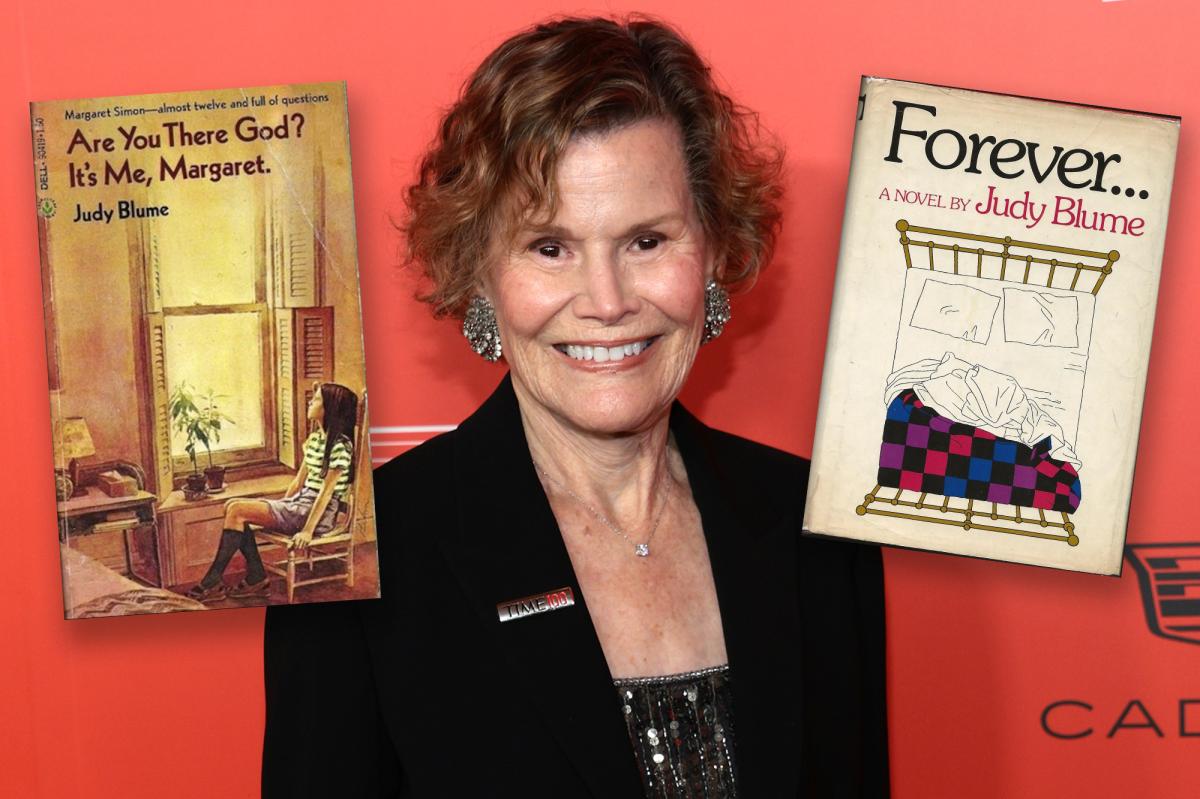
I have a confession: I am not a Judy Blume girlie.
Sure, as a kid growing up in the 1990s, I enjoyed some of her books. I adored the chaotic mayhem of 1972’s “Tales of a Fourth Grade Nothing” and 1980’s “Superfudge.” And I had a soft spot for Sheila Tubman (of 1972’s “Otherwise Known As Sheila the Great”), whose bratty impudence masked a terrified, tender vulnerability.
But I was a girl who did not want to grow up. I craved escape (dragons, princesses, Victorian orphans). Blume wrote about childhood and adolescence with a tough, frank realism that sometimes scared me.
It wasn’t until I was older that I appreciated the radical candor of Blume’s no-nonsense books — and understood how validating they were for the tens of millions of readers who had seen themselves in them.
Blume is a literary trailblazer. Her novels deal with divorce, menstruation, peer pressure, fat-shaming, shoplifting, voyeurism, body hair, and the gross and exciting mysteries of sex and puberty. (They are among the most frequently challenged or banned, according to the American Library Association.) A main character going through a religious crisis who actually wanted to get her period? Kids could relate.
Blume, now 88 and vital as ever, knew they would. Judging by Mark Oppenheimer’s new biography, “Judy Blume: A Life” (G.P. Putnam’s Sons, out now), that’s what she went through, too.
“There are authors who research lives very different from their own [for their fiction],” Oppenheimer told The Post. “And then there are authors who draw a lot from their own experience. Judy Blume is somebody who draws on her own experience.”
For example, Oppenheimer noted, when Blume wrote “Wifey,” her first adult book, from 1978, “she was certainly drawing on her own first” — unhappy — “marriage.”
He continued: “When she wrote ‘Are You There, God? It’s Me, Margaret,’ she was drawing on her own childhood, somewhat. When she wrote ‘Blubber’ [about an overweight girl bullied by classmates] she was inspired by a story that her daughter had told her about something that happened to a different child at school.
“She was creating fictional characters, but with the help of her own life experience,” he added.
Oppenheimer — himself a Blume devotee, who read “Margaret” as a preteen boy — delves into that experience, thoroughly excavating Blume’s life over 400 pages. We learn when she had her first sexual experiences (age 11, with one of her best girl friends), her first period (age 14), her first STD (shortly after getting married, the first time), her nose job (age 37) and her two abortions (when she was 39 and 41 and married to her second husband).
We also learn how hard she worked — the reams of rejected manuscripts, the hours and hours of revisions, the relentless hustling to try to get her books published — and how she managed to do it all while raising two children.
“I really just wanted to tell the story of her life and let other people draw the conclusions that they wanted to draw,” Oppenheimer said. “I didn’t have any agenda.” Blume, who initially participated in the biography and sat down for extensive interviews, has since distanced herself from the project and is not promoting it.
“Obviously, with any biography, part of the hope is that you’ll grow to understand the interior life of the person and what motivates the person … ,” Oppenheimer added. “I think I got pretty close. … But, for me, it is very much about telling a chronological story of this woman who has been so influential to millions.”
Judith Sussman (she became Blume with her first marriage) was born in 1938 in Elizabeth, NJ. She was the youngest of two kids, the only daughter of dentist Rudy and homemaker Essie.
Blume described herself to Oppenheimer as a “small, shy, anxious child with eczema” who would “play alone for hours, bouncing a ball against the side of our house, making up stories inside my head.”
Her imagination was far preferable to the books she would find at the library: sci-fi fantasies or historical fiction like “Little House on the Prairie.”
“None of the girls in these books are anything like me,” Blume wrote in an unpublished biographical sketch, which Oppenheimer quotes. “They don’t think about the things I think about. Their families are nothing like mine.”
Still, she did not dream of becoming an author — especially not a children’s author. Little Judy wanted to grow up as quickly as possible.
Her games were serious. Her paper dolls would get into “terrible automobile accidents and have to go to the hospital.” In fifth grade, she and her friends formed a club called the Pre-Teen Kittens (the inspiration for the Pre-Teen Sensations, who famously chanted “we must, we must, we must increase our bust” in “Margaret”), where they talked about boys, school, breasts and their periods — and studied a book about sexual development.
Indeed, Oppenheimer credits another sex manual, the groundbreaking “Love Without Fear,” which Blume read in college, as an influence on her unflinching writing style.
“Good writing, as [Blume] was coming to understand it, was not coy or euphemistic,” he writes.
Pre-teen Judy, like “Margaret,” was desperate to get her period. She had, also like “Margaret,” practiced wearing a sanitary pad for two years before she started menstruating. When she finally got her period, in ninth grade, she was ecstatic, but couldn’t share the news since — like another character in the book — she had told her friends she had gotten it back in sixth grade.
Blume was one of the few girls in her high school class to go to college, and she ended up studying education at NYU. She met her first husband, a law school grad named John Blume, during the spring of her sophomore year. They married, settled in the New Jersey suburbs and had two kids.
She hung her college diploma above the washing machine “to remind myself that I was an intelligent, educated person.”
As she approached 30, Blume began to feel restless. She started making felt art, even selling some pieces to Bloomingdales. Next, she tried her hand at songwriting, but her tunes were derivative.
Then, one day, she got a brochure for continuing education classes at NYU and saw a course on writing for children. She signed up, taking the bus from Scotch Plains, NJ, to New York City every Monday evening.
Her first book, “The One in the Middle Is the Green Kangaroo,” was published in 1969. By 1974, “she had written 10 books in five years, for readers from preschool through junior high,” writes Oppenheimer.
She was part of a group of emerging writers — including S.E. Hinton — changing the idea of what a children’s book could be: tackling subjects such as divorce, premarital sex, drug or alcohol abuse and more. Blume often had her young daughter Randy review her manuscripts, to see if they seemed authentic to a young person. (This resulted in Blume having to explain to her daughter what a “wet dream” was after Randy read a draft of her 1971 book “Then Again Maybe I Won’t.”)
Still, her husband treated her career as an amusing hobby. “Writing keeps her out of Saks,” John would remark to friends. When she would ask if he could help around the house, he would respond: “Ask me again when we’re earning the same amount.”
They divorced in 1975. That same year, she published “Forever,” the scandalous teen romance that included pages of detailed, explicit sex scenes. She did not let her mother — who usually typed her final manuscripts — read it. It was a sensation.
Oppenheimer digs up new information about Blume’s second marriage, to physicist Tom Kitchens — whom he describes as “rigid” and “possessive” and who Randy called “a jerk.” The union lasted about four years. Blume met her current husband, George Cooper, in 1979, and the two now run the independent Books & Books store in Key West.
Her books continue to captivate readers across generations, selling more than 90 million copies in the past five decades.
“I think it’s a misunderstanding that people read her books because of menstruation, discussions of bra sizes,” Oppenheimer said. “Any writer can do that — that’s easy. What’s really hard that Judy did so well was create relatable, authentic characters.”
Read the full article here