


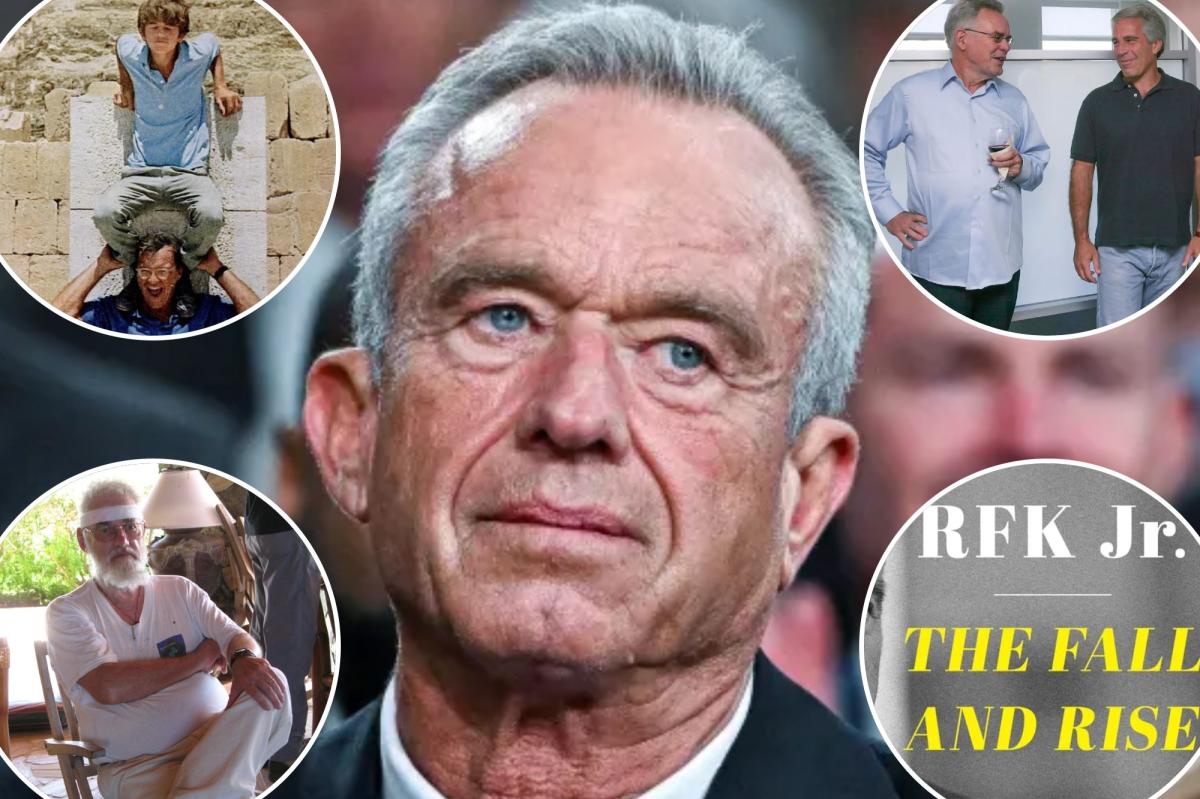
In 2013, a year after the suicide of his second wife, Mary Richardson Kennedy, The Post’s Isabel Vincent was given extraordinary access to three of Robert F. Kennedy Jr’s secret journals. Since then she has pored over more than 1,200 pages of the Secretary of Health and Human Services’ deepest thoughts. In this adapted excerpt from “RFK Jr.: The Fall and Rise” (Harper Collins), out April 14, Vincent chronicles Kennedy’s break with his famous family and the Democratic Party, as well as the evolution of his controversial views of the environment and health, including vaccines — and the father figures who shaped them.
Following his father’s assassination in June 1968, Robert F. Kennedy Jr. began a dangerous downward spiral.
The Secretary of Health and Human Services was 14 years old and began experimenting with drugs. His addiction to marijuana — and then heroin and cocaine — saw him kicked out of two elite boarding schools.
His mother, Ethel, was largely absent, overwhelmed with her own grief and the needs of the youngest of her 11 children — including daughter Rory, who was born six months after Robert’s death.
Instead, the wayward teenager known as Bobby came to rely on a trio of surrogate fathers who would have a profound effect on his way of thinking about science, the environment, and medicine, as well as public service.
Kirk Lemoyne “Lem” Billings, who was lifelong best friends with Kennedy’s uncle John F. Kennedy and a popular usher at Kennedy weddings, became Bobby’s most important surrogate parent when Ethel was unavailable and losing patience with her mischievous son.
She was not amused when Bobby spiked drinks with a laxative at a birthday party for his brother David, who turned 13 a week after their father was killed at the Ambassador Hotel in Los Angeles while campaigning for the presidency.
That summer, Billings volunteered to take Bobby on a three-week trip to East Africa — a vacation that had originally been planned by the boy’s father.
The two went on safari, photographed lions and elephants, and even managed a short sightseeing trip to Egypt. At one point, the 14-year-old tossed a football at a pride of lions, who shredded it.
Billings encouraged his young charge to keep a diary of the trip, and later helped him select the photos for a spread in LIFE magazine, which was published on Valentine’s Day 1969. Kennedy was paid $25,000 for the exclusive photos, equivalent to more than $200,000 today.
He told the magazine that he hoped to set up a memorial to his father in the Serengeti with the cash. No official memorial exists.
The images from “Bobby Jr. in Africa: A Kennedy Goes on a Boyish Safari” show a scrawny and sunburned boy who looks younger than his age, with a patina of fine dust covering his body — like a character in “Lord of the Flies” or a real-life Mowgli from “The Jungle Book.”
More trips with his surrogate father followed the “boyish safari,” including a journey through the Peruvian Amazon in 1975.
Billings tried to keep Bobby in line, filling in for his parents at school functions, and visiting him at the Millbrook School in the Hudson Valley to take him and his school friends to lunch. Those lunches could be annoying, with Billings constantly reminding the boy that he needed to live up to the Kennedy legacy of public service.
“He was a second father to Bobby,” said former Millbrook classmate Peter Jenny. “But [Billings] was a strange guy. What he was doing was cruel. Nobody should be saddled with that burden.”
Later, when Bobby was at Harvard, the two would share a more alarming bond.
After the boy was suspended from Millbrook in 1970, Billings found him another elite boarding academy, the Pomfret School in Connecticut. But Kennedy continued to do drugs and refused to do any schoolwork, leading to his expulsion.
Despite the boy’s truancy and addiction, Billings believed that Bobby was destined for greatness and saw it as his responsibility to prepare him to fulfill his father’s legacy and become president one day.
In 12th grade, Bobby attended the Palfrey School, an experimental day school outside Boston, where he encountered James “Skip” Lazell, a right-wing zoologist and expert on amphibians.
“The teacher who had the most influence on me was my Palfrey School biology teacher, Skip Lazell,” Bobby wrote in his diary on June 11, 2001.
For Bobby — who once wanted to be a veterinarian and whose father had arranged an after-school job at Washington, DC’s National Zoo — Lazell, who had worked at the Philadelphia Zoo, was a true kindred spirit.
He was also a supporter of the Vietnam War, unlike Robert Kennedy, and a member of the John Birch Society, a secretive group that opposed civil rights, free trade, and wanted the US to withdraw from the United Nations.
In the 1950s and 1960s, the group also believed that the fluoridation of drinking water was a Communist plot and had no trust in vaccines. They promoted “health freedom” and opposed mandatory vaccinations.
Bobby, a future critic of vaccines who believes that some are linked to high rates of autism, has called fluoride “a dangerous neurotoxin” and claimed that it has been linked to a host of maladies, including thyroid disease, arthritis, and bone breaks.
Although Lazell’s conservative worldview might have shocked the progressive Kennedy clan, Bobby was intrigued.
“[Lazell] was contrary by nature and was an outspoken supporter of the Vietnam war at a liberal progressive school, an active member of the YAF [Young America’s Foundation] and firm supporter of the John Birch Society,” Bobby wrote in his diary, referring to the far-right groups that his father would likely have been against.
Bobby first heard about the dangers of climate change and global warming from Lazell in the early 1970s. The teacher also told his students that he had gotten a vasectomy in 1960 when he was 21 years old.
“Skip believed that the vigor of the human race was being destabilized by radical technology that makes genetic defects proliferate, and he had himself fixed to spare future generations the burden of the diabetes genes that he carries,” wrote Bobby in his diary.
Every spring, Lazell, who died in 2023, took “all his adoring students” on a weeklong camping trip to Cape Hatteras on South Carolina’s Outer Banks to document wildlife. Bobby described how he would drive with a can of beer in a plastic cup holder near the steering wheel.
“He always had a girlfriend from his classes and stayed with her in a private tent,” wrote Bobby, who went on the trip during his senior year. “He taught us how to catch skunks without being sprayed,” as well as rattlesnakes and all manner of lizards, he wrote.
It would foreshadow Bobby’s later life — such as when he scooped up a road-killed bear on a New York State highway in 2014, dumping it in Central Park when he realized he needed to catch a plane. In his diary, he writes about cutting off the penis of a road-killed raccoon in 2001, while his “kids waited patiently in the car,” so that he could examine it later.
His daughter Kick recounted in 2012 how Bobby once chain-sawed the head off a dead whale, found on a Massachusetts beach, and used a bungee cord to strap it to the roof of the family’s minivan before driving back to New York.
From the Palfrey School, Bobby’s entry into Harvard University was seamless thanks to his storied lineage. But he spent much of his free time there doing drugs, especially speedballs — a mixture of cocaine and heroin.
And when he visited New York City, he found an unexpected drug buddy: his father figure Lem Billings.
The two frequently shot up heroin together in Billings’s Upper East Side apartment, which became a kind of haven and flophouse for many of the young Kennedy scions in the 1970s.
At Harvard, it was professor Robert Trivers, the self-described “bad ass of evolutionary biology,” who was “the best teacher I ever had,” Bobby wrote in his diary.
Although white, Trivers was a member of the radical Black Panther Party. He smoked pot and studied lizards. His theory of Reciprocal Altruism, a behavior in which a group of animals or humans help each other in order to later collect a favor, rocked the scientific world in the 1970s, while Bobby was his student.
Decades later, Bobby’s Make America Healthy Again (MAHA) campaign would become an example of Reciprocal Altruism, as a coalition of like-minded supporters provided an important platform for their shared vision on health care in exchange for political influence.
Trivers also maintained a relationship with Jeffrey Epstein, who funded some of his research, around $40,000, he told Reuters in 2015.
Trivers also defended Epstein over charges that he paid for sex with underage girls (Epstein pleaded guilty in 2008 to prostitution-related charges), saying, “By the time they’re 14 or 15, they’re like grown women were 60 years ago, so I don’t see these acts as so heinous,” he said to Reuters.
Emails in the Epstein files reveal that Epstein encouraged Trivers to pursue the study of “transgender biology,” and the professor wrote in 2020 that he was “getting to the end of ‘transsexuality.’”
Trivers passed away on March 12, 2026, at age 83.
While Bobby was at Harvard, his pal Billings wrote a letter of recommendation to support the scion’s application for a Rhodes Scholarship.
“I have watched him overassert himself with that raw strength that young men so often [possess] . . . and I have watched him learn to restrain himself,” wrote Billings in a letter to one of the US committees for the Rhodes Scholarship at Oxford University. “I am almost sixty years old, and I have watched a few great ones come along. I’ve fought in a war, and I’ve been active in politics and business, and I know what qualities are the ones that shape strong men into strong leaders. Bobby has those qualities.”
It was an impressive letter, but not enough to get him in. And although Bobby did go to England to spend a few months at the London School of Economics after finishing his Harvard studies, he spent much of his time there doing drugs and chasing women.
When Billings died of a heart attack at age 65 on May 28, 1981, Bobby gave a revealing funeral speech.
“He felt pain for every one of us — pain that no one else could have the courage to feel,” Bobby said. “I don’t know how we will carry on without him. In many ways, Lem was like a father to me, and he was the best friend I will ever have.”
Read the full article here