


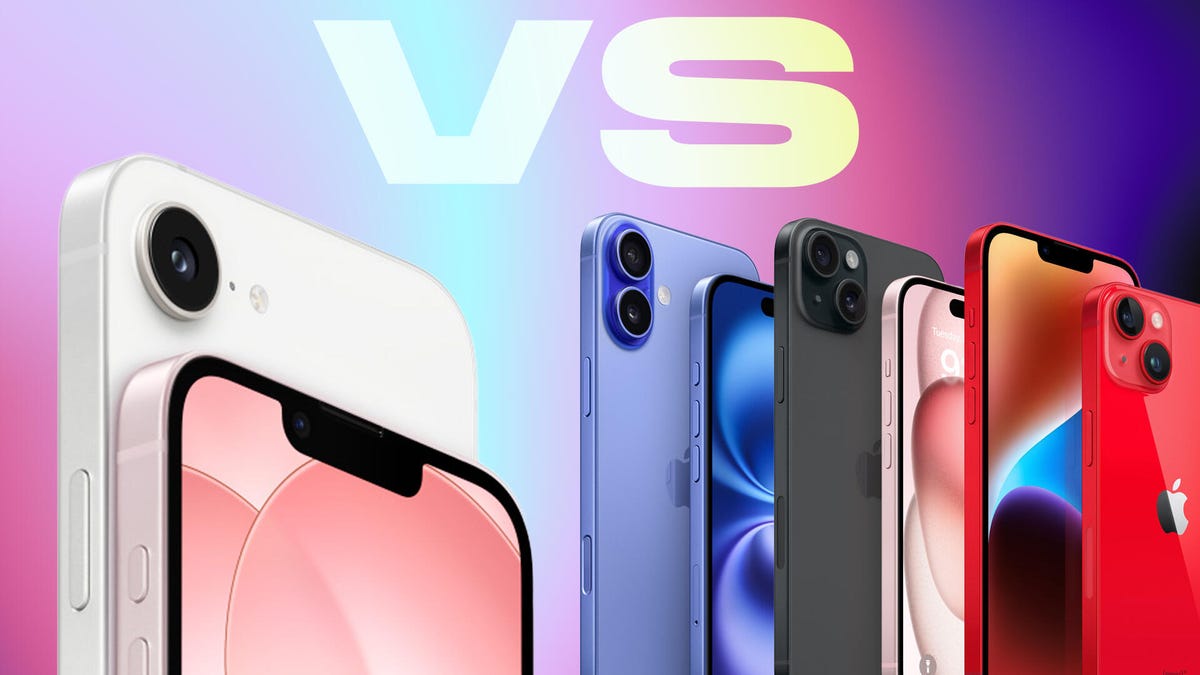
Apple announced the iPhone 17E with some premium upgrades borrowed straight from the more expensive iPhone 17. Like the $799 model, Apple’s most affordable iPhone now starts at 256GB of storage, has an A19 chip (albeit with a four-core GPU instead of five), a 48-megapixel camera and MagSafe magnetic technology — all for the same $599 price as before. This is a sweet successor to the iPhone 16E, fixing that phone’s omission of MagSafe while doubling the starting storage from 128GB.
But how do these upgrades help it stand tall against the older iPhones — the ones with Dynamic Island, two rear cameras and support for Live Activities? If you’re looking to upgrade from an iPhone 16, iPhone 15, or the iPhone 14 with a notch, but don’t want to spend $799 on a new iPhone 17, here’s how the midrange iPhone 17E compares to your current Apple device.
iPhone 17E vs. iPhone 16
The iPhone 17E adds a bunch of new features but they shouldn’t tempt you to upgrade from an iPhone 16.
Both iPhone 17E and iPhone 16 have a similar in-hand feel. The new phone is slightly smaller but weighs the same 170 grams. It’s similarly light and comfortable to use with a single hand. The 17E is tougher than its 2024 counterpart. Apple gave it the same Ceramic Shield 2 protection as its latest iPhone 17 series. By contrast, the iPhone 16 has a less scratch-resistant and more reflective Ceramic Shield front. This means the iPhone 17E is less prone to scratches by pocket lint and is easier to view in direct light.
The iPhone 16 has a pill-shaped Dynamic Island cutout on the front to house the Face ID sensors and selfie camera. It’s also responsible for surfacing system alerts and showing live updates on apps running in the background. However, you miss out on these features with the iPhone 17E, which is stuck with an iPhone 13-like notch.
Both of these Apple devices have a 6.1-inch OLED screen that supports the same resolution, contrast ratio and a 60Hz refresh rate. The iPhone 16 is brighter as it can go up to 2,000 nits outdoors (Apple doesn’t state this stat for the iPhone 17E), 1,600 nits (compared with 1,200 nits on the 17E) for supported HDR content and 1,000 nits (800 nits on the 17E) typical max brightness. It can also go down to 1 nit minimum brightness, so the screen on the iPhone 16 is more comfortable for bedtime reading with lights off.
You can expect a similar content consumption experience in most scenarios but the 16 will be slightly more immersive, thanks to slimmer bezels.
The Dynamic Island on the iPhone 16 gives you more intuitive Live Activities around the display cutout.
The iPhone 17E has an A19 chip (four-core GPU version), while the iPhone 16 is powered by the A18 processor. You won’t notice a major difference in performance in day-to-day activities, but the new chip is paired with Apple’s C1X cellular modem for improved power efficiency. Other connectivity differences include Wi-Fi 6 (vs. Wi-Fi 7 on the 16) and the lack of the second-generation Ultra Wideband chip (which enables Precise location tracking on the AirTags) on the 17E.
Apple says its iPhone 17E supports up to 4 hours more video playback time than the iPhone 16. In CNET’s iPhone battery test, we didn’t notice a difference between the two iPhones. Both of them dropped from 100% to 86% in our 3-hour video streaming test and by 3% in our 45-minute battery endurance test.
They’ll last you an entire day on moderate use. Both of them support 20-watt wired charging and 15W wireless charging. I love the fact that Apple added MagSafe support to its new affordable device because snapping magnetic accessories (whether it’s a power bank, wallet or tripod) to my iPhone is a convenience I missed on last year’s iPhone 16E. If you’re coming from the 16, you can now use all your magnetic accessories with the $599 iPhone.
Both these devices have the same 48-megapixel main camera that can shoot “optical-like” (essentially, in-sensor zoom) 2x zoom shots. You get the same 12-megapixel camera on the front. However, the iPhone 16 has a more capable and versatile camera system. It has sensor-shift optical image stabilization (vs. optical image stabilization on the 17E) on the main sensor and another 12-megapixel ultrawide-angle camera. Plus, the iPhone 17E lacks the ability to shoot in Macro mode, Cinematic mode and Action mode, and doesn’t have the Camera Control button.
The bottom line: While iPhone 17E’s quality-of-life updates (Ceramic Shield 2, A19 chip and MagSafe) are welcome additions, the iPhone 16 remains a solid device in 2026. It has a more immersive display, versatile cameras, Live Activities and a UWB chip for precise location tracking. In many ways, it’s still a better device than the iPhone 17E. If your iPhone 16 is working fine, you shouldn’t upgrade to the 17E.
iPhone 17E vs. iPhone 15
The iPhone 17E has thick bezels as compared to the iPhone 15.
The iPhone 17E and iPhone 15 have a similar in-hand feel. You get an aluminum frame and glass construction for a premium look. The 15 is a feather heavier at 171 grams (compared with the 170 g 17E) and taller (147.6mm vs. 146.7mm) but it isn’t noticeable in daily use. However, there are some major design differences between the two Apple products:
-
The iPhone 15 was one of the last iPhones to have a Ring/Silent switch. It was replaced by an Action Button on the iPhone 16 series, which is also present on all the latest iPhones, including the 17E.
-
Apple gave the same Ceramic Shield 2 protection to the iPhone 17E as its more expensive siblings. In comparison, the 15 has a less scratch-resistant and more reflective first-generation Ceramic Shield front.
-
Like the aforementioned iPhone 16, the iPhone 15 has a pill-shaped (Dynamic Island) for the Face ID sensors and the selfie shooter. By contrast, the iPhone 17E has a big notch and shows Live Activities on the homescreen.
-
The iPhone 15 has slimmer bezels on its display, which makes it a more immersive panel for content consumption.
Both of them have a 6.1-inch OLED screen with the same resolution, contrast ratio and a 60Hz refresh rate. However, the iPhone 15’s screen is brighter. It goes up to 2,000 nits outdoors (Apple doesn’t state this stat for the iPhone 17E), 1,600 nits (1,200 nits on the 17E) for supported HDR content and 1,000 nits (800 nits on the 17E) typical max brightness.
The iPhone 17E runs on a custom A19 chip with a four-core GPU. In comparison, the iPhone 15 is powered by a three-generation-old A16 Bionic chip. It is less power-efficient and lacks hardware-accelerated ray tracing. The iPhone 15 is also the last to come without Apple Intelligence support. AI isn’t a selling point on any phone yet but it enables a few useful features like quick object removal in photos using CleanUp and Priority Notifications, among others. The lack of Apple Intelligence also means your iPhone 15 won’t support the now-delayed smarter Siri update.
The iPhone 15 in pink still looks nice.
Both these devices have Wi-Fi 6 and Bluetooth 5.3 for wireless connectivity but the 17E lacks a UWB chip. The iPhone 15 has Apple’s second-generation Ultra Wideband chip, which enables Precise location tracking for AirTags.
The new affordable iPhone’s battery life will last longer than the 2023 model. Apple says the iPhone 17E supports up to 6 hours more of video playback than the iPhone 15. This change aligns with our testing in CNET’s battery tests. In a 3-hour streaming test over Wi-Fi, the 17E’s battery dropped from 100% to 86%, while the iPhone 15 hit 85%. Similarly, in our 45-minute endurance test, the iPhone 17E’s battery went from full to 97%. The iPhone 15 dropped by 5% in the same test. You are likely to notice a significant difference in endurance between the two iPhones with extended use.
Both of them have a 48-megapixel main camera that can shoot “optical-like” (in-sensor zoom) 2x zoom shots, and you get the same 12-megapixel selfie camera on the front. But there’s an additional 12-megapixel ultrawide-angle camera on the 15. The 2023 model edges out in videography with support for Action mode and Cinematic mode. However, it lacks some useful iPhone 17E features like wind noise reduction and Audio Mix for videos.
The bottom line: The iPhone 17E sees some drastic changes on the inside, compared to the iPhone 15. While it might not look like a new Apple phone from the front, the 17E has a stronger screen, longer-lasting battery life, double the storage in the base variant and added futureproofing with Apple Intelligence support. If you’re looking to upgrade from your old iPhone 15 on a budget, the iPhone 17E might have just enough to be noticeable for you. With MagSafe support, it’ll also support all your magnetic accessories. The main loss would be the ultrawide camera, depending on how often you use that for expansive shots.
iPhone 17E vs. iPhone 14
MagSafe is one of the biggest additions to the iPhone 17E.
If you’re coming from an iPhone 14, the 17E has some quality-of-life upgrades that you’ll appreciate. Both these devices have an aluminum frame and a notch on the front. The new iPhone is built stronger with, Apple says, a three times better scratch-resistant Ceramic Shield 2 on the front. It also has an anti-reflective coating, which reduces glare in direct light. This comes in handy, especially because both of them support the same brightness levels on their 6.1-inch OLED screens.
Other important design changes include the presence of a USB-C charging port and an Action button on the iPhone 17E. The iPhone 14 was the last of its kind to have a Lightning port. This means the new affordable iPhone will work with the more-universal USB-C cables, making it easier to connect to laptop chargers and external displays. It is also 2 grams lighter than the 14, which isn’t much but a lightweight design is always appreciated.
The iPhone 14 doesn’t hold up against Apple’s new iPhone 17E.
The iPhone 17E got a strong processor boost this year. It has the same A19 chip as the more expensive iPhone 17 but with a four-core GPU (instead of five-core). This is a major upgrade over iPhone 14’s A15 Bionic chip. As a result, you get support for Apple Intelligence, hardware-accelerated ray tracing for gaming and better battery life. The company says its new iPhone 17E will last 6 hours longer than the iPhone 14 in video playback time.
The iPhone 14 has a 12-megapixel main camera and another 12-megapixel ultrawide-angle camera on the back, while the iPhone 17E gets just one sensor in the form of a 48-megapixel camera. It is capable of shooting good-quality zoom photos at 2x. On the front, you get a 12-megapixel camera on both.
The bottom line: The iPhone 14 has the most noticeable differences with the iPhone 17E. While you lose out on camera versatility, you gain a better quality main camera, improved battery life, significantly better performance and, at last, a USB-C port. There’s added flavor for Apple Intelligence as well.
Who should upgrade to the iPhone 17E?
The iPhone 17E is a lightweight phone, best suited for anyone upgrading from the iPhone 14 or an older generation device.
The iPhone 17E is an impressive upgrade if you are coming from an iPhone 14 or older device (including the iPhone SE and iPhone 13, among others). You’ll notice the biggest difference switching from Apple’s Lightning port to the more universal USB-C for wired charging without losing compatibility with your MagSafe accessories. Other upgrades include a significantly better battery life, improved optics and smooth performance, alongside the Apple Intelligence goodness.
As for the iPhone 15 and iPhone 16 owners looking to upgrade, I highly recommend going for the $799 iPhone 17 where possible instead of the 17E (so you don’t lose out on camera versatility). It is the best value-for-money product in Apple’s current iPhone lineup. In fact, it is close to a Pro upgrade. You’ll get an all-new 18-megapixel front camera with auto-framing and a brighter and stronger screen with a 120Hz refresh rate (same as iPhone 17 Pro). It’s accompanied by a longer-lasting battery, 256GB of storage on the base variant and an upgraded ultrawide-angle camera.
Apple iPhone 17E vs. iPhone 16, iPhone 15, iPhone 14
| Apple iPhone 17E | Apple iPhone 16 | Apple iPhone 15 | iPhone 14 | |
|---|---|---|---|---|
| Display size, resolution | 6.1-inch OLED display; 2,532×1,170 pixels; 60Hz refresh rate | 6.1-inch OLED; 2,556×1,179 pixel resolution; 60Hz refresh rate | 6.1-inch OLED; 2,556×1,179 pixels | 6.1-inch OLED; 2,532×1,170 pixels |
| Pixel density | 460 ppi | 460 ppi | 460 ppi | 460 ppi |
| Dimensions (inches) | 5.78×2.82×0.31 | 5.81×2.82×0.31 in | 2.82×5.81×0.31 in | 5.78×2.82×0.31 in |
| Dimensions (millimeters) | 146.7×71.5×7.8 | 147.6×71.6×7.8 mm | 71.6×147.6×7.8 mm | 147x72x7.8 mm |
| Weight (ounces, grams) | 167 g (5.88 oz.) | 170 g (6 oz.) | 171 g (6.02 oz) | 172 g (6.07 oz) |
| Mobile software | iOS 26 | iOS 18 | iOS 17 | iOS 16 |
| Camera | 48-megapixel (wide) | 48-megapixel (wide), 12-megapixel (ultrawide) | 48-megapixel (wide), 12-megapixel (ultrawide) | 12-megapixel (wide), 12-megapixel (ultrawide) |
| Front-facing camera | 12-megapixel | 12-megapixel | 12-megapixel | 12-megapixel |
| Video capture | 4K | 4K | 4K | 4K at 60 fps |
| Processor | Apple A19 | Apple A18 | A16 Bionic | Apple A15 Bionic |
| RAM/Storage | RAM unknown + 256GB, 512GB | RAM N/A + 128GB, 256GB, 512GB | 128GB, 256GB, 512GB | RAM NA; 128GB, 256GB, 512GB |
| Expandable storage | None | None (Face ID) | None | None |
| Battery/Charger | 4,005 mAh | Up to 22 hours video playback; up to 18 hours video playback (streamed). 20W wired charging. MagSafe wireless charging up to 25W with 30W adapter or higher; Qi2 up to 15W | Undisclosed; Apple claims up to 20 hours of video playback (16 hours streamed) | Undisclosed; Apple claims 20 hours of video playback |
| Fingerprint sensor | None, Face ID | None (Face ID) | None (Face ID) | None (Face ID) |
| Connector | USB-C | USB-C | USB-C (USB 2.0) | Lightning |
| Headphone jack | None | None | None | None |
| Special features | MagSafe, Qi2 charging (up to 15W), Action button, Apple C1 5G modem, Apple Intelligence, Ceramic Shield, Emergency SOS, satellite connectivity, IP68 resistance | Apple Intelligence, Action button, Camera Control button, Dynamic Island, 1 to 2,000 nits display brightness range, IP68 resistance. Colors: black, white, pink, teal, ultramarine. | Dynamic Island; 5G (mmw/Sub6); MagSafe; water resistant (IP68); wireless charging; eSIM; satellite connectivity | 5G (mmw/Sub6); MagSafe; water resistant (IP68); wireless charging; eSIM; satellite connectivity |
| Price at launch (USD) | $599 (256GB) | $829 (128GB) | $799 (128GB), $899 (256GB), $1,099 (512GB) | $799 (128GB), $899 (256GB), $1,099 (512GB) |
Read the full article here