


NASA rovers have revealed fascinating details and close-up images of Mars and the moon, but exploring other planets is slow. Most rovers are remotely controlled from Earth, and their careful, energy-efficient design limits how much ground they can cover.
Now, new research from the University of Basel, ETH Zurich, and the European Space Agency, published Tuesday in the journal Frontiers in Space Technologies, examines how robots that can “think” for themselves might help us search a planet’s surface much faster.
Because rovers are built and guided in specific ways, exploration is often limited, making it hard to collect data across a large area of the planet. It also takes a while to transmit data across the vast distance between Earth and other celestial bodies.
“Rovers are designed for energy efficiency and safety, and to move slowly across hazardous terrain,” the researchers said in a statement. “Here, we tested a different approach.”
They experimented with a “semi-autonomous robotic explorer” that can investigate multiple targets and collect data without being told where to go.
“The results showed that semi-autonomous robots equipped with compact instruments could significantly speed up resource prospecting and the search for ‘biosignatures’ (i.e., evidence of life) on planetary surfaces,” the researchers wrote.
So instead of humans controlling the robots via remote control over long distances, the researchers found that a robot outfitted with the right tools can navigate the surface and collect data at separate locations all by itself.
Testing autonomy
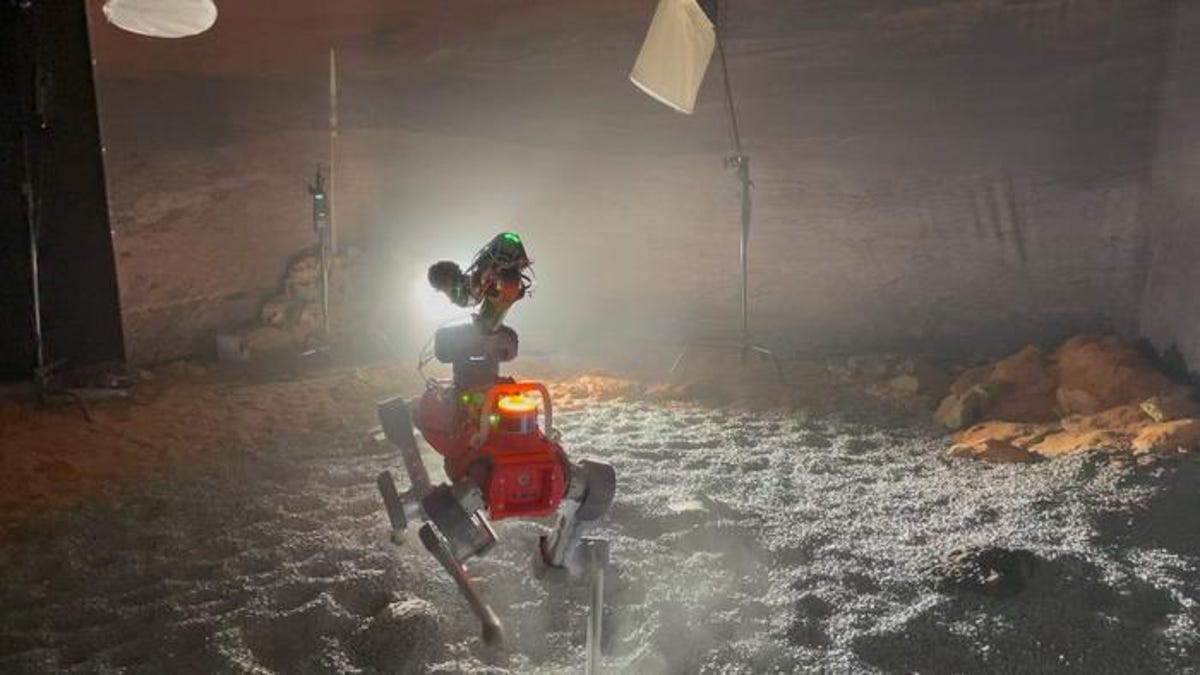
The researchers used a quadrupedal robot with a robotic arm. The robot, which they programmed to work without humans, carried a special camera and a spectrometer, designed to identify different materials.
“(The robot’s) autonomy is limited to the execution of predefined commands, including locomotion, waypoint navigation, instrument deployment and data return,” the researchers wrote in the paper.
To test the robot, the team used the Marslabor facility at the University of Basel in Switzerland. This facility simulates planetary surface conditions with a rocky environment and special lightning.
The robot moved through the facility to selected targets, like specific rock types hidden in the landscape. Then it used its robotic arm to deploy the science instruments and returned images and data for analysis.
The researchers compared this new strategy with a more traditional approach: scientists guiding the robot to explore one target at a time.
The researchers found that multi-target missions took the semi-autonomous robot 12 to 23 minutes, while human-guided missions took 41 minutes to conduct similar exploration and analysis.
Moon maneuvers
While most rovers use wheels to get around, using a robot with legs could be helpful, the researchers wrote, as some lunar resources are found in hard-to-reach terrain with steep crater walls, which could be a challenge for wheeled robots.
NASA has also been working on autonomous rovers that can explore and excavate on the Moon with minimal human direction. And while the current Artemis II mission won’t use a lunar rover, these robots could help pave the way for a sustained human presence on the moon.
In December, NASA used AI to successfully plot a course for the Mars rover Perseverance. The team used Anthropic’s Claude AI models for two demonstrations. The rover navigated obstacles on the Martian surface and drove approximately 1,500 feet without issue.
Read the full article here