


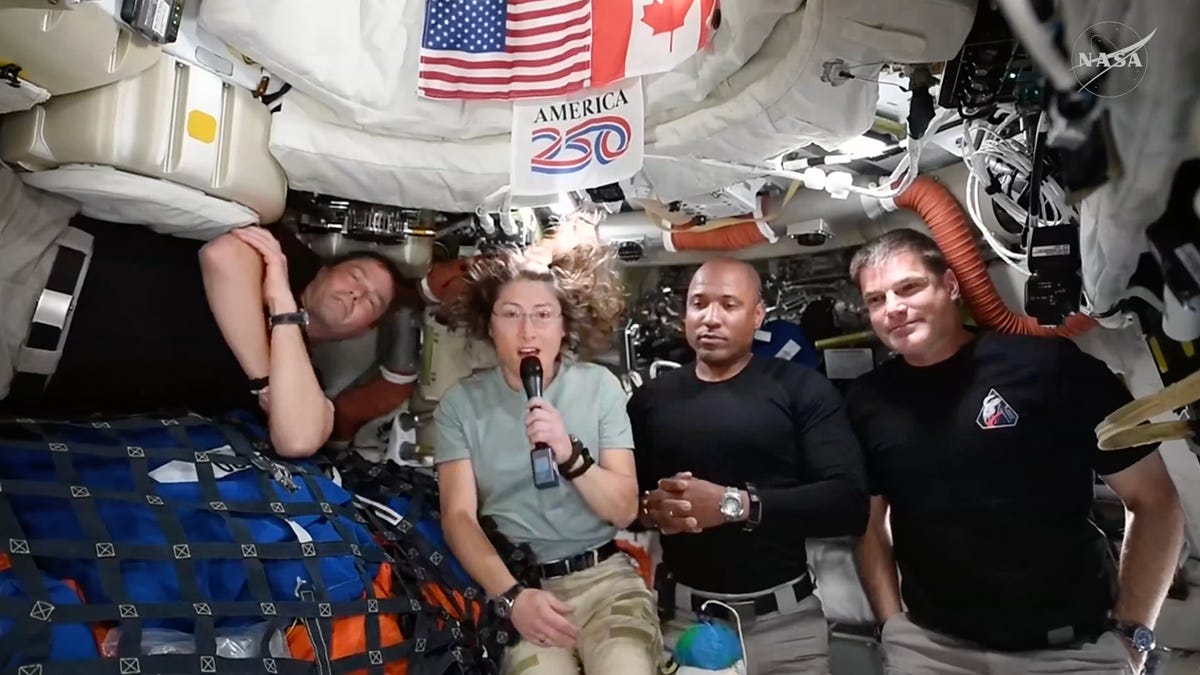
The astronauts aboard the Artemis II mission are called a crew, but they really regard themselves as a team, right down to just getting around the Orion spacecraft’s cabin. But they have been intently focused on the overall success of the Artemis program, as there is a lot at stake because it’s the first crewed deep-space flight in more than 50 years. And the astronauts are acutely aware of that and how what they will impact future moon missions.
“Part of our ethos as a crew and our values from the very beginning were that this is a relay race,” Mission Specialist Christina Koch said during a virtual news conference with reporters Wednesday evening. “In fact, we have batons that we bought to symbolize physically that. We plan to hand them to the next crew. And every single thing we do is with them in mind.”
Koch referenced tasks she and the Orion crew have performed so far during their mission, such as manually piloting the spacecraft and ensuring that procedures are as they should be.
“We’re always thinking from the perspective of what is the next crew going to think about this, how will this help them to succeed,” stated Koch.
It also takes teamwork just to live in such a small space. Koch said that the Orion’s cabin feels bigger in microgravity than what she expected, even though the astronauts are constantly bumping into each other “100% of the time.” Moving around the cabin, even to perform simple tasks, requires them to narrate their exact movements to one another to avoid colliding with crewmates.
“Everything we do in here is a four-person activity, but it’s also really fun,” joked Koch.
That insight was among the personal details the Artemis crew shared from space on Wednesday evening — the eighth day of their mission — as they prepare for their return to Earth on Friday after a historic 10-day journey around the moon. The first crewed deep-space flight since 1972 saw the Orion Integrity spacecraft carry the crew 252,756 miles from Earth — the farthest distance humans have ever traveled from our planet.
Watch this: Watch NASA’s Artemis II Launch to the Moon
During the mission, the astronauts also shared an emotional moment with viewers back on Earth when they proposed naming one of the craters on the moon “Carroll,” in memory of Commander Reid Wiseman’s late wife, a nurse who died of cancer in 2020 at the age of 46. Wiseman opened up about his feelings in that moment when asked during the press conference. Mission Specialist Jeremy Hansen made the proposal to Mission Control to name the crater on Orion’s lunar flyby.
“When Jeremy spelled Carroll’s name C A R R O L L, that’s when I was overwhelmed with emotion. I looked over and Christina was crying. I put my hand down on Jeremy’s hand as he was still talking. (It was right there on that rail.) And I could just tell he was trembling,” remembered Wiseman. “We all pretty much broke down right there. And just for me personally, that was the pinnacle moment of the mission for me.
Wiseman went on to say the moment was “where the four of us were the most forged, the most bonded, and we came out of that really focused on that day ahead.”
Earthset captured through the Orion spacecraft window at 6:41 p.m. EDT, April 6, 2026, during the Artemis II crew’s flyby of the moon. On Earth’s day side, swirling clouds are visible over the Australia and Oceania region. On the moon in the foreground, the Ohm crater has terraced edges and a flat floor interrupted by central peaks.
The crew is also focused on the journey back to Earth — and has been for more than three years, as Pilot Victor Glover pointed out to reporters.
“We’ve actually been thinking about entry since April 3, 2023, when we got assigned to this mission, and one of the first press conferences, we were asked, ‘What are we looking forward to?'” Glover said. “And I said, ‘splash down.’ And it’s kind of humorous, but it’s literal as well, that we have to get back. There’s so much data that you’ve seen already, but all the good stuff is coming back with us.
He explained that there are so many more pictures and stories that the Artemis II crew still has to share. Glover also admitted that he hasn’t even begun to process everything the astronauts have been through over the past week.
“We’ve still got two more days, and riding a fireball through the atmosphere is profound as well,” Glover exclaimed.
The Artemis crew is scheduled to return to Earth on Friday, with a splashdown in the Pacific Ocean off the coast of San Diego at 5:07 p.m. You can follow the conclusion of the mission on CNET. You can also watch the entirety of Wednesday’s press conference on NASA’s YouTube channel.
Read the full article here