


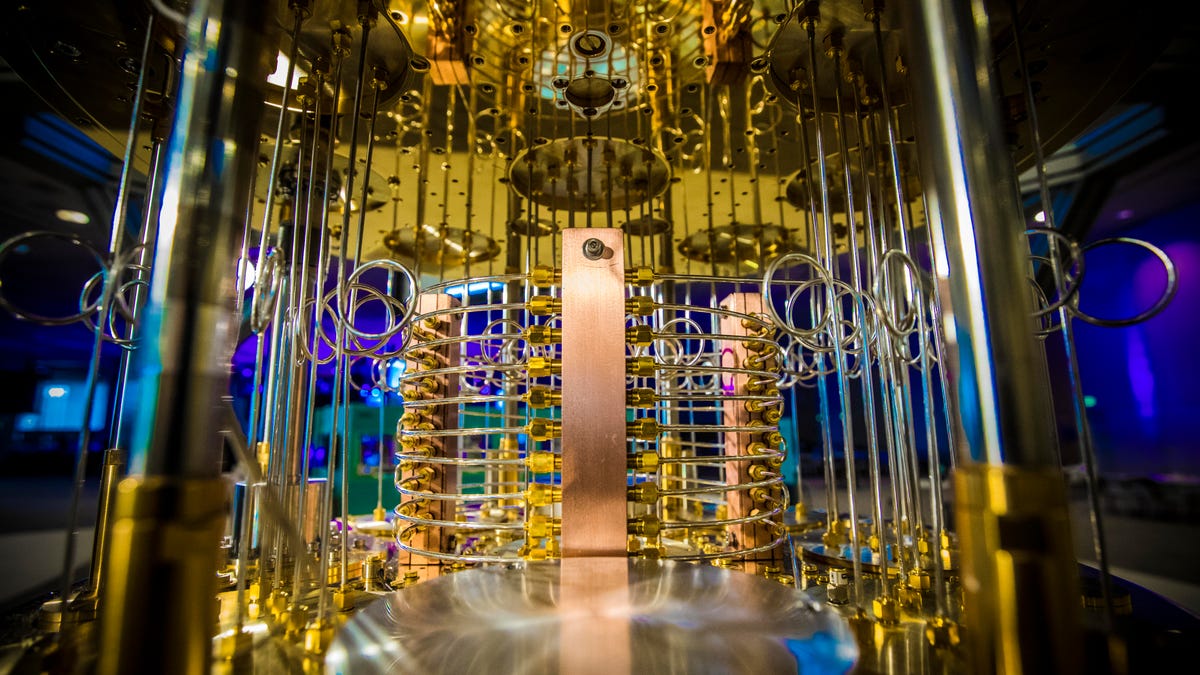
AI models have been helping with predictions for a while now. Doctors, weather forecasters and stock brokers all use AI to try to peek into the future. Inside the Leibniz Supercomputing Centre in Germany, researchers have been experimenting with an AI model and a quantum computer. The quantum computer helps the AI with complex predictions it can’t handle alone.
The research team from University College London, who published their findings on Friday in the journal Science Advances, say that one day, quantum computers could help AI models make fast, accurate predictions across a range of industries, which would take regular computers weeks to figure out.
“The paper demonstrates that for these kinds of studies, even today’s relatively small and unreliable quantum devices can enhance the predictions of conventional AI models,” Peter Coveney, UCL professor and the study’s coauthor, told CNET.
Quantum computers differ from regular computers in several ways, including being able to perform simultaneous calculations rather than step-by-step calculations, and using quantum bits. While classical computers use bits as the smallest data unit, with each representing either a zero or a one, qubits can represent both zero and one simultaneously (superposition). Two qubits can also be linked together (entanglement).
Superposition and entanglement allow quantum computers to solve complex problems much faster than traditional computers. But quantum computers are incredibly delicate and must be kept at extremely low temperatures, making them impractical for everyday use.
But while today’s quantum computers are still experimental and often finicky, they might help AI solve big problems that would otherwise be too complicated or time-consuming.
Quantum advantage
The AI model used in the study is housed on a supercomputer connected to the quantum computer at the research center.
The team used this setup to predict how gases and liquids in a system would move and interact over an extended period. Climate science, medicine and city engineering all use this kind of modeling.
“Our new method appears to demonstrate ‘quantum advantage’ in a practical way — that is, the quantum computer outperforms what is possible through classical computing alone,” coauthor Maida Wang, a PHD student at UCL, said in an announcement.
Quantum computers are incredibly sensitive. Even tiny disturbances in the environment throw off the calculations, so the technology is still mostly used in research labs.
Because quantum computing is still limited, the researchers did most of the study with the supercomputer. The AI model handled the data processing, then used the quantum computer for one step.
After completing the hard calculations, the quantum computer handed the reins back to the AI model, so it could take care of everything else.
“Even today’s noisy and error-prone quantum devices can enhance the performance of conventional machine-learning algorithms trained on data from modern supercomputers,” Coveney said.
Solving big problems
Hooking up an AI model to run calculations on a quantum computer might sound outlandish, but there are already real examples of companies using this approach in healthcare.
In 2025, Google said its Quantum Echoes algorithm could calculate the structure of molecules that could pave the way for future drug discovery. Also, last year, the University of Toronto and Insilico Medicine used AI with a quantum computer to build molecules that target an “undruggable” form of cancer.
While there are still challenges with ensuring predictions are reliable, as well as with the sheer size of the datasets involved, Coveney said quantum computers can improve complex predictions.
“We are already at work on real-world applications,” he said.
Read the full article here