


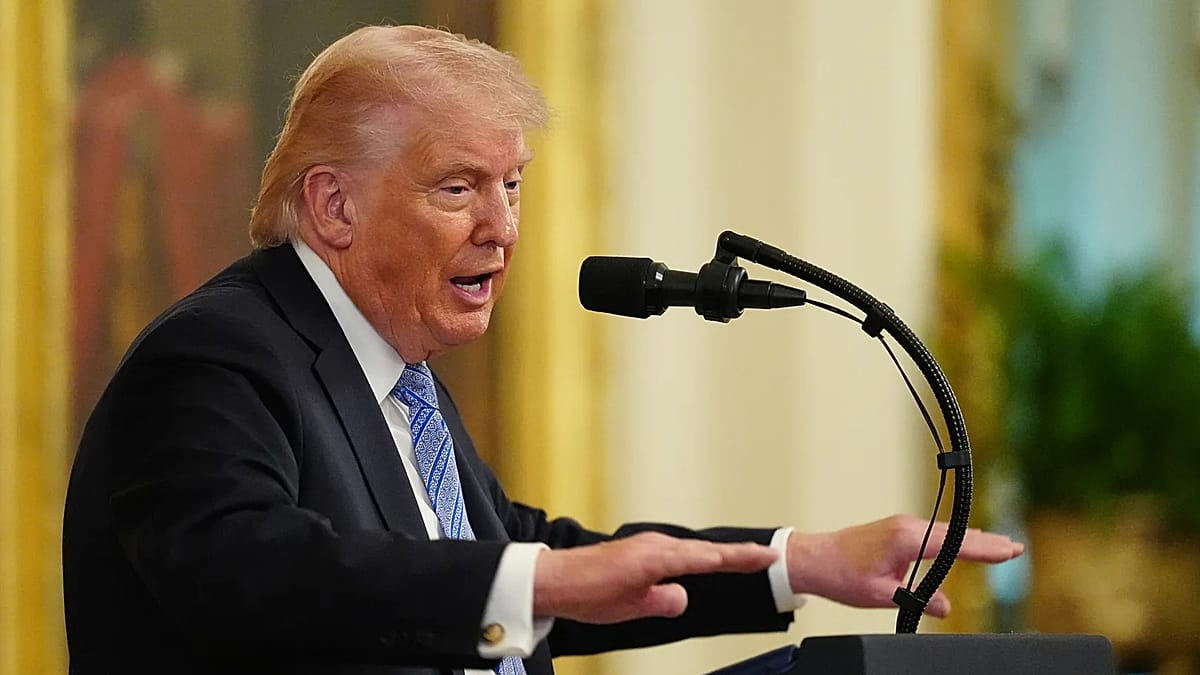
The EU’s 27 finance ministers have so far reacted cautiously to US President Donald Trump’s threat to impose 25% tariffs on EU cars.
Meeting for an Economic and Financial Affairs Council in Brussels on Monday and Tuesday, the ministers said they would adhere to the framework agreed with the US in July 2025, which limits US tariffs on EU goods to 15%.
The EU-US trade deal signed by Trump and European Commission President Ursula von der Leyen is currently being negotiated by EU governments and MEPs ahead of its implementation, with the bloc committed to removing tariffs on US industrial goods.
“We have a deal and that deal is being negotiated […] we are willing to keep on with this deal in good faith, and we hope everyone is in the same frame of mind,” French Finance Minister Roland Lescure told journalists ahead of the meeting on Monday.
Lescure and others echoed Ursula von der Leyen’s stance, who earlier on Tuesday said the institution would “remain very calm.”
“A deal is a deal, and we have a deal. And the essence of this deal is prosperity, common rules and reliability,” European Commission President Ursula von der Leyen said on Tuesday.
“We want from this work (to achieve) mutual gain, cooperation and reliability. And we’re prepared for every scenario,” she added.
Avoid escalation
Trump’s threat to impose 25% tariffs on EU cars came last Friday after German Chancellor Friedrich Merz criticised the US war in Iran. Washington also announced the withdrawal of 5,000 US troops from Germany, further straining transatlantic relations.
German Vice-Chancellor Lars Klingbeil said on Monday that Berlin wanted to avoid “escalation” but was prepared if tensions intensified.
“We want to have a common path with the US. But of course, it is clear that we are also prepared,” Klingbeil said.
The Commission also said that options remain “open” on the European side if the US threats are carried out. Last year, the EU suspended a package targeting €95 billion worth of US products, after weeks of trade disputes with the US.
The option of deploying the bloc’s anti-coercion instrument was also repeatedly raised in 2025. The mechanism allows the EU to retaliate against economic pressure from third countries by restricting licences or intellectual property rights, alongside traditional trade defence measures.
Spanish Economy Minister Carlos Cuerpo, for his part, was reluctant to respond, viewing it as just another social media post from the US President.
“With regard to this weekend news of 25% for cars or trucks, there is no measure, no specific executive order. Therefore, there would be nothing new beyond that of the tweet or, in this case, of that intention,” he said.
European Commissioner for Trade Maroš Šefčovič is scheduled to meet US Trade Representative Jamieson Greer on Tuesday to try to ease tensions with Washington ahead of a G7 trade ministers meeting.
Lescure and French trade Nicolas Forissier are also expected to talk with their US counterparts the same day.
Read the full article here