


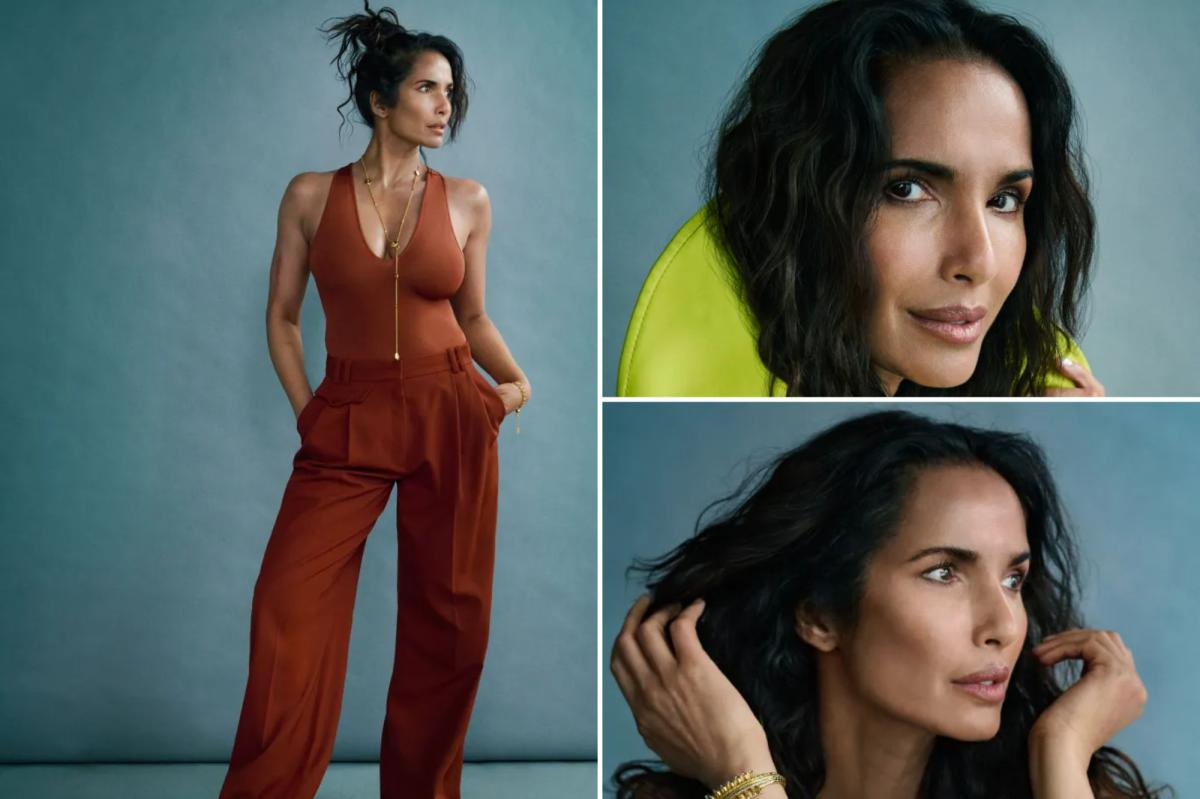
Spring is in full bloom in New York, and so is Padma Lakshmi’s career. “I was passing by Central Park, and all these beautiful flowers, magnolias, cherry blossoms, were in bloom,” says the glamorous host of “America’s Culinary Cup,” whose finale airs next week. Over Zoom, she reflects on the triumph of making a show that was truly hers — and the glittery pieces she wore while filming it.
“I’ve always had an affinity for jewelry,” Lakshmi, 55, tells Alexa. “Women buy jewelry to have talismans. It’s very sentimental.” Viewers of “Culinary Cup” may have noted a couple of Lakshmi’s own favorites on the show. “I have some very select pieces I’ve amassed over the years,” she shares. “I have a beautiful cocktail ring from the ’60s that I wore in the finale. And in the saucier challenge, I wore this topaz necklace, with these sharp oval bezel-cut stones, that I got in India over 20, 25 years ago.”
For her Alexa shoot, Lakshmi kept it simple. “I wanted the jewelry to stand out, because the minute you pair it with a gown, it goes someplace else,” she says, reflecting on the ubiquity of gowns in her professional life for decades. “For so many years, before I did ‘Taste the Nation,’ there was just one way people saw me on the red carpet. The only way I can tell the years apart at the Emmys is by the dress. But that rarefied image of me is, in my mind, not really accurate.” Where she really feels like herself, she says, is when she’s kicking her shoes off to play in the kitchen.
Lakshmi describes “Culinary Cup” to Alexa as “my biggest professional swing.” After soundly democratizing foodie entertainment with “Taste the Nation” and 19 seasons hosting “Top Chef,” she had been ready to realize her dream of creating a competition that treated its chefs like the vaunted professionals they are.
“So many of these competition shows are designed to thwart or put obstacles in the chef’s way, by not giving them all the best equipment or having them have to fight for ingredients,” she says. “There’s always someone who gets the bum stove with a hot spot or whatever. I just didn’t want that.”
Given free rein to make it her way, she spent months obsessing over how to reinvent the genre. “I’d be at the gym, and I’d be like, ‘Oh, that [aspect] used to bug me — what if we didn’t do that?’” she recalls. One of her top priorities was getting chefs the caliber of raw material they’d need to create truly top-tier dishes. “They have quail eggs and pheasant, they have every protein they could want. They have all organic spices from Burlap & Barrel. They have obscure spices you usually don’t see in mainstream markets.”
If there’s one person who knows her spices, it’s Lakshmi, who literally wrote the book. One of her six published tomes is “The Encyclopedia of Spices & Herbs: An Essential Guide to the Flavors of the World.”
Though the grand size and aim of “Culinary Cup” differ from “Taste the Nation,” a definitive flavor palate runs through both shows: Lakshmi’s dedication to showcasing the indelible influence and interweaving of ethnic cultures from around the world into American cuisine. “With ‘Taste the Nation,’ I definitely had an agenda,” she says. “It’s one person’s point of view: mine.” On “Culinary Cup,” she gave the POV squarely to her competitors, but that doesn’t mean she didn’t enjoy seeing where they took the challenge. In the saucier episode, she says, “Diana Davila, the Mexican chef, got bechamel. And she decolonized it. Instead of using ground wheat flour, which is something Europeans brought to America, she used corn masa, which is indigenous to the Americas. It’s beautiful to watch. Their politics came out in their creativity, and that’s as it should be.”
Lakshmi tries to find moments of peace and joy in her own life, which often come through in her line of work, at its core a celebration of food as love.
“Making a beautiful plate of food is a very simple act that billions of people do every day for their families,” she says. Her international work keeps her well aware that not everyone is so lucky. “Just that simple act of cooking in one’s kitchen, being able to buy vegetables that you want, having the privilege to peruse a spice aisle. Many people don’t have that.”
Lakshmi was born in India and moved to the United States with her mom, an oncology nurse, at a young age.
“When I first came to this country, I was barely 4 years old, and I always felt at home in New York,” she says. “We lived in Queens and then in Manhattan; my mother worked at Sloan Kettering. Because there weren’t that many Indian grocery stores in Manhattan, we would have to travel to Chinatown to find Asian vegetables, and then to Spanish Harlem to get things like sugarcane or tamarind or cilantro. Cilantro was not easily found in supermarkets in the ’70s!”
She began a modeling career at 21, breaking barriers by becoming the first Indian supermodel, then published her first cookbook, “Easy Exotic,” at age 29, and was hosting her own Food Network show, “Padma’s Passport,” a few years later. Countless globe-trotting series, fashion and food columns, and five more books followed. The latest, last year’s “Padma’s All American,” won praise for its “recipes inspired by recent immigrants, perfect examples of their skill and resourcefulness in adapting their cuisines to their new homeland,” raved the Wall Street Journal.
For Lakshmi, New York reigns supreme for sheer culinary adventure, and always has. “I have a friend who teaches creative nonfiction at NYU, named Suketu Mehta, who once took me on a food tour here,” she shares. “We ate Burmese food, Tibetan, Nepali, Ecuadorian, Indian. He even took me to an apartment building that we never entered, but he just said, ‘Look at the last names on all of the buzzers. Every ethni-city that you could want.’ New York is sort of the mecca for this.
“But,” she adds, “there are other great cities, too. Chicago is another great food city, underrated. San Francisco, same thing. In Minneapolis, there’s great Hmong food. There’s a wonderful indigenous restaurant [Owamni], which has really revolutionized the interest in Native American foods, by Sean Sherman.”
She cherishes finding the small spots, the kitchens where one chef’s worldview takes charge. In LA’s Koreatown, she shares, “there’s this place where the whole dining room is 12 feet by 20 feet. All the cooking is done by one elderly woman, and it’s fantastic, because she has a very specific point of view. I find kitchens run by women tend to be a lot more specific in their food and spice choices, and a lot more detail-oriented.”
Her 16-year-old daughter, Krishna, whom Lakshmi shares with businessman Adam Dell (the two amicably separated in 2021; she was previously married to Salman Rushdie from 2004 to 2007), often appears alongside her mother in social media posts and on red carpets. The young woman
Lakshmi nicknamed “Little Hands” when she was little cheerfully rolls her eyes at her mom in their cooking posts, and occasionally issues her own salty teenage edicts. “Can everyone stop calling me ‘Little Hands’? It’s, like, very weird,” she pleaded in a recent cooking post.
Meanwhile, Lakshmi continues her advocacy work. Her own struggle with endometriosis, for which she didn’t find effective treatment until she was 36, helped fuel her involvement in fund-raising and research development for the oft-misunderstood and misdiagnosed condition. In 2009, she co-founded the Endometriosis Foundation of America with Dr. Tamer Seckin. “There are many people working behind the scenes just to forge ahead, and I’m very happy about that.”
Looking back on her own journey, Lakshmi is relishing being at the top of her game. “My life was very turbulent and difficult the first 35 to 40 years,” she says. “Now, I’m very fortunate. My life has eased out. My career is thriving, and I have more control of my own destiny — though none of us are, it seems, in control of anything. So, I just try and focus on appreciating and savoring what I have.”
Photographer: Mark Hom Editor: Alev Aktar; Stylist: Anahita Moussavian; Photo Editor: Jessica Hober; Talent Booker: Patty Adams Martinez; Hair: Jimmy Paul at Susan Price NYC; Hair Assistant: Tomoko Kuwamura; Makeup: Fulvia Farolfi at MA+ Group; Makeup Assistant: Robert Reyes; Manicure: Nori Yamanaka for See Management using Dior; Lighting Director: Timothy Young; Photo Assistants: Toby Sprague, Faisal Mohammed; Digital Tech: Andrea Fremiotti; Fashion Assistant: Dominic Turiczek; On-set Fashion Assistant: Jena Beck; On-set Assistant: Yared Glicksman, Videographer: Ross Thomas Video Editor: Don Pearsall Contributing Editor: Serena French
Read the full article here