


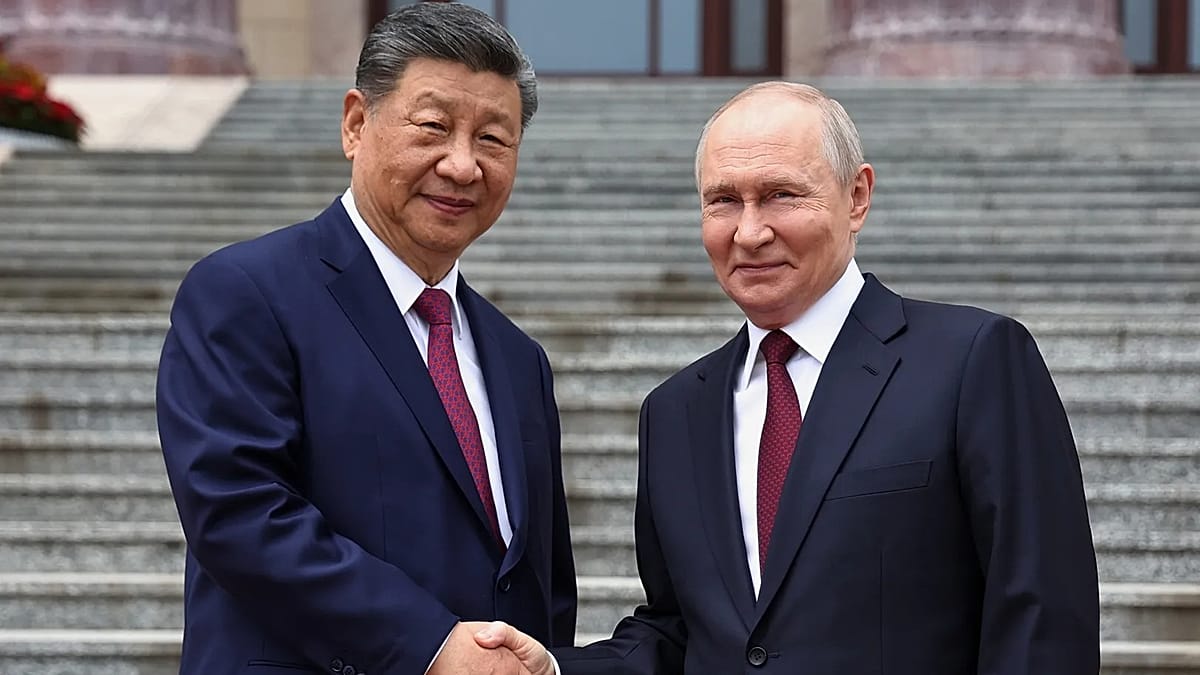
Chinese leader Xi Jinping welcomed Russian President Vladimir Putin to Beijing early on Wednesday morning for talks on the state of play in various global conflicts.
“In the current tense situation on the international stage, our close partnership is particularly needed,” Putin told Xi, calling the Chinese leader “a dear friend”.
According to Chinese state media, Xi said China and Russia should promote what he described as “more just global order” warning of “unilateral hegemony running rampant” across the world.
“As permanent members of the UN Security Council and important world powers,” Xi reportedly said, China and Russia should adopt a “long-term strategic view” and cooperate to build “a more just and equitable global governance system”.
Middle East conflict at a ‘critical juncture’
During the meeting with Putin, Xi reportedly mentioned the Middle East conflict, saying it is “imperative” to stop the fighting, but that the situation is now at a “critical juncture” and is currently transitioning from war to peace.
“My four-point proposal for maintaining and promoting peace and stability in the Middle East aims to further build international consensus and contribute to easing tensions, deescalating conflict, and promoting peace,” Xi said, according to state news outlet Xinhua.
Xi’s four-point proposal, put forward last month during his meeting with the crown prince of Abu Dhabi, promotes “peaceful co-existence, national sovereignty, international rule of law, and a coordinated approach to development and security”.
Russia’s Deputy Foreign Minister Sergei Ryabkov said on Wednesday that Moscow is ready to assist with talks between the US and Iran.
”Russia is ready to provide all possible assistance in resolving this conflict, and the parties involved are well aware of this,” Ryabkov said ahead of Putin’s meeting with Xi.
Before Putin and Trump visited Beijing, Iran’s foreign minister, Abbas Araqchi, made his own visit to China.
Can Xi pressure Putin over Ukraine?
German Chancellor Friedrich Merz said on Tuesday that he hoped Xi would persuade Putin “to end this war in Ukraine which he cannot win”.
“We are, of course, monitoring President Putin’s visit to Beijing very closely,” Merz told reporters. “We have also noted various statements made during the previous meeting between President Xi Jinping and President Trump. We have taken note of these with interest.”
“We do not currently expect a fundamental shift in the strategic relations between Russia and China. But we naturally associate this visit with the hope that President Xi will also urge President Putin to end this war in Ukraine, which he cannot win. On the contrary, it is a war that is causing heavy loss of life for Russia every single day.”
China has effectively become Russia’s most important international partner since the full-scale invasion of Ukraine, a dynamic of increasing concern in Western capitals, including Brussels.
Western diplomats and analysts believe Beijing’s economic and diplomatic backing has helped sustain Russia’s war effort in Ukraine. Even if China has not explicitly come out in support of Moscow’s war, it has not used the levers it has to make it stop.
Deeper cooperation
As the top-level visit progresses, Russia and China are set to sign about 40 documents, with Putin and Xi personally overseeing the signing of 21 of them.
According to Russian state media, two documents will take centre stage: a joint statement on further strengthening the countries’ comprehensive partnership and strategic interaction, and a “declaration on the emergence of a multipolar world anda new type of international relations”.
Chinese state media have also reported that the “Treaty of Good-Neighbourliness and Friendly Cooperation between China and Russia has been extended”.
It outlines the basis for peaceful relations, economic collaboration, and diplomatic and geopolitical reliance between the two countries. It includes stipulations about military cooperation and defence pacts.
The 20-year treaty was signed in 2001 by Putin and then-Chinese leader Jiang Zemin. It was extended for another 5 years after its expiration in February 2022, and has now reportedly been extended again.
Read the full article here