


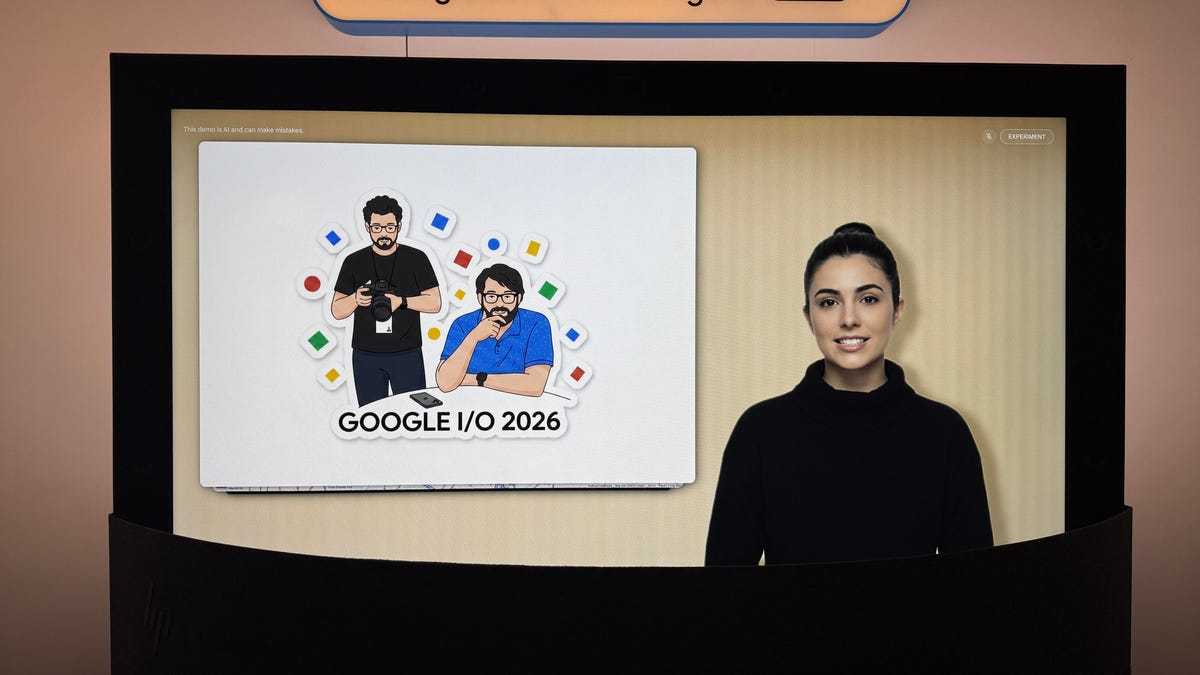
Sitting down in a comfortably air-conditioned booth in the overheated outdoor demo landscape at Google I/O this week, I had a pleasant and uncanny chat with a smiling person who wasn’t actually there. Nor were they even a real human being.
The booth was a demo setup of Google Beam, a large-screen camera-studded telepresence video screen device. As we talked eye to eye, it all felt shockingly real.
I’ve experienced Google Beam demos before, back when it was called Project Starline: with actual humans on the other end, in holographic glasses-free 3D. This was a whole new twist, and while the demo was 2D, it could easily adopt 3D rendering, too.
@scottsteinsayshi A hyper realistic uncanny AI video agent demo via Google Beam at Google IO. And yeah it made AI images of me. Where the heck is this going to end up and will it ever aim to replace a coworker…or end up in a hotel or theme park?
♬ original sound – scottstein89
Google’s planning a larger-scale rollout later this year for Beam, its business-focused collaborative video chat technology created with HP. Beam’s central idea is connecting two people remotely as if they were sitting across a table in person. That requires two people with Beams, though. Google’s next step is imagining situations where others are more easily brought in from other devices, or there isn’t another person, period.
Watch this: Is Google’s Uncanny Virtual Human a Future Coworker or Concierge?
The custom-made AI video agent, created with in-house models Google didn’t share, actually shocked me. Like a true deepfake, the woman-like agent was photoreal (the agent didn’t have a name, I just started talking with it), and smiled and gestured and talked with me casually. This agent was there just to help me and casually chat, just like Gemini or any AI chatbot.
I asked it to generate a photo of me doing magic tricks at a New York Jets game, and it happily served it up. It asked about prop bananas on the table and complimented my cameraperson’s backpack. It gave us map search recommendations from a contained demo experience delivered by a Google employee while I watched, as it gestured at the maps and images next to me.
Yes, me doing magic at a New York Jets game again — it’s my Will Smith pasta AI test.
It was uncanny. This video agent, even though it wasn’t in 3D (just standard 2D), was one of the realest almost-people I’ve ever chatted with before.
But do we need Beam? Many of us already have a telepresence readily at hand, in video chats on our phones. For those who want it, there’s connecting via VR headsets, or future iterations of telepresence as it might emerge on AR glasses. Microsoft just pivoted away from trying to evolve its telepresence realism in Teams. Will Google Beam make enough of a difference to businesses and institutions to convey a larger-scale sense of actual presence? And would an agentic video AI assistant make things helpful or awkward? And what jobs would an agentic video agent like this possibly replace?
According to Andrew Nartker, the general manager for Google Beam, who guided me through demos, this video AI agent is very much an experiment. But it’s also something that could land in an office as much as a public-facing location, like a talking interactive kiosk.
On the whimsical side, the demo made me think of theme parks. Would a 3D light field version of an AI character greet me at a food stand in some future Disney Star Wars Galaxy’s Edge expansion, serving me interplanetary food as it wrinkled its alien face? Would a theme hotel use it to create a magical experience? Or would it be used to replace actual concierges and workers in certain situations, a more advanced concept of the AI chatbot drive-through windows that already exist?
I can see all of these pathways at once. The Google Beam demo did impress me, though, and wowed me — and concerned me — more than almost anything else at this year’s Google I/O.
Read the full article here