


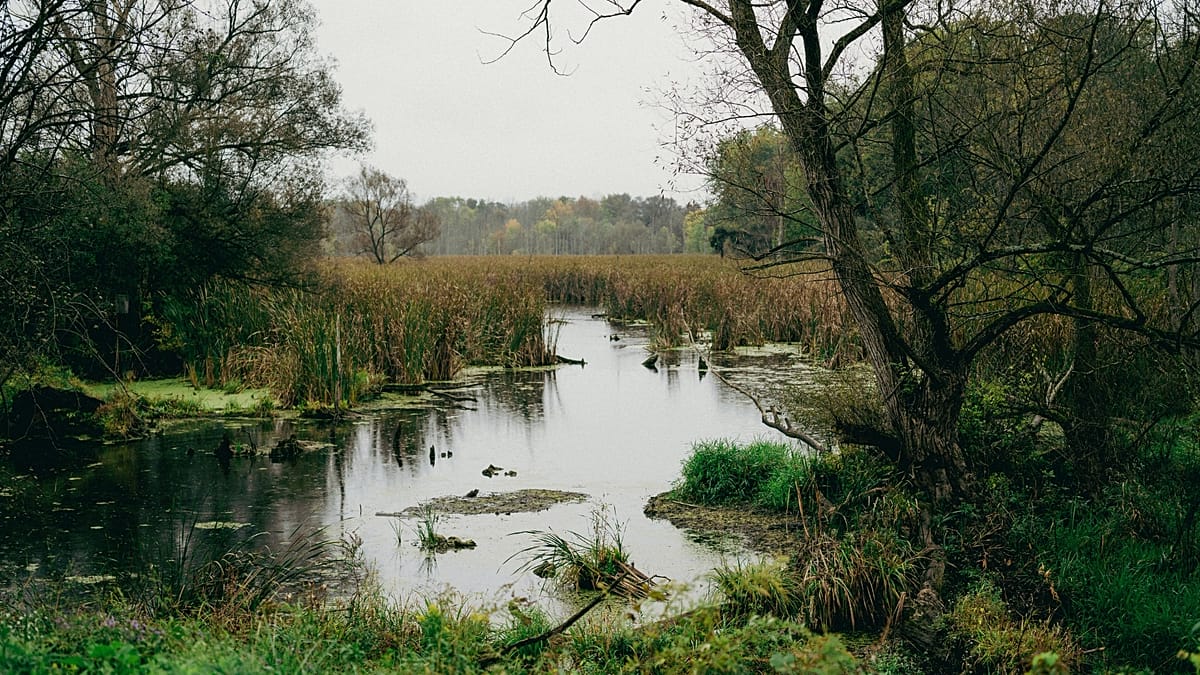
When people talk about defence, they usually think of tanks, drones or border fortifications. Peatlands are rarely the first thing that comes to mind. Yet their wetness, inaccessibility and limited passability make them a factor of relevance for security policy.
The Baltic states – Estonia, Latvia and Lithuania – are examining, as part of the Baltic Defence Line, how peatlands and other wetlands can be incorporated as natural barriers into border defence.
For Germany, the issue combines climate action, biodiversity, water management and defence planning at the same time: intact peatlands store carbon, retain water and can make movement across terrain more difficult.
Peatlands as a natural border
Anyone moving heavy equipment through boggy ground loses speed and situational awareness. What used to be regarded as an obstacle is now being reassessed strategically.
Prof Dr Hans Joosten, co-founder of the Greifswald Mire Centre and one of the world’s most renowned peatland researchers, explains in an interview with Euronews.
“Peatlands have shaped border regions everywhere in the world. You can see that the border between some countries – whether between Germany and the Netherlands, between Tomsk and Novosibirsk or around Lake Chad – is always formed by wetlands or peatlands. It is easier to defend these areas,” he says.
For heavy military equipment they are almost like a minefield only more humane, Joosten says. There are passages, but they are clustered in narrow corridors and can therefore be monitored much more closely.
Jan Peters, managing director of the Michael Succow Foundation, a partner in the Greifswald Mire Centre, sees the main security-policy leverage outside Germany.
“Within Germany, that is in fact a difficult case to make. Resources can be deployed most efficiently in the Baltic states and in Poland because there, along the EU and NATO external border, there is a direct threat situation, there are still many areas that can be restored, and land prices and conflicts of interest are significantly lower than here.”
Even so, the issue is increasingly coming into focus in Germany as well, not least because the Bundeswehr is establishing its first foreign brigade in Lithuania, bringing it into closer contact with precisely these regions.
Between climate and security
In Germany, policy on peatlands has so far been primarily environmental in nature. The federal government wants to rewet drained peatland areas in order to cut emissions, store water and safeguard habitats. Peatland researcher Joosten illustrates the scale of the issue: “Worldwide, 5% of all emissions come from drained peatlands. In Germany the figure is 7%, in Mecklenburg-Western Pomerania even 40%.”
From a climate perspective, rewetting is not a question of if but of when, Joosten stresses: “Ultimately, from a climate point of view, we have to rewet all peatlands anyway over the next 30 years. That is not optional.” The key question is whether climate action can be combined with defence where this makes sense.
Jan Peters, who works on peatland-related policy,points to the wider benefits of peatlands: “That is of course the big advantage – all these positive side-effects.”
He lists climate action, biodiversity and water availability; defence is now being added as a further argument.
A spokesperson for the Bundeswehr’s Federal Office of Infrastructure, Environmental Protection and Services told Euronews that natural obstacles in the form of wetlands affect the ability of both adversary and own forces to move and are taken into account in operational barrier planning. Rewetting could be “advantageous, but also disadvantageous for the conduct of our own operations.”
As Germany as a hub for NATO troop movements to the east, the country depends on open corridors. Rewetting therefore has to be weighed against military requirements.
Baltics and Poland: landscape as part of defence
The situation is more immediate in the Baltic states. They are closer to Russia and Belarus and think more in terms of spatial defence axes. There, rewetting is also being discussed as part of security planning.
According to the New York Times, Lithuania is planning to restore 6,000 hectares of peatland as part of its total defence strategy. Deputy Defence Minister Tomas Godliauskas described the peatlands, according to the report, as “an integral defensive line.”
Rewetting is cheaper than classic obstacles such as anti-tank ditches or minefields. The Lithuanian Environment Ministry plans to restore the areas over 30 years, guided by the EU’s nature restoration regulation.
Poland, too, is relying on natural barriers. The so‑called Eastern Shield will consist of 700 kilometres of defensive installations near Poland’s eastern border. One third of this is to be made up of dense wilderness that is difficult to penetrate.
Historical significance
The debate also has a historical dimension. Joosten points to the Prypiat peatlands between Belarus and Ukraine. When they were to be drained in the 1960s and 1970s, it was the Russian Defence Ministry of all institutions that became the fiercest critic.
“These peatlands stopped Napoleon, they stopped Hitler,” it argued at the time. The ministry opposed the intervention and lost.
The war against Ukraine has made this link visible once again. Flooded areas, swamps and impassable ground have been able to slow and divert Russian advances. In an information paper published in May 2025, the Greifswald Mire Centre points to historical examples ranging from the Dithmarschen farmers to the defence of the Ukrainian capital in 2022. Peatlands can act as natural moats because they hinder rapid troop movements and force attackers into predictable corridors.
Natural infrastructure for security
Prof Dr Stefan Bayer, research director at the German Institute for Defence and Strategic Studies (the Bundeswehr’s think tank in Hamburg) and a member of the German Council for Sustainable Development, considers peatland restoration to be relevant and compatible from a security-policy perspective.
In a response to Euronews he writes: “In addition to the various purposes of peatlands, such measures – if properly scaled – could also increase the efficiency of defence spending.”
At the same time, he points out that the issue is being taken up in the Bundeswehr as part of national defence planning and that countries on NATO’s eastern flank in particular, such as Estonia, Lithuania, Romania and Ukraine, should step up such measures.
Bayer also sees a degree of ideological inhibition when it comes to judging the choice of instruments: defence is usually associated with “heavy metal,” whereas peatland rewetting has for decades been discussed mainly as an environmental and climate protection issue. This example, he argues, shows that the much-talked-about Zeitenwende has not yet reached all parts of society.
Climate action remains the core
Despite the security-policy debate, the main reason for rewetting peatlands remains climate action. Intact peatlands are enormous carbon stores and important water reservoirs. They help to cushion drought, slow down flooding and preserve habitats for rare species. In Germany, around 95% of peatlands have been drained, according to Joosten. Without rewetting, climate neutrality cannot be achieved.
That is precisely why the new perspective is so striking: it does not set nature conservation against defence, but shows that the two fields can converge on certain questions. Stefan Bayer emphasises that peatland restoration simultaneously strengthens climate action, promotes biodiversity and supports national defence. Anyone who criticises this as a “militarisation of nature conservation” overlooks the fact that a single measure addresses three threats at once.
A politically sensitive advantage
Even so, Jan Peters calls for careful language. Peatland restoration must not be understood as a way of sealing off Germany from EU and NATO partners, but has to be conceived as a shared task within the alliance. For Germany, the issue makes most sense when it is placed in a European context.
A swamp on its own will not stop a drone or a cruise missile. But as part of a multi-layered defence architecture, peatlands can deliver what no concrete foundation can replace: they do not require maintenance, cost little and fight in silence.
Read the full article here