


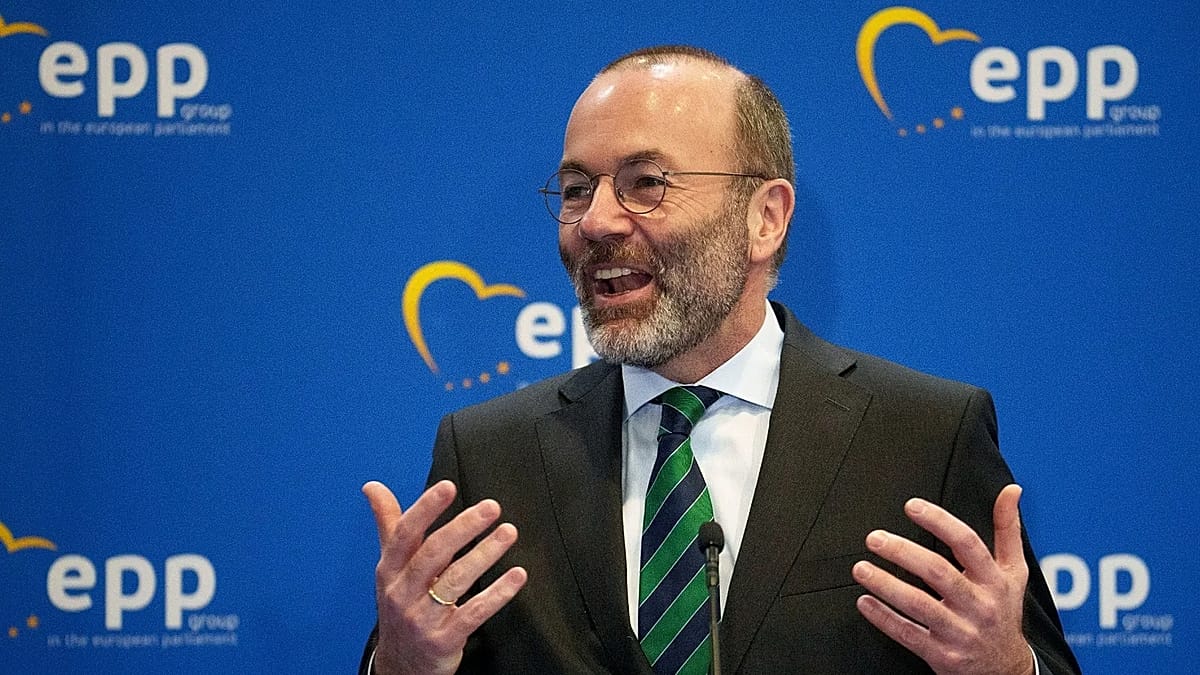
Spain’s massive plan to regularise undocumented migrants is “an issue” for all of Europe, according to senior MEP Manfred Weber.
In an exclusive interview with Euronews, the president of the European People’s Party (EPP) slammed Prime Minister Pedro Sánchez’s initiative, which has attracted more than 1 million applications from people already residing in Spain.
Weber said that even though the Spanish law granting residence permits that are not valid in other member states, the move would effectively enable migrant people to move around Europe and thus affect other Schengen countries.
“They can go to France, they can go to Belgium, they can go to Poland,” he told Euronews’ flagship programme Europe Today. “I would expect that [EU] leaders speak about this kind of massive, 1-million-people legalisation.”
Welcome and unwelcome
The EPP is taking an increasingly tough stance on migration, siding with right-wing and far-right parties in the European Parliament to pass bills that tighten migration rules.
Whereas Sánchez argues that immigration is essential to sustaining the country’s economy as its population ages, warning that Spain could lose 19 percent of its GDP by 2050 without it, Weber believes that the individuals set to be regularised in Spain are not the right ones.
“We need qualified people who can really contribute to our system. And that is not happening in Spain,” he said, arguing that while Europe needs legal migration to fill the gaps in the labour market, but a sudden regularisation of 1 million people in a few weeks is “not a normal procedure.”
The EPP leader also defended the EU’s new “return regulation” allowing the establishment of return centres for irregular migrants outside the bloc. The measure was recently approved by the European Parliament despite criticism over potential human rights violations.
“If someone is illegal, he has to leave the EU, and only 20 percent [of the returns] are enforced at the moment,” Weber said, arguing that return hubs in third countries will provide a solution to increase the number of repatriations.
However, he did not specify whether EU funds should be used or not to finance these centres, nor in which non-EU countries they should be set up.
“We have partners in Africa, in the Middle East, where we can work with. But it is now up to the member states,” he said.
Limits to asylum
According to current rules, any third-country national is entitled to ask for asylum in the EU, regardless of how he or she entered the European territory. In its general assembly on Tuesday in Vienna, the EPP adopted a resolution urging the European Commission to limit the right to asylum for certain groups of migrants.
According to the text, EU Member States should be granted the right to refuse asylum procedures at their borders “in cases of instrumentalisation” and when irregular migrants try to enter the EU from a third country that is considered “safe”.
Last February, the European Parliament approved a legislative change to dismiss some asylum requests, enabling EU states to deport asylum seekers to unrelated countries before their claims are processed.
The EPP now wants to go further, abolishing the status of subsidiary protection and excluding from the right to asylum any individual who is pushed to the EU borders by other countries’ instrumentalisation tactics, as was the case in recent years at the Finnish border with Russia or the Polish border with Belarus.
Watch Weber’s answers on migration in the video player above.
Read the full article here