


Two hundred and fifty years ago, 13 colonies fought to become the founding states of a new nation. Each of them is intrinsic to the story of the USA; no wonder, many families will choose to travel through America’s OG baker’s dozen during the year’s 250th anniversary.
But not all of their attractions are so obvious.
That’s why we’ve unearthed the most all-American attraction in each of these patriotic states to visit on your next only-in-America trip.
Virginia (1607)
In 2010, contractor Howard Hankins was hired to demolish the 20-foot high, 22,000 pound busts of Georges Bush and Washington, among others, that had been created in a failed attempt at a presidential park. Instead of smashing them, though, he dragged them to his own property where they still sit on what’s officially an industrial recycling facility.
He called his accidental attraction the President’s Heads, and it’s open on for self-guided or assisted tours on select weekends year-round; use the Scavenger Hunt on its website to keep kids’ entertained and make sure to wear sturdy footwear, it’s often muddy.
Massachusetts (1620)
If you’ve ever eaten in a diner on the East Coast, thank Worcester for the privilege: The city’s Lunch Car Company made more than 650 of them at its factory here, shipped by rail or truck in a single piece to their permanent homes. The local historical museum tells the story in depth, but better to tour some examples of its craft and sample the menus to see how they compare.
The well-preserved 1930s-era Boulevard Diner is a standout that’s open 24 hours from Thursday-Saturday or try the Miss Worcester Diner, a barrel-roofed design right across from the onetime factory.
New Hampshire (1623)
The radical Quakers known as the Shakers split off from mainstream America in the mid 1700s, earning their nickname for their rapture-like services. Since then, they’ve become more famous for the beautifully simple furniture they make to help fund their celibate, communitarian living setups — and one of the best preserved is Canterbury, which dates back to 1792. It’s a 700-acre site with around two dozen original buildings, as well as exhibits on Shaker life and original furniture. (You can pick up modern, locally made takes on the style from woodworker Stephen C. Barlow about an hour’s drive away in Harrisville.)
For the 2026 season, the Village is inviting local and regional visitors to “ReDiscover Canterbury Shaker Village,” featuring new programming, active preservation projects, and fresh experiences for people to rediscover the National Historic Landmark.
Maryland (1634)
The military’s been a mainstay of Annapolis since its founding (including its brief stint as capital of the newly formed United States for a year or so). Come here to see American naval might ats its greatest, via the Yard, that 300-acre or more waterfront campus right next to downtown where you can still watch drills and dress parades from enlistees right on the Chesapeake Harbor. Visit in mid-May for the ultimate experience, when newly minted grads from the academy scale the greased Herndon Monument aka the Plebe Climb in a tradition that dates back to the late 1940s.
Connecticut (1636)
Tom Sawyer and Huckleberry Finn helped shape the idea of American boyhood, so make a pilgrimage to the home of the man who dreamed them up: Mark Twain, whose 25-room Victorian home in Hartford is now run as a non-profit tribute. Book a guided tour to see the restored rooms, as well as documentary on Twain by Ken Burns and an archive of more than 50,000 doodads relating to his life. Don’t walk past the neo-Gothic cottage next door on Forest Street without pausing, either: his neighbor was Uncle Tom’s Cabin author Harriet Beecher Stowe, and that’s now a museum to her, too.
Rhode Island (1636)
Boardwalks, clapboard houses and the crash of the ocean: nowhere epitomizes an all-American summer more perfectly than the classic beach spots Narraganssett and Block Island. Think lobster rolls — grab one to go from Monahan’s Clam Shack by the Sea – plus the chance to bike to grab some ice cream — Nana’s soft serve is right by the town beach. Hop on a ferry over to Block Island for more dramatic scenery, including rugged bluffs and wide beaches, all of them easily walkable from the harbor.
Delaware (1638)
When the founding fathers cooked up a document they hoped would act as a template for the future of their fledgling country, the first colony to sign up for what became the Constitution was tiny Delaware. It trumpets that bravery via a series of historic sites dubbed First State National Historical Park. It comprises everything from an early courthouse to a Nordic church, built in the 1690s and a nod to the heavy Swedish influence once dominant here, as well as the onetime plantation home of John Dickinson in Dover, a k a, the Penman of the Revolution (so prolific in his writings, he was more like an Independence-era Substacker, hence the nickname)
North Carolina (1663)
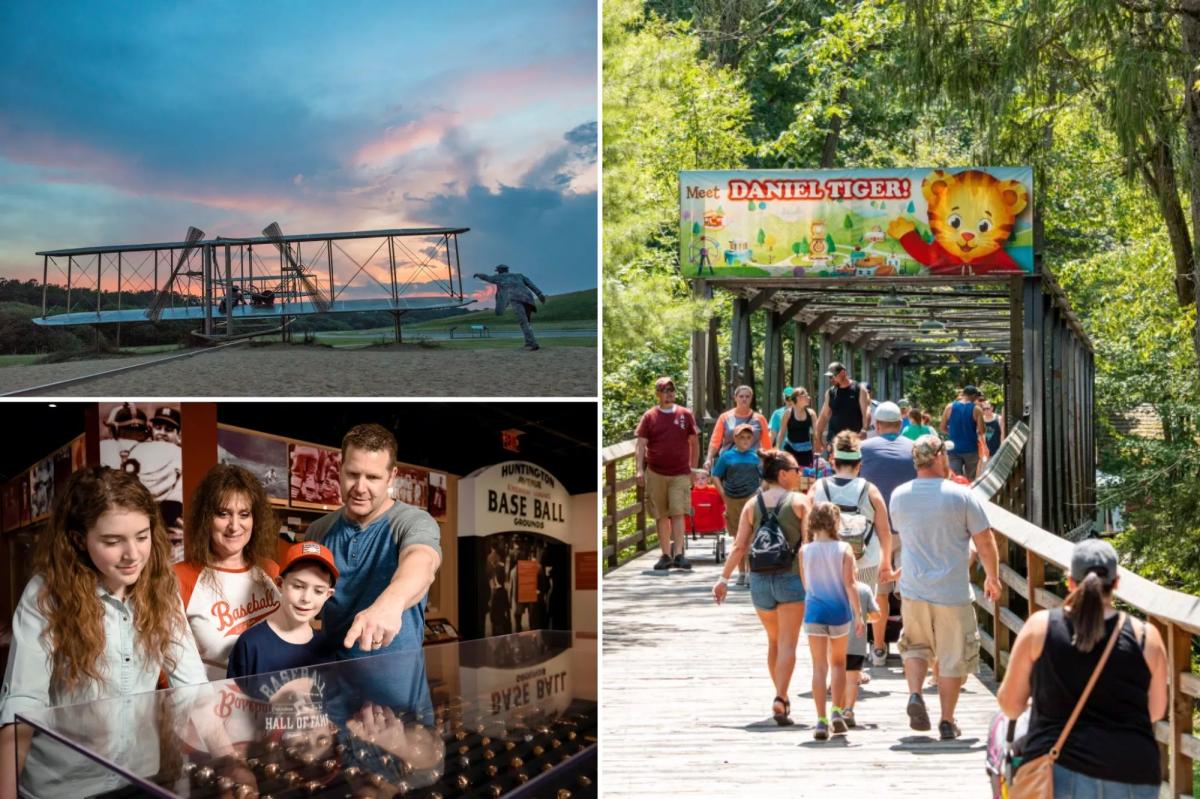
When you touch down at Norfolk airport to head to the Outer Banks, remember the Wright Brothers: they came to Kill Devil Hills to pilot their new contraptions (dubbed ‘flying machines’) which hoped to use the winds and soft dunes as ideal lift off and landing spots. The first ever controlled powered flights — lasting up to 59 seconds — took place right here in 1903, and the visitor center recounts the stories in depth. If you can’t fly a private plane, the next best thing in the OBX: kitesurfing, especially round Hatteras Island, where you can lift off for a few moments without an engine.
South Carolina (1670)
Head to Charleston to sample low-country cooking, the regional cuisine that’s a delicious mishmash of the cultures that were brought here, voluntarily or otherwise, after its founding. It was mostly West African chefs cooking for British families who remixed traditional European dishes with ingredients and flavors from Africa to create this cooking tradition.
Spots like Magnolia’s, Poogan’s Porch and Hyman’s Seafood serve up classics like shrimp-powered lowcountry boil, creamy, roe-enriched she-crab soup and the slow-cooked, rice-spiked stew chicken bog.
New York (1664)
It’s a shaky claim that Civil War general Abner Doubleday actually invented baseball in Cooperstown, upstate New York, in 1839 — it’s likely just an evolution of a classic bat and ball game — but embrace the story of the sport with a trip to this Norman Rockwell-ready town.
The National Baseball Hall of Fame on Main Street opened here in 1939 (Babe Ruth was among the first class of inductees) and remains a charming museum slash tribute. Superfans should mark induction weekend as the must-visit time; this year it’s July 24-27.
New Jersey (1664)
The Jersey shore is the ultimate all-American beach and there’s nowhere more appealing than the kitschy Wildwoods, a trio of towns at its far southern reaches. The towns were built as resorts in the 1950s, and the motels there cartoonishly designed with themes ranging from Polynesia to the Space Age.
There were once 300 or so operating, but now around 50 remain in the historic district, including the tiki-riffing Ala Kai and the restored Caribbean, which features a Tomorrowland-style ramp. One signature detail: the plastic palm trees everywhere, whose fronds are carefully removed for storage over winter.
Pennsylvania (1682)
Pennsylvania’s early emphasis on public transport deeded it an impressive network of trolley lines; picnic grove-style parks popped up at the end of them to act as lures for weekend getaways. They soon morphed into full-scale amusement parks, which sat by the roads which replaced those railways, so the state still contains the finest selection of rollercoasters and more dotted in a rough line from east to west. Hit Kennywood, with eight coasters including three dating back to the 1920s, as well as Idlewild, with its steam carousel and Knoebels, with more than 60 rides as well as its own campground.
Georgia (1732)
The World of Coca Cola is a fountain of pop culture at the heart of downtown Atlanta, a tribute to one of America’s most famous exports. The top-secret formula’s housed in a Vault here, as well as an array of memorabilia that recount its story dating back to the first place it was sold: Jacobs Pharmacy, about a half mile away from this spot. Make sure to head upstairs to Taste It, the Wonka-like area where you can sample beverages the firm sells around the world — and yes, see if you dare try a glug of Beverly, the bitter soda sold in Italy that’s the ultimate challenge.
Read the full article here