


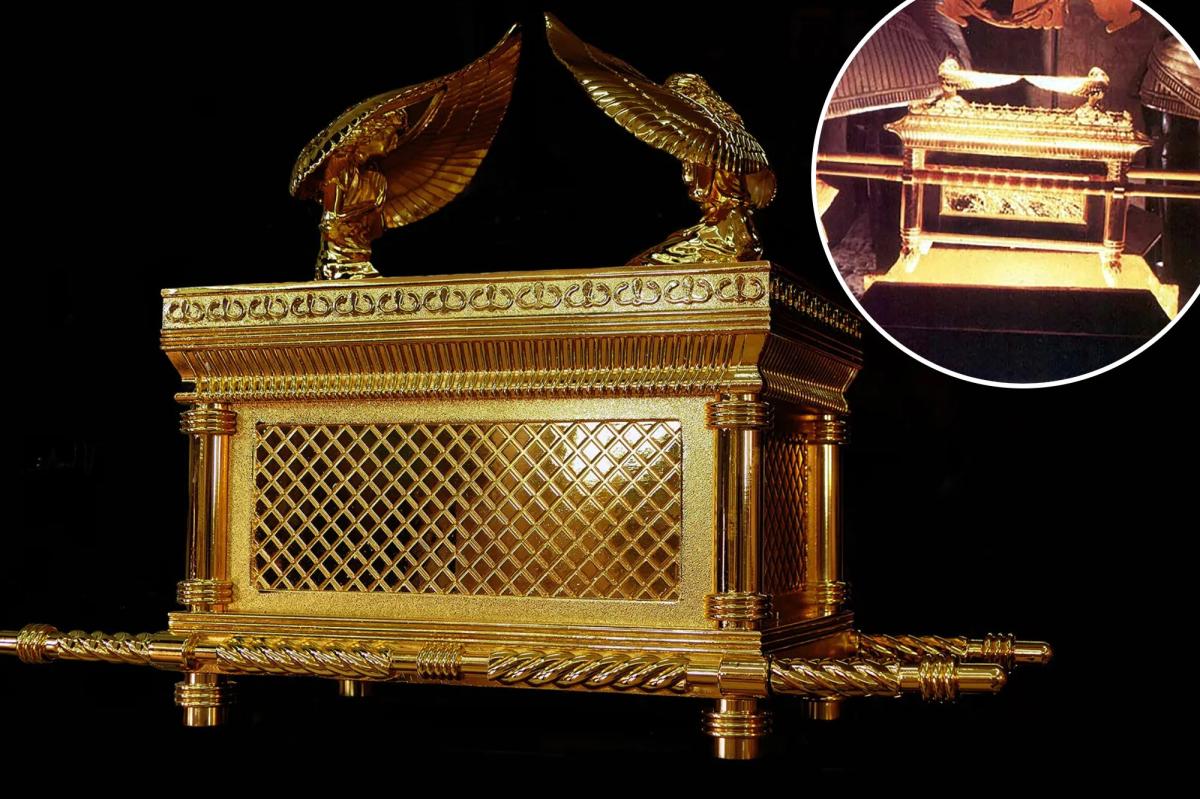
Could modern technology help solve the 2,600-year-old mystery of the Lost Ark of the Covenant? Archeologist Chris McKinny believes so, and unlike Indiana Jones, he’s not making it up as he goes along. “I’m not just grabbing a shovel and going to Jerusalem to dig for treasure,” he says.
McKinny, an associate professor at the Lanier Center for Archeology at Lipscomb University in Tennessee, has studied biblical texts and history for years and determined that the Ark’s final resting place could be in Jerusalem beneath the City of David, just south of the Dome of the Rock. His theory is discussed in detail in the recently released streaming documentary “Legends of the Lost Ark,” in which McKinny serves as host.
The film explores the legends surrounding the Ark’s possible locations after it disappeared following the Babylonian sacking of Jerusalem in 586 BC. According to lore, the prophet Jeremiah went to great lengths to hide the Ark from invaders. The most popular theory holds that he buried the artifact in the Temple Mount in Jerusalem.
The City of David, the heart of Jerusalem, is a key archeological hub, dating back over 3,000 years. It is where King David established his capital and is considered the birthplace of Jerusalem. The Temple Mount is north of the City of David and is overseen by the Jerusalem Islamic Waqf, a Jordanian-appointed religious trust. Despite all the excavation done in the surrounding areas, the Temple Mount remains, according to McKinny, an archeological mystery due to the difficulty of digging in such a sensitive area where the relics of historical eras are literally stacked on top of each other.
“We’ve mapped huge portions of…the City of David. We probably know more about Jerusalem’s archaeology than any other city on Earth, except maybe Rome and Athens,” McKinny says. “But the pinnacle, the reason people care in the first place, is the Temple Mount. And there, we only have a few hours’ worth of observations from 150 years ago and whatever we can get out of dumped rubble. “When it comes to the Temple Mount, the part people care about most, we have almost nothing. It’s a black hole.”
McKinny is optimistic that emerging technology will allow him and his team to digitally scan underground spaces beneath the Temple Mount, without disturbing sensitive territory. The archeologist suggests muon detectors, which track subatomic particles that come from cosmic rays striking our atmosphere, will be able to identify underground aqueducts, tunnels, chambers and concealed spaces. These cosmic-radiation devices were created by a team of researchers at Tel Aviv University led by renowned physicist Erez Etzion. The detectors can be used to scan earth and reveal hidden voids beneath rocks at ancient sites such as the Temple Mount.
Professor Etzion says muon detectors can make archeological digs more efficient by doing much of the work before a shovel ever hits the dirt. “The goal is to actually come before the excavation even starts and place detectors below the ground, map the area, do an imaging of the underground,” Etzion says. “So this is kind of an EKG before you actually do the heart surgery.”
“We’ve already demonstrated the proof of concept in the City of David,” McKinny says. “They put a detector in one chamber and showed they could ‘see’ a known cavern on the other side, and even picked up a small tunnel they hadn’t noticed before.”
The dream, according to McKinny, is to line the western and southern outer walls of the Temple Mount with muon detectors and let them passively scan into the rock and fill behind the retaining walls.
As fond as he is of the potential of this new technology, McKinny says there will always be a need for archeologists to get their hands dirty in the quest for history. “Technology is slowly catching up but archeology is by nature destructive,” McKinny says. “We’re never going to come to a time where we can
approach an ancient site, press a button and know everything about it. We have to get our hands dirty. There’s going to always be sweat… always going to be a certain level of manual labor involved.”
Anyone who’s seen the 1981 Harrison Ford classic “Raiders of the Lost Ark” knows the common perception is that the Ark is a gold-plated, highly ornate box said to contain the tablets of the 10 Commandments. Some observers, including McKinny, suggest the Ark could be detected somewhere below tons of rock, with the gold acting as a trigger for the muon detectors.
“I asked Erez point-blank, ‘Can this detect gold?’” he said. “His answer was yes, in principle, muons are sensitive to both voids and very dense anomalies. In that sense, gold is your friend.”
But the professor sounds more hesitant regarding the ability to make such a discovery. The muon detection system, he notes, measures density, not metal, and works best for big contrasts: huge empty spaces versus solid rock, or massive dense bodies versus lighter surroundings. A thin layer of gold over a wooden chest, buried under tons of limestone, is not exactly a neon sign.
“If you have a huge gold mine, then there’s a chance that the detectors will react, it will absorb more muons than normal…and therefore there’s a chance that you’ll be able to detect it,” Etzion says. “But if you’re talking about a small amount of gold, something that is gold plated, then there’s no way to actually distinguish between that. So kind of a thin layer of gold will do nothing to the muons.”
No active digging at the Temple Mount is underway yet. And before it begins, many political and financial hurdles will have to be overcome. A set of muon scanners that could work at excavation sites currently costs hundreds of thousands of dollars. But Professor Etzion is hopeful that the devices would eventually pay for themselves.
“I think at the end of the day we’ll be able to build something which is pretty generic,” Etzion says, “And they can be moved from one [location] to the other.”
Not far from the Temple Mount, another team is searching for clues to the Ark’s history. Researchers from the Associates for Biblical Research are digging around the ancient city of Shiloh. They believe they have discovered the Tabernacle, the Ark’s original home. The muon detectors could potentially aid this research as well.
For McKinny, the quest is about more than just discovering arguably history’s greatest artifact.
“The Ark is the big shiny object at the center, like the One Ring in “The Lord of the Rings,”” he says. “My first impulse is not, ‘Let’s go find it.’ It’s, ‘Why did people write these legends? What are they saying? How do they interact with the Bible’s own story?’”
There is no shortage of skeptics who think the search for the Ark is a fool’s errand, however.
Dr. Jeremiah Johnston, an author, pastor and president of the Christian Thinkers Society, says the “body of evidence” points to the Ark being destroyed or lost forever in the Babylonian catastrophe. “The Ark now holds no spiritual significance because the Ark as a symbol was completely fulfilled in Christ,” Johnston says. “I do not believe the ark will be found.”
He adds that it has “no spiritual significance” for Christians, since the New Testament presents Jesus as fulfilling and superseding what the Ark symbolized.
Tudor Parfitt, a British scholar and current professor at Florida International University, once wrote a book on the search for the Ark. Ask him his thoughts on whether it will ever be found, and he does not mince words. “They’re not going to find it,” Parfitt says. “The most probable conclusion is it does not exist anymore as a recoverable object.”
Parfitt says there is simply no plausible evidence to indicate the Ark exists. He says the fascination with the biblical artifact persists because of the various conspiracy theories that dot the Internet. “There are many legends about the Ark of the Covenant in different cultures,” he says. “But I’m a sensible person, and most Ark stories, and the people who chase them, are not sensible.”
Despite the naysayers, McKinny remains optimistic that history is within reach. But whether it is thanks to muon detectors or divine intervention, if the Ark is discovered, McKinny is certain of one thing. “I won’t be the one opening it,” he says.
“I’ve seen [Spielberg’s] movie.”
Read the full article here