


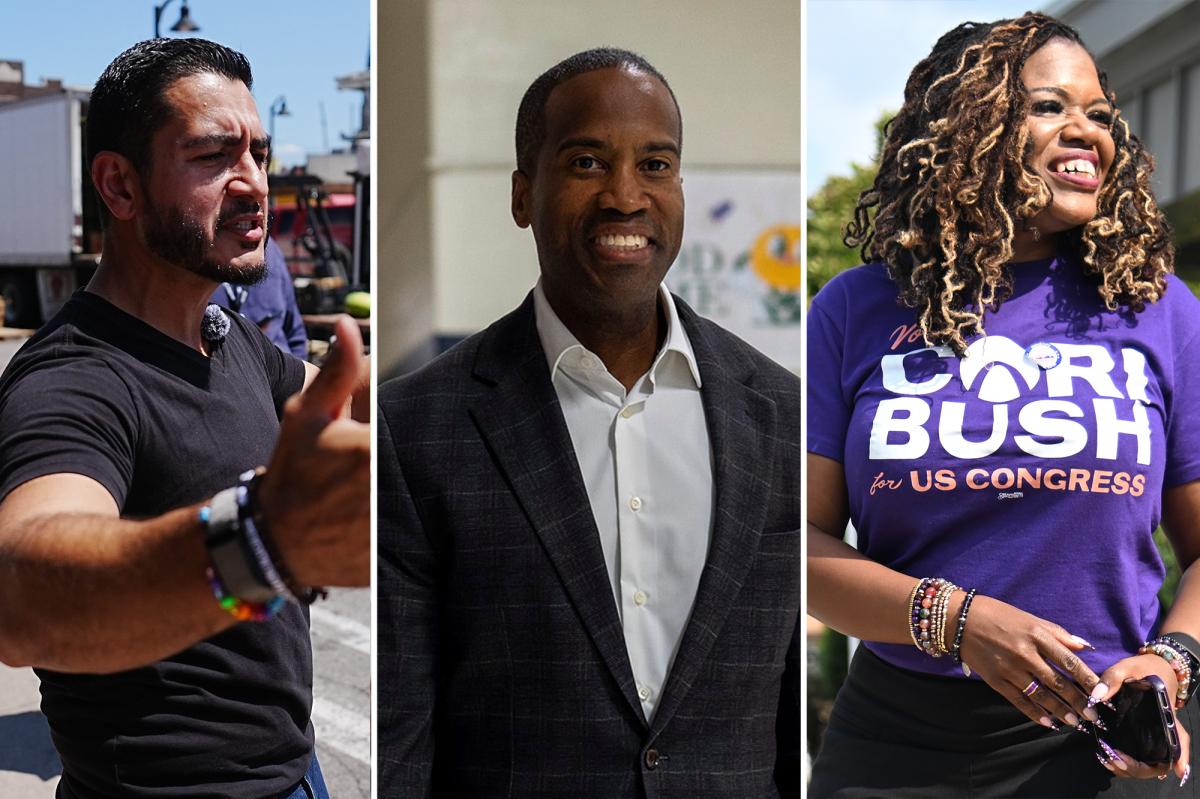
As Tuesday night became Wednesday morning, Michigan’s closely watched Democratic Senate primary remained uncalled, with progressive Abdul El-Sayed holding a narrow lead over Rep. Haley Stevens and seemingly on track to secure the nomination.
Elsewhere in the Midwest, voters rejected sweeping and transformative ballot measures, while Republicans once again overwhelmingly backed candidates endorsed by President Trump.
Here are five key takeaways from primary night in Michigan, Missouri and Kansas.
1. Sharp Democratic splits in Michigan
Before Wolverine Staters went to the polls Tuesday, many pundits were predicting an easy victory for El-Sayed over Stevens after no fewer than five surveys taken in the last month showed the former Detroit public health official up double-digits.
And then the results started coming in.
With 95% of the expected vote counted as of 7 a.m. ET, El-Sayed led Stevens by fewer than 20,000 votes out of more than 1.5 million cast, an unexpectedly close outcome whose effects could linger into the fall general election against the Republican nominee, former Rep. Mike Rogers.
While Stevens easily won rural areas and held her own in Detroit and its suburbs, El-Sayed ran up massive margins in the college town of Ann Arbor as well as the growing city of Grand Rapids, home of the young, white and college-educated voters who have flocked to the Democratic Socialists of America (DSA) elsewhere.
El-Sayed championed radical left-wing economic and social reforms, including “Medicare for all,” abolishing Immigration and Customs Enforcement (ICE), hiking taxes and ending US aid to Israel
Stevens, meanwhile, ran on a more pragmatic, centrist platform focused on protecting American manufacturing, lowering the cost of healthcare and boosting federal funding for education and infrastructure.
The “dueling Democratic visions” dynamic played out in a pair of key House races as well. In the 7th District, centered around the state capital of Lansing, moderates Bridget Brink — a former US ambassador to Ukraine and Slovakia — and ex-counterterrorism official Matt Maasdam split the vote and handed victory to progressive William Lawrence, founder of the left-wing, climate change-focused Sunrise Movement.
Like El-Sayed, Lawrence campaigned on “Medicare for all,” cutting off arms sales to Israel and implementing a federal moratorium on new AI data centers. He was endorsed by Sen. Bernie Sanders (I-Vt.) actor Mark Ruffalo, Democratic socialist congressional candidates Melat Kiros (Colorado) and Chris Rabb (Pennsylvania), and “Squad” member Rashida Tlaib (D-Mich.)
In the deep-blue 13th District, Sanders-backed state Rep. Donavan McKinney, a DSA member, led two-term US Rep. Shri Thanedar by just 3.2 percentage points with still a quarter of the expected vote left to count early Wednesday.
2. John James tries for high office again in Michigan’s gubernatorial race
Elsewhere in the Mitten State, Rep. John James (R-Mich.) clinched the GOP nomination for governor, teeing up a tough general election contest against Democratic Secretary of State Jocelyn Benson.
James, a two-time Senate candidate who narrowly missed out on unseating Sen. Gary Peters in 2020, has repped parts of suburban Detroit since 2023 and bested businessman and former GOP presidential candidate Perry Johnson by about 15 percentage points in the Republican primary.
Benson, who has served as Michigan secretary of state since 2019, cruised to victory in her primary over Genesee County Sheriff Chris Swanson by a whopping 66 percentage points.
James trails Benson by 7.3 percentage points in the latest RealClearPolitics average of polls.
Michiganders have not elected a Republican to the governorship since Rick Snyder won a second term in 2014.
3. Trump-backed candidates notch victories
James was one of several Trump-endorsed candidates who emerged victorious Tuesday night, further cementing the importance of the commander-in-chief’s support.
In Michigan’s 10th Congressional District – the seat being vacated by James – Army veteran Michael Bouchard cruised to victory with 72.2% of the vote after getting Trump’s stamp of approval in June.
Republicans are forecast to have a slight edge in the district, which covers Detroit suburbs in Oakland and Macomb counties, and Bouchard will benefit from a famous family name. His father Michael has served as Oakland County Sheriff since 1999 and as a state senator prior to that.
In Kansas, state Senate President Ty Masterson emerged from a field of seven GOP candidates to claim the nomination for governor with 40.5% of the vote.
Trump endorsed Masterson in May, calling it a “great honor” to support such a “fantastic candidate.”
Masterson is running to replace term-limited Democrat Gov. Laura Kelly. Like Michigan, Kansas last elected a GOP governor in 2014, when Sam Brownback edged out a re-election win.
4. Cori Bush falls short in comeback attempt
Incumbent Rep. Wesley Bell (D-Mo.) easily fended off a bitter primary challenge from former “Squad” Rep. Cori Bush, who had vowed revenge against the American Israel Public Affairs Committee (AIPAC) after her 2024 defeat.
Bush had hoped to ride the wave of anti-Israel sentiment that has propelled several far-left Democrats this cycle back to her old House seat.
However, she mustered only 36.9% of the vote in Missouri’s deep-blue 1st Congressional District, while Bell garnered 59.2% support.
In a wild rant after her 2024 loss, Bush declared that she had been radicalized and that AIPAC needed “to be afraid.”
“Let me say this, AIPAC, I’m coming to tear your kingdom down,” she said.
Bell received nearly $9 million in support from AIPAC and the pro-Israel group’s aligned super-PACs in 2024, but only about $3.1 million this go-around.
5. GOP-backed ballot measures fail in Kansas and Missouri
Voters in Kansas and Missouri overwhelmingly rejected a pair of Republican-sponsored ballot measures pushing for monumental changes to state government.
In Kansas, a proposal to make the state Supreme Court an elected office, with 6-year term limits, was opposed by 62% of voters.
Republicans, upset with the court’s recent support for abortion rights, pushed the initiative in an effort to do away with gubernatorial appointments.
In Missouri, voters turned aside a constitutional amendment that would have abolished state income taxes, with more than 82% voting to reject the proposal.
Republican Gov. Mike Kehoe supported the measure, calling it a “generational opportunity” to make the Show-Me State “more competitive” for jobs and outside investment.
Opponents, however, expressed concern that the state would have to expand other forms of taxation to make up for the loss in revenue.
Missouri would have been the 10th state to eliminate individual income taxes, joining Alaska, Florida, Nevada, New Hampshire, South Dakota, Tennessee, Texas, Washington and Wyoming.
Read the full article here