


Zap!
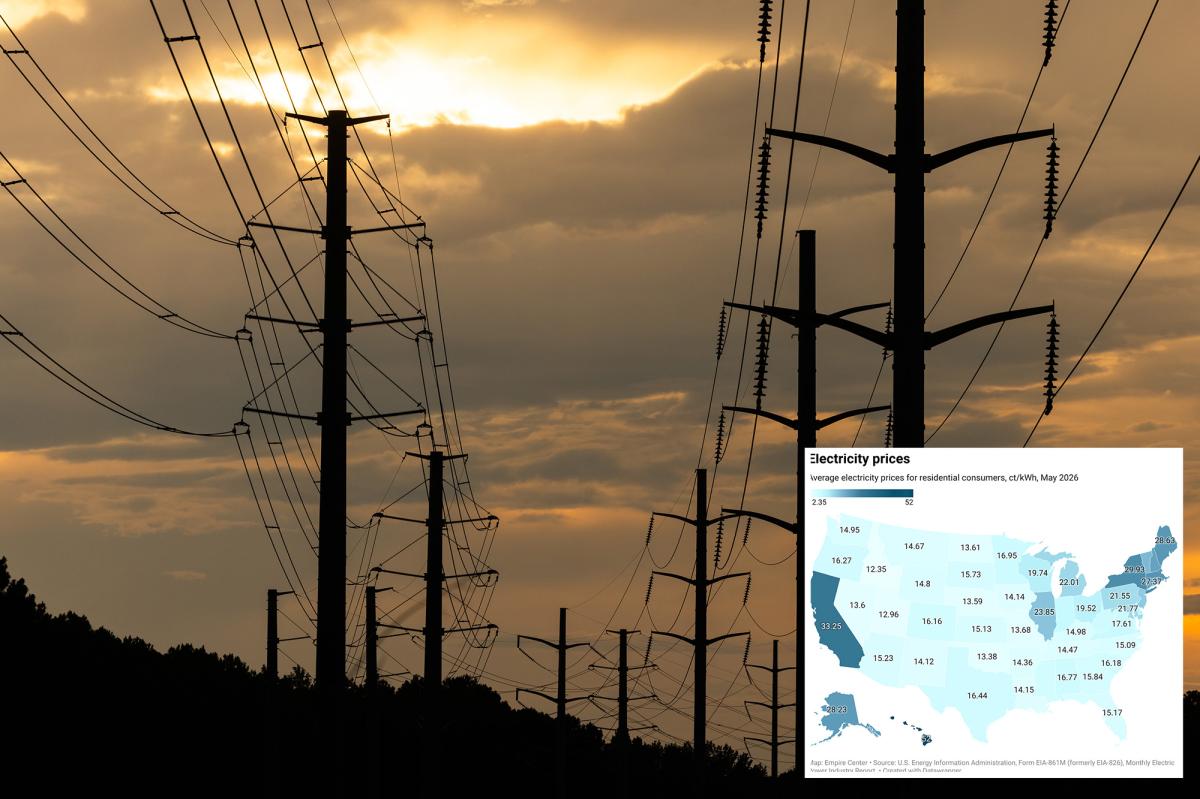
New Yorkers pay the third-highest residential electricity prices in the country — trailing only Hawaii and California, a shocking new report reveals.
Frustration over New York’s sky-high high energy costs has emerged as a top campaign issue in the governor’s race pitting Republican Bruce Blakeman against Democratic incumbent Kathy Hochul.
“Third highest in the nation is not where New York should want to be on electricity prices,” said Zilvinas Silenas, president of the Empire Center for Public Policy.
“If this is affordability, New Yorkers cannot afford it.”
New York’s residential electricity prices were a whopping 29.93 cents per kilowatt-hour in May, based on the latest federal data, the analysis by the Albany-based think tank found.
Hawaii came in at 52 cents per kilowatt-hour, and California at 33.25 cents per kilowatt-hour, the common billing unit for electrical energy supplied by a utility.
New York’s prices were 62% higher than the national average, nearly double Florida’s and more than 80% higher than Texas’.
Electricity prices in the Empire State also rose 12% from a year earlier — twice the rate of increase for the US average.
And New York has jumped in the rankings — from 8th highest among states last October and November, to 6th highest in December to 4th in April and 3rd in May, according to the Empire Center.
Meanwhile, New York’s average residential natural gas prices were 15% above the national average, and ranked 19th highest in the US, the analysis found.
“New York’s energy policy is contributing to the higher costs we have warned about for years,” said Silenas, adding increased electricity demand is also a factor.
Gavin Donohue, president of the Independent Power Producers of New York State said “the biggest culprit of high electricity rates in New York is high taxation.”
Transmission and distribution costs, taxes and fees and green energy mandates combined account for 70% of utility bills, he said.
At the same time, New York is not producing enough new energy capacity while closing older oil, gas and nuclear power plants, Silenas said.
The Indian Point nuclear power plant in Westchester County had provided 25% of New York City’s energy before it closed in 2021.
One energy expert said New York’s high-tax burden significantly contributes to the higher costs.
“The New York City property tax is the big distortion on the Con Ed bill,” said John Howard, a former member of the state Public Service Commission that regulates utilities.
Utility companies are also charged a gross receipts tax, a franchise tax and sales tax on commodities, and a “systems benefit charge” to promote solar and other clean energy investments, Howard noted.
Con Ed and National Grid are allowed to pass those costs on to customers.
Energy costs have emerged as a hot campaign issue in the governor’s race, with Blakeman blaming Hochul’s administration for approving 48 utility rate electric and gas hikes during her tenure, via the Public Service Commission. She appoints most of the PSC members who regulate the utility industry.
“Kathy Hochul’s utility bills are killing us,” Blakeman said.
“When I am governor, I will cut utility bills in half, repeal Hochul’s costly surcharges, and return $2.4 billion in unspent energy tax funds directly to ratepayers,” he vowed.
According to yearly average billing data from Con Edison and NYSEG, Hochul has presided over larger rate increases compared with her predecessor, former Gov. Andrew Cuomo.
Between Hochul’s first full year in office in 2022 and 2025, the average NYSEG delivery charge – the part of utility rates subject to the state’s approval – for upstate ratepayers spiked an eye-watering 75%.
ConEd’s average rates for the same period increased 25%.
Based on the same data, delivery rates only increased 25% for NYSEG and 9% for ConEd between 2016 and 2021, the bulk of Cuomo’s term.
Hochul, seeking re-election to a second term in November, pivoted earlier this year, forcing the legislature to delay implementation of mandates in the state’s green energy law — the Climate Leadership and Community Protection Act of 2019 — over concerns of rising costs.
The state will also be sending “utility rebate” checks out this fall, a clear signal that Hochul and her fellow Dems in the state Legislature are worried about backlash at the ballot box over massively increasing energy costs.
The state budget approved in May tapped $1 billion from the treasury to redistribute as $100 to $200 rebate checks ostensibly meant to help defray burdensome state utility costs.
The checks, however, will be based on residents’ 2024 income, regardless of whether someone actually paid utility bills.
Concerned about straining the power grid, Hochul also recently issued an executive order imposing a one-year freeze on opening energy hungry AI-driven data centers in New York State.
The Hochul campaign defended the governor’s energy record.
“Governor Hochul is putting energy rebate checks directly in New Yorkers’ pockets and taking on the big utility companies to bring down costs, but if ‘100% MAGA’ Blakeman had his way, New Yorkers would get stuck with higher bills, no energy rebates, no tariff refunds, and no help whatsoever while he and Trump jack up prices,” said Hochul campaign spokesperson Ryan Radulovacki.
“While the governor fights to bring down energy costs for families, Blakeman thinks Trump is doing an ‘amazing job’ as he signs legislation to jack them back up.”
Blakeman has called the rebate checks “a political ploy to buy votes for the election, and I tell you what, New Yorkers are not going to buy that.”
Read the full article here