


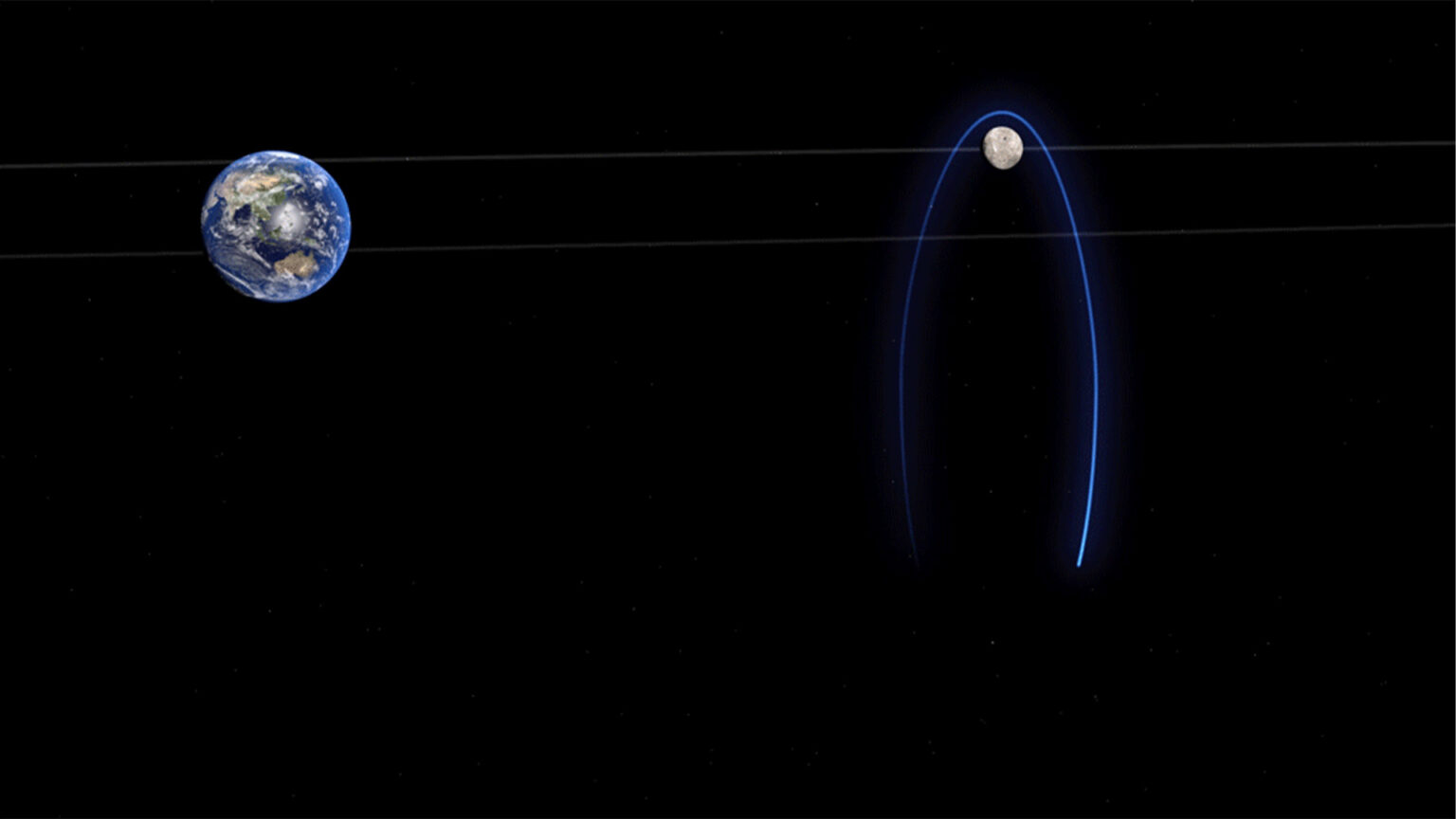
Historically, humankind has sent only one thing to the moon at a time so that it has the whole metaphorical highway to itself. But NASA’s planned moon base is expected to have a lot more concurrent traffic in the future, which means it’s time to start writing rules for a busier road. Engineers from Texas A&M, Purdue and NASA’s Johnson Space Center joined forces to help write some of those rules.
The system is outlined in a recent study, and it’s a lot more complex than one would think. Gateway and other spacecraft orbiting the moon are expected to use the near-rectilinear halo orbit, which takes spacecraft around both poles of the moon.
This is pretty simple for a single space station like the now-defunct Gateway space station, for which this control system was designed, but it gets complicated quickly when you have the Orion crew capsule, uncrewed cargo ships and lunar landers all sharing the same orbit, thereby necessitating the need for an air traffic control system similar to an airport on Earth.
“Collisions and serious damages could happen. To ensure crew safety and mission success, effective traffic management in the NRHO is crucial,” Diane Davis, associate professor of space engineering at Texas A&M and an author of the study, said in a statement. “The future of lunar explorations depends as much on the traffic management as it does on the rocket science.”
NASA announced plans for a moon base in March, aiming to establish a sustained human presence on the moon. This three-phase program would start with sending a bunch of stuff to the moon, building a base with nuclear power and other new technology and then finally staffing it with people who would stay there on a rotating basis. It’s expected to take most of the next decade to achieve.
Major Tom to ground control
There isn’t anything tangible that you can see with this traffic control system, but if you’ve ever flown in an airplane before, you have experienced it. Air traffic control on Earth is an intricate dance that helps airplane pilots know where to fly and where to land without colliding into other aircraft. That means managing holding patterns so airplanes don’t collide midair, assigning runways and making sure the sky is clear for aircraft taking off.
The control system for the moon isn’t much different in terms of basic functionality. Spacecraft coming and going might be headed for the surface or loitering around waiting for their chance to head back to Earth. These spacecraft have to be managed just like aircraft or they’ll eventually crash into each other, which is about as devastating as you can imagine. They also have to conserve fuel to keep costs low.
“Larger orbits at the moon that are suitable for staging an Orion and lander mission to the surface take many hours or days to make (a) revolution around the moon,” Davis told CNET in an email. “In order to keep propellant costs low, often there are particular locations along the orbit where it is most efficient to leave your loiter station and particular points where you want to meet up.”
There are many other difficulties, the most notable being that there is no physical airport. That means no tarmacs, no waiting rooms and no long lines for security checks and boarding passes. This “airport” is situated in orbit around the moon, using the orbital path itself as the proverbial tarmac, where spacecraft wait to either reach the moon’s surface or go back to Earth. Engineers had to figure out how to “park” spacecraft that are constantly moving.
“For us on the ground, and for spacecraft in low Earth orbit like the International Space Station, we can know almost exactly where we are thanks to the GPS (Global Positioning System) constellation,” Davis said. “But in lunar orbit, we don’t have an analogous system yet to give us a good measure of where we are.”
Davis says that once a spacecraft leaves the comfort of the GPS satellites, no one knows exactly where the spacecraft is, but they can estimate an approximate location by using radio signals from the Deep Space Network in California, Spain and Australia or by using optical instruments on the spacecraft.
The NRHO is not the most hospitable orbit. Spacecraft are subjected to gravity from the moon, Earth and other sources from deep space. They have to adjust constantly to avoid crashing into one another, falling into the moon or drifting into space. The new control system takes the NRHO’s quirks into account and successfully simulated multiple spacecraft in the same orbit without them crashing into each other.
Why the NRHO?
Why pick such a difficult orbit? NASA says the NRHO grants enough access to the lunar surface to send and receive shipments to the moon, but is far enough away from the lunar surface to not require constant fuel to avoid being dragged down by the moon’s gravity.
“Every spacecraft is constantly moving,” Davis said. “It’s a Goldilocks zone of keeping ‘parked’ vehicles far enough from each other to be safe, but close enough to their destination so that resources are used effectively.”
An interesting tidbit is that NRHO was chosen for the Gateway space station. NASA canceled the space station to skip directly to the moon base, so Davis says the agency is now considering other orbits since it doesn’t have to deal with a space station anymore, but the research still applies to whatever NASA chooses to do.
“To enable the ambitious lunar missions planned by NASA, bold new mission designs are being created,” Davis said. “These designs take advantage of the opportunities presented by the gravitational tug-of-war in cislunar space: These orbits often allow significant propellant savings and opportunities that just aren’t available with more familiar low Earth or low lunar orbits.”
The traffic control system is getting its first test with the Capstone 02 mission, which is expected to launch sometime next year, per Davis. It’ll get further testing with the next Artemis mission, which is also set for launch in 2027.

See full bio
Read the full article here