


General Charles de Gaulle used to talk about Europe stretching “from the Atlantic to the Urals”. At the time, he was defending a geopolitical project designed to reunify the continent as the Cold War split Europe into two blocs.
But in the midst of the current global geopolitical shift, could the Atlantic border extend to Canada?
Perhaps de Gaulle, who had a fierce desire for independence from the US, would have sympathised with Ottawa’s concerns and said “oui”.
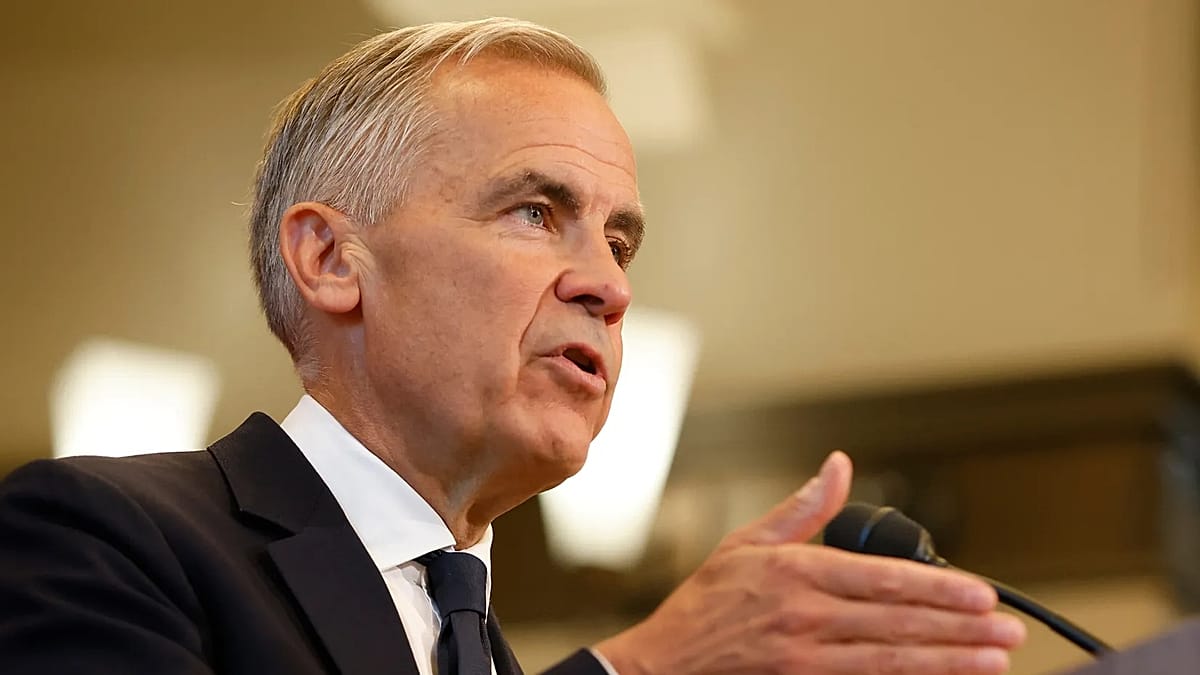
The arrival of Canada’s Prime Minister Mark Carney in Strasbourg in mid-September to attend the State of the Union address by European Commission President Ursula von der Leyen and then address the EU’s parliamentary assembly will be the first step in a rapprochement between Ottawa and Brussels.
Since last week, Canada has been waging a trade war against its historical ally, the US, a move that could lead Ottawa closer toward the EU. European Parliament President Roberta Metsola said in a social media post that the visit would be “an opportunity to deepen EU-Canada ties and strengthen our bond.”
But what shape will this new bond take – and would it be beyond the pale to think of EU membership?
An ocean apart
“Asking the question puts us somewhere between hope and constructive provocation,” Italian liberal MEP Sandro Gozi, from the parliamentary committee on constitutional affairs, told Euronews. The MEP thinks that the new geopolitical order makes the issue unavoidable.
According to a poll by Nanos Research published in April, 28% of Canadians support full EU membership, while 29% “somewhat” support it.
Geography, however, is a fundamental issue. Article 49 of the Treaty on European Union states that “any European State which respects the values referred to in Article 2 and is committed to promoting them may apply to become a member of the Union.”
The values referred to are “human dignity, freedom, democracy, equality, the rule of law and respect for human rights, including the rights of persons belonging to minorities”, but the term “European state” would appear to put a geographical limit on EU membership.
“The notion of a ‘European state’ is imprecise for countries on the continent’s margins, where questions may arise over Europe’s geographical boundaries, but it is clear-cut for countries that are manifestly outside the European geographical space,” Sebastien Maillard, special adviser at the Jacques Delors Institute, told Euronews.
In 1987, the European Communities rejected Morocco’s membership application as the country was regarded as an African state and not a European one, and the question was then debated after Turkey applied the same year. Turkey has only around 5% of its territory in Europe, with the rest in Asia. (Membership negotiations with Ankara have since been frozen.)
In the east, some geographers argue that the Caucasus is part of Europe, while others, on the contrary, consider it part of Asia.
“But there is no doubt that a Canadian in Vancouver feels far away from Europe,” Maillard added. “The EU is regional, it is not intended to have a global scope.”
Nonetheless, shared values and a common vision of the current geopolitical order, in which the US is challenging its historical alliances, are bringing Canada and the EU closer.
Last May, in Armenia, Carney travelled for the first time to a meeting of the European Political Community, the political forum of European countries launched after the start of the war in Ukraine to discuss strategic issues in Europe. Ottawa is also, with the US, the only non-European member of NATO, and is also part of the G7, as are EU members France, Germany and Italy.
Last January, in a speech at the World Economic Forum in Davos, Switzerland, Carney took note of the new geopolitical realities facing the West and urged fellow ‘middle powers’ to come together.
“Middle powers must act together because if we’re not at the table, we’re on the menu,” he said, adding that powerful nations were exploiting economic leverage to get their way.
A ‘transatlantic United Kingdom’
Another point of reference for what a Canada-EU relationship could look like lies just across the English Channel.
“Canada is somewhat like the “transatlantic United Kingdom” in relation to Europe: a state that is not a member of the European Union, but with which we share a genuine community of interests and values,” Eric Maurice, an expert from the European Policy Center, told Euronews.
After Brexit, the UK and the EU clinched the largest and most open trade and cooperation deal the EU has ever had. It has neither tariffs nor quotas, and has a broad scope encompassing not only goods but also public procurement, energy, fisheries, security cooperation and the participation of the UK in some EU programmes such as Horizon Europe, a research and innovation programme.
“In this new historical movement we are living through, we need to show creativity and imagination,” Gozi said.
While conceding that it is difficult to envisage Canada becoming a full member of the EU any time soon, he believes that “increasingly, if we look at the United Kingdom or Norway – which is part of the single market and cooperates with the EU in the field of defence – and now Canada, there is a need to develop new forms of association and special partnerships.”
The EU and Canada already have a trade deal, but there is room to push it further. Turkey and the EU share, for instance, a customs union. Access to the single market, where EU member states share four core freedoms of movement – of goods, persons, services and capital – is another step.
“Access to the single market would mean, however, that Canada would agree to align with European law without having a say in shaping it,” Maillard said. “Because when you are part of the European Economic Area, you adopt EU legislation without having a hand in shaping it. So that can be democratically frustrating.”
According to Gozi, the EU should consider a “special association” status with Canada that could include enhanced political dialogue, with invitations for the Canadian Prime Minister or Canadian ministers to participate in the work of the Council – where EU leaders meet and EU ministers vote on legislation – as well as joint work on defence.
The EU should seize a membership application from Canada as a political opportunity to brainstorm on reforms, Gozi said.
“The future of the European Union is to become a leading player in forging new alliances among democracies.”
Read the full article here