


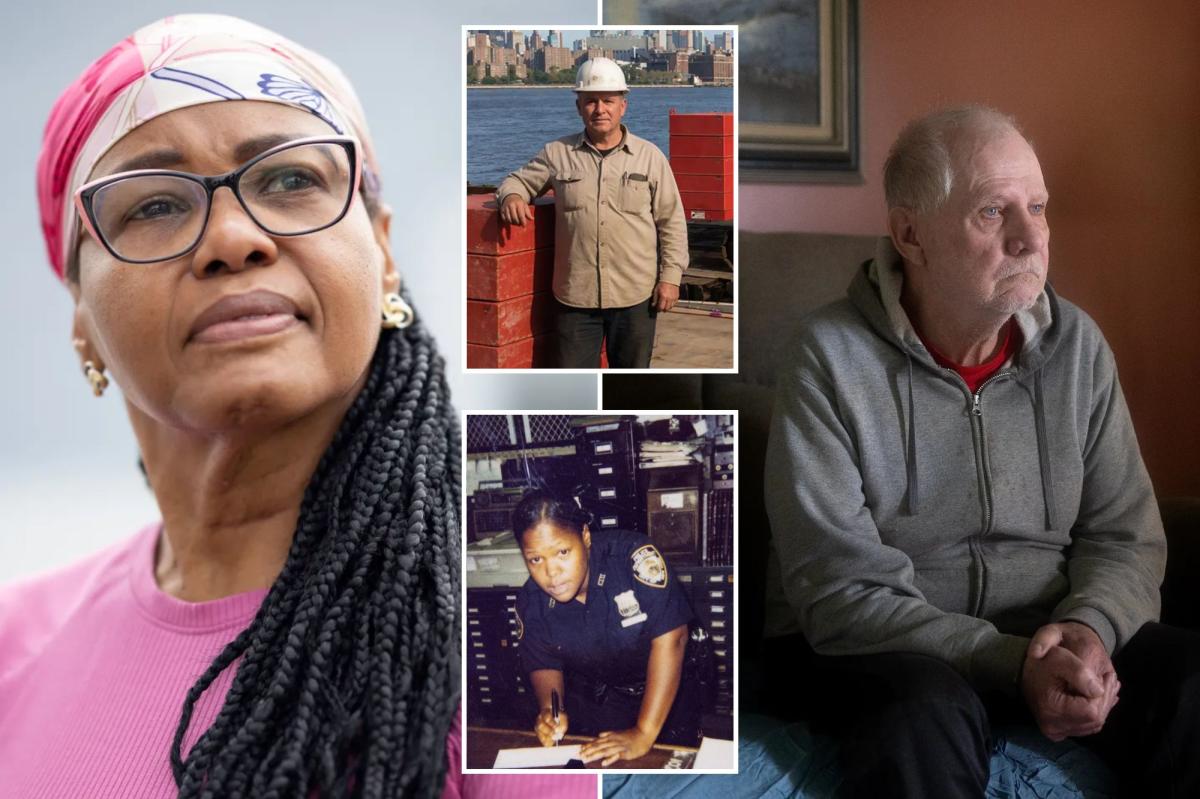
America promised to “never forget” the horrors of 9/11 — but a cruel medical time bomb is forcing Ground Zero heroes to do exactly that.
A growing body of research is connecting exposure to the toxic miasma at the World Trade Center site with early-onset dementia — with one landmark study finding severe exposure to cause a staggering 36-fold increase compared to the normal population.
The number of responders showing signs of dementia is almost certain to grow with continued monitoring – and has now reached 522 out of 6002 people studied – an alarming rate of 8.7%. That’s more than seven times the incidence in the general population.
Lucille Fredericks, 59, thought she would never forget what she saw in Manhattan driving around the city as part of an NYPD Queens South Task Force mobile response team after Sept. 11.
But these days, she’s not so sure.
Fredericks, 59, of Floral Park, has trouble remembering some basic tasks and concepts in her daily life – even words that are on the tip of her tongue.
“I get real frustrated because I’m trying to figure out what it is. It’s there – but I can’t get the right words to recall it. It gets me very frustrated,” she told The Post.
She noticed her memory beginning to fail after she left the force in 2005.
The landmark Journal of the American Medical Association study looked at 5,010 out of about 10,000 responders on Long Island from 2014 to 2023, when the median age of 9/11 first responders was 53. The average age of responders has now reached 59.
Responders who heroically braved the dust and debris after the attacks are suffering increased incidence of cognitive problems and even dementia later in life, the research shows.
The more they encountered toxic dust – often without protective gear – the worse the outcome.
The study, which was funded in part by the National Institute on Aging, has identified “cognitive dysfunction, cognitive decline, and widespread cerebral atrophy among severely exposed WTC responders at midlife as compared with expectations.”
The pulverized toxic particles made it inside responders’ brains either traveling through the nose or through the blood. The amount of exposure, and whether the responders wore protective gear, was critical.
In the general population, dementia rates are about 1.19 per 1000 person-years – a collective measure. But among those with “low” WTC exposure, the figure more than doubles to 2.95.
Among those with “mild” exposure, it hits 12.16. Among “high” it hits 30.09, and for those with “severe” exposure, it goes all the way to 42.37 – a 35-fold increase from normal.
Out of 5,010 responders who were analyzed in the study, there were 228 cases of dementia. “More severe exposure to dust or debris was significantly associated with a higher risk of dementia before 65 years of age,” the JAMA study found.
Responders taking part in the World Trade Center Health and Wellness Program at Stony Brook University are showing symptoms far earlier than the typical population. For some, it can be debilitating. For others, it causes daily struggles as they try to navigate their new lives and interact with loved ones.
Fredericks says her memory problems made it harder for her to continue her education and advance in her new career as a mental health therapist for troubled youth. “It holds me back. I try to cover it up because most of my staff that I work with, they’re 20, 30, 40,” she said.
The young ages at which responders’ symptoms appeared have alarmed medical researchers.
“People who are in their mid 40s or early 40s – it’s extremely rare for them to develop any cognitive impairment,” said Dr. Benjamin Luft, who directs the WTC monitoring program at Stony Brook.
“Our feeling was that there was a problem here,” he said. “As time went on, there was a significant number of people whose cognitive function continued to decrease. Today about between 3%-5% of our patients have developed what we’d call dementia,” he said. The program monitors about 13,000 responders overall.
“To have 3-5% of them to have dementia is very abnormal,” he said. “It portends something that can really be impacted into the future.”
The WTC Health Program’s new report that looked specifically at FDNY responders found that “a greater proportion of FDNY members with high WTC exposure reported cognitive concerns than those with moderate or low exposure,” concluding it was “highly related” to whether a member had PTSD.
“People who developed PTSD were more likely to go on to develop cognitive impairment,” noted Luft.
Meanwhile, researchers continue to probe the damage linked to World Trade Center dust particles that were attached to neurotoxins. The dust has been found to include Dioxyn, PCBs and heavy metals — which all can can disrupt brain function or the brain’s chemical signals.
The Samet family of Long Island is enduring the nightmare consequences of their father’s call to duty on 9/11.
John Samet, 74, an operating engineer with the city Sanitation Department, rushed to the WTC the night of the Islamic terror attacks, and spent 18 months at Fresh Kills landfill sorting through materials in the search for remains.
He developed post traumatic stress disorder, which his family links to the macabre work of sorting through debris in the search of human body parts, along with a sudden fear of going inside tunnels and subways.
“He came home one day and he just fell down on the floor and started crying and freaking out and he couldn’t remember anybody,” daughter Tammy Samet said. He couldn’t even identify a picture of his brother.
“He tried to almost jump in front of a train. And then it just progressively got worse,” she said.
Soon, Samet, was having trouble distinguishing visions from reality.
His severe dementia began in 2013, she said.
He forgot his wife of 56 years, Hope.
He began to wander away from the home where he’s lived for 50 years, including on a night when it was “freezing cold,” while wearing just a T-shirt.
“He lays in bed all day so we have to fight to get him into a shower,” said Tammy Samet, who lives in Alabama but has returned home to help out. “His dementia is getting worse and worse every day.”
The 9/11 Victims Compensation Fund has provided funding to help with some of the physical ailments like cancers and mesothelioma. But it doesn’t list his or other responders’ mental ailments as qualifying, which puts a financial strain on the entire family.
He gets anti-depressants, but they tend to make his dementia worse. He got a one-time payment of $80,000 to deal with gastrointestinal surgery, but that doesn’t come close to making up for the nearly $200,000 he used to earn working for NYC.
“It might take 20 years” to get relief, Tammy said. “But in 20 years, he’s going to be dead. We need the help now.”
Sebastian Pierini is dealing with some of those more severe symptoms identified by investigators.
Back in 2001, Pierini, 60, was an officer as part of the force protecting the NY Stock Exchange.
He got downtown just as the second tower came down and stayed non-stop for six consecutive days, sleeping at the office, he said.
Before 9/11, he had no problems and a good financial life.
Then he had a stroke in 2005 at age of 39 that his doctors trace to undiagnosed sleep apnea.
Suddenly he struggled with basic math and keeping up with tasks and appointments.
He hasn’t worked since. “It’s a tremendous strain,” he said.
The connection wasn’t direct or immediate, which is why researchers are still studying the population. Pierini says his symptoms progressed to atrial fibrillation – a heart rhythm disorder – which triggered the early stroke.
It’s frustrating when friends don’t understand.
“You don’t walk in my shoes — you don’t live in my head where I’m fighting with myself because of the simple tasks that I used to be able to do,” he said.
Read the full article here