


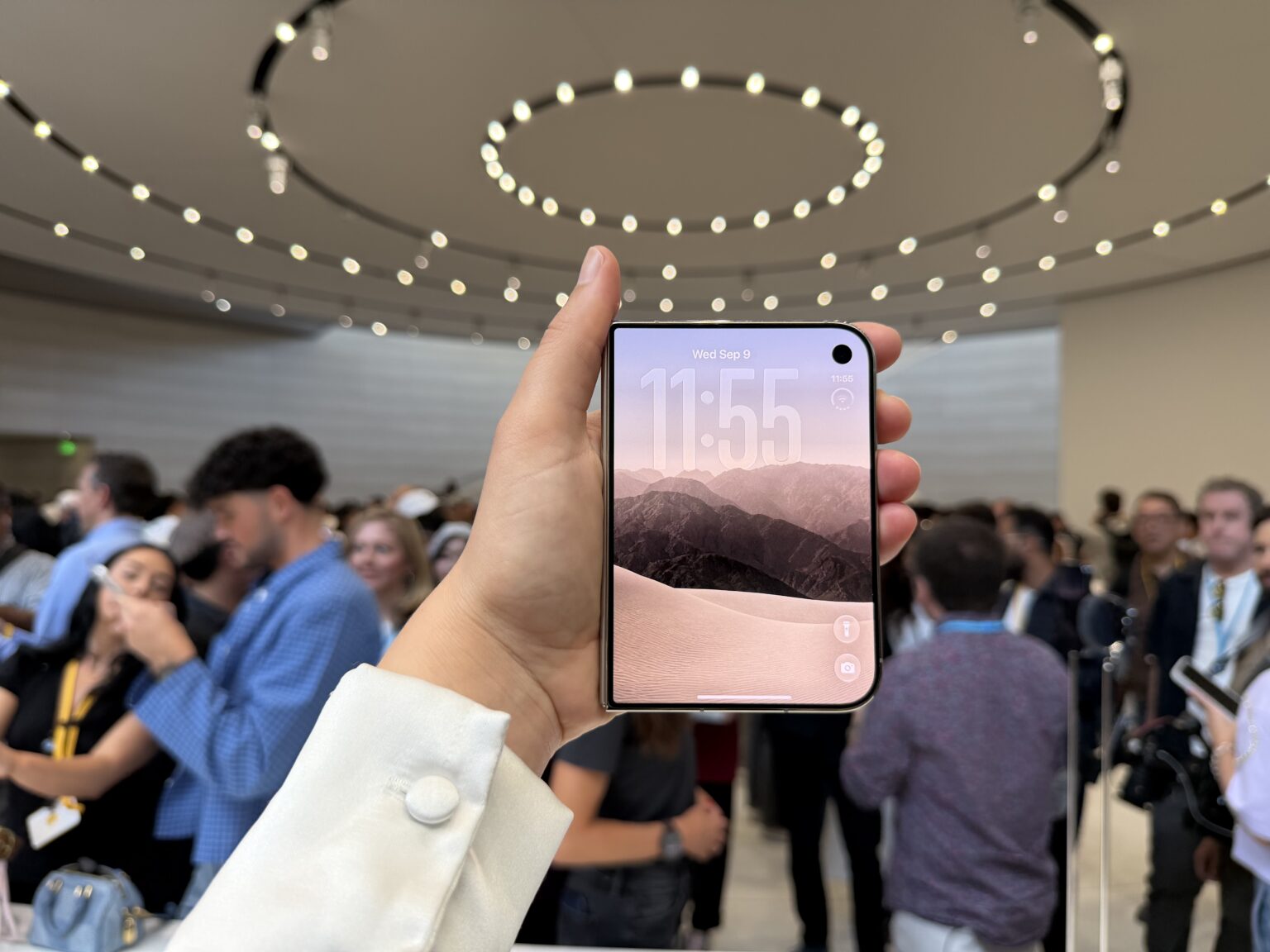
First impressions last a lifetime, and the iPhone Duo certainly made one when I got my hands on it at Apple Park earlier this month. But along with the intrigue came a handful of questions that I can’t wait to explore once the Duo becomes my everyday phone.
Apple’s passport-sized foldable iPhone, which opens for preorders Oct. 16 and launches Oct. 23, is designed to be versatile. You can quickly text or check notifications on its 5.4-inch cover screen, then unfold it to watch videos or multitask on the 7.6-inch inner display. Rotate it to portrait orientation, and it’s well suited to scrolling through vertical social content. Judging by how much I enjoy using Samsung’s similarly sized Galaxy Z Fold 8, I have high hopes for the iPhone Duo.
In my short time with the Duo, I got a glimpse of how Apple’s hardware and software work together to differentiate the phone in an increasingly competitive foldable market. But with this being Apple’s first foray into the space, I have plenty of questions I look forward to answering once I can test the phone.
Here are the five features I’m most eager to explore on the iPhone Duo.
How streaming will be optimized for the displays
One of the biggest draws of a foldable phone is the ability to watch videos on a larger inner display.
Traditional book-style foldables such as the Galaxy Z Fold 8 Ultra and Google Pixel 11 Pro Fold tend to have taller designs that resemble a slab phone when closed. When you open the phone to watch widescreen video, the content is letterboxed, leaving massive black bars at the top and bottom of the display. With a passport-sized foldable such as the Galaxy Z Fold 8, whose 4:3 aspect ratio is better suited for content consumption, those bars are significantly reduced, allowing more of the inner display to be used for video.
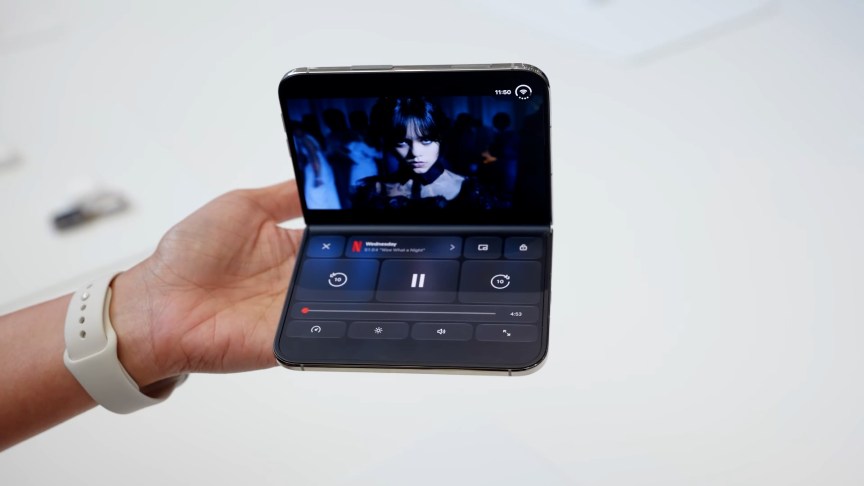
At Apple’s product unveiling, the company demonstrated how Netflix is optimizing its app for the iPhone Duo, ensuring content is well suited to both the phone’s cover and inner displays by reducing those black bars. The Duo sizzle reel shows similar customizations for Apple TV. The question is how other streaming services will customize their apps for the Duo’s 1.4:1 aspect ratio to deliver a more immersive viewing experience.
One standout feature of the iPhone Duo compared to other foldable phones is its matte main display reduces glare and the appearance of a crease. That can make it easier to watch videos under various lighting conditions, and I especially look forward to testing that under the bright California sun. It’ll be interesting to see whether colors look significantly more muted as a result of that matte screen, or if I hardly notice a difference. In my limited time with the phone, I didn’t sense there was a huge tradeoff when it came to the display’s vibrancy, but I also look forward to exploring that more.
Another element that could make on-screen content feel more immersive is the Duo’s “disappearing” under-display inner camera. While phones such as the Galaxy Z Fold 8 have a noticeable hole-punch cutout on the larger display, the Duo essentially hides its camera when it’s not in use. That means fewer visual distractions when watching TV shows and movies, while also keeping a tiny black hole from getting in the way of documents and other content on the larger screen.
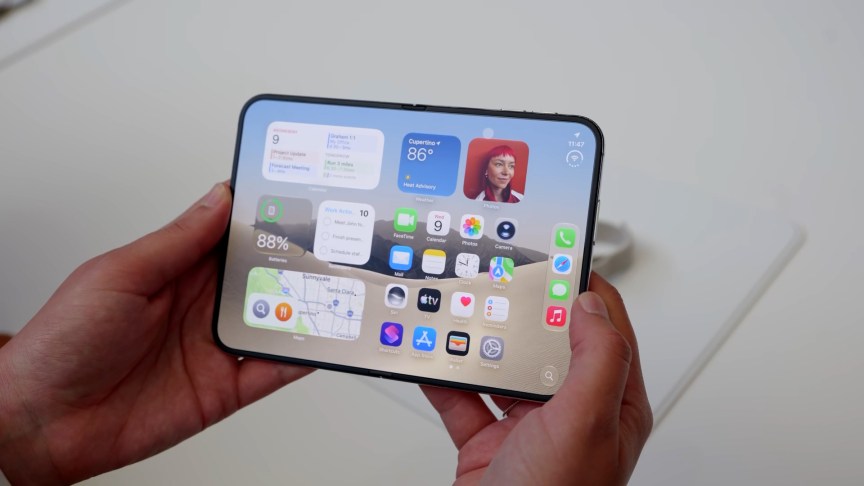
Notably, the Duo’s speakers sit on opposite sides of the foldable phone, with one set on the upper left half and the other on the bottom right. The Galaxy Z Fold 8, on the other hand, places both speakers on the left side. I was initially thrown off by the Z Fold 8’s slightly lopsided audio, but I’ll admit I quickly stopped noticing it as I continued to use the phone. Still, the Duo could have a noticeably improved sound experience because of its more balanced speaker setup, paired with Apple’s Spatial Audio.
It’s also interesting that the Duo’s volume buttons sit at the top of the phone when it’s held in landscape, therefore making the controls easier to access when the phone is rotated to portrait. That may be a slight adjustment for me at first, but I’m curious if I’ll end up preferring that arrangement as I swipe through endless reels.
The multitasking experience
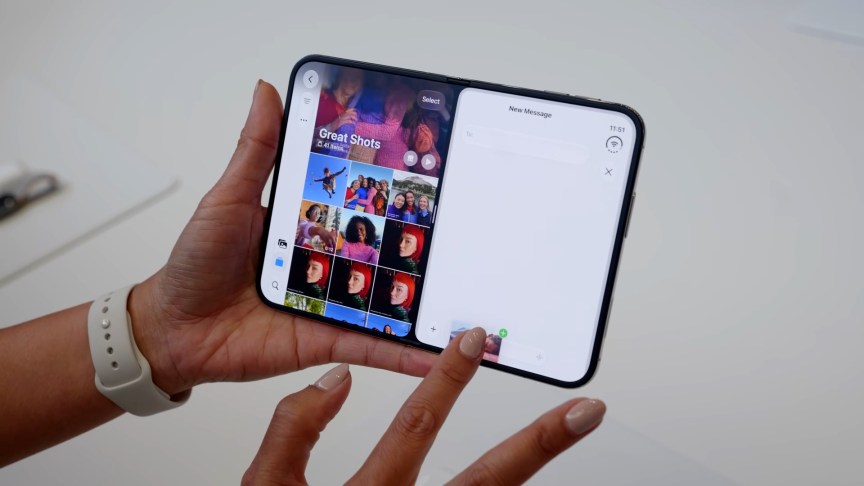
Another major perk of foldables is the ability to multitask. Unlike the Galaxy Z Fold 8, which allows for multitasking with up to three apps, the Duo is limited to two. That’s not much of a letdown for me, since I usually stick to running two apps simultaneously on the Z Fold 8 to prevent overcrowding.
Like other foldables, including the Galaxy Z Fold 8, 8 Ultra and Pixel 11 Pro Fold, you can easily drag and drop content across apps on the Duo. I played with this a little bit during Apple’s event by quickly attaching photos to text messages, but I’m curious how many other apps, both internal and third-party, will support this capability.
Apple Pencil support could really make the Duo feel like a tablet
The iPhone Duo has frequently been referred to as a hybrid between an iPhone and an iPad Mini, and one aspect that makes that especially true is its support for the Apple Pencil stylus. That support is slated to arrive later this year via a software update.
Rumors pointed to Apple designing a smaller Apple Pencil for the Duo, which never materialized due to “technical problems” before mass production, according to Bloomberg. Instead, Apple opted for its USB-C Pencil (but notably not the Apple Pencil Pro).
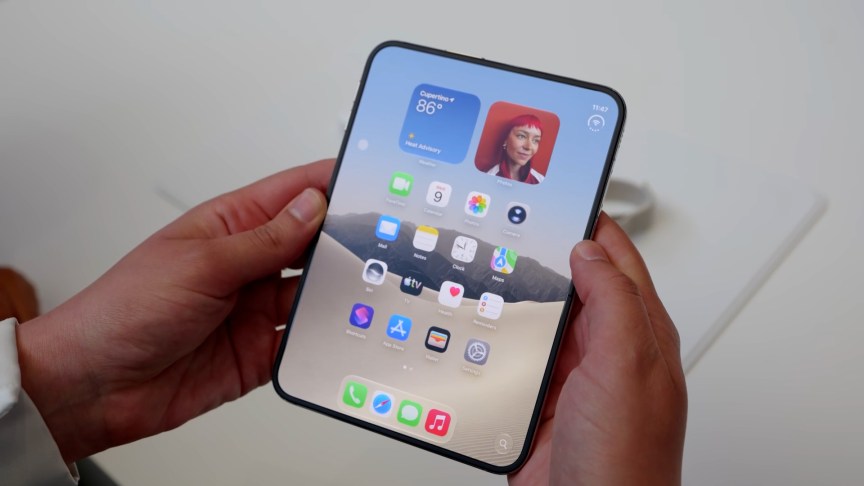
I’ve never owned a tablet; I haven’t been able to muster a strong enough reason to spend hundreds of dollars on what I see as a larger and less capable version of a smartphone. Foldables are a happy medium for me, allowing me to use a compact or standard-size handset that doubles as a larger canvas for watching, working and multitasking. Stylus compatibility could elevate the Duo above competitors such as the Galaxy Z Fold 8, which doesn’t have S Pen support.
That said, I hardly ever reach for the stylus on the Galaxy S26 Ultra, because typing and swiping with my fingers feels so much more intuitive. But having the option to use the Apple Pencil with the Duo is a plus either way. I’ll have to see if it opens my eyes up to a world of tablet-like productivity I’ve been missing out on.
Camera performance
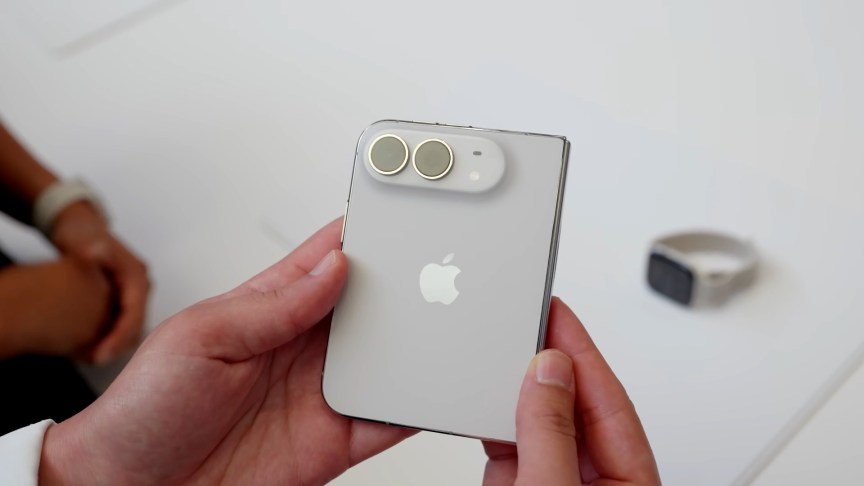
Foldable phone cameras have long had a bad rap, given that early models had less room for larger image sensors and lenses. This resulted in images that were significantly downgraded from what you’d get on a flagship, despite the high sticker price.
That gap has narrowed in recent years as both camera hardware and foldable design have evolved to become sleeker and more capable. Phones such as the Galaxy Z Fold 8 Ultra and the Pixel 11 Pro Fold have impressive cameras that may not be quite on par with their non-folding premium counterparts, but that still deliver great images.
The iPhone Duo appears poised to offer up similarly high-quality shots, with a 48-megapixel main camera and a 48-megapixel ultrawide camera. Like the Z Fold 8, though, there’s no telephoto camera. I was mentally prepared for this omission, given my experience with Samsung’s passport-sized foldable, and I don’t really mind the absence of a telephoto lens on that device. That said, it is disappointing when a phone in the $2,000 range doesn’t have the most specced out rear camera setup.
The biggest looming question is how good the iPhone Duo’s internal selfie camera will be. In its tech specifications, Apple simply refers to it as an “under-display FaceTime camera” that supports 1080p video recording at 30 or 60 frames per second — but no official word on the megapixel count. This implies it may be a step down from the 12-megapixel selfie camera on the front of the Duo.
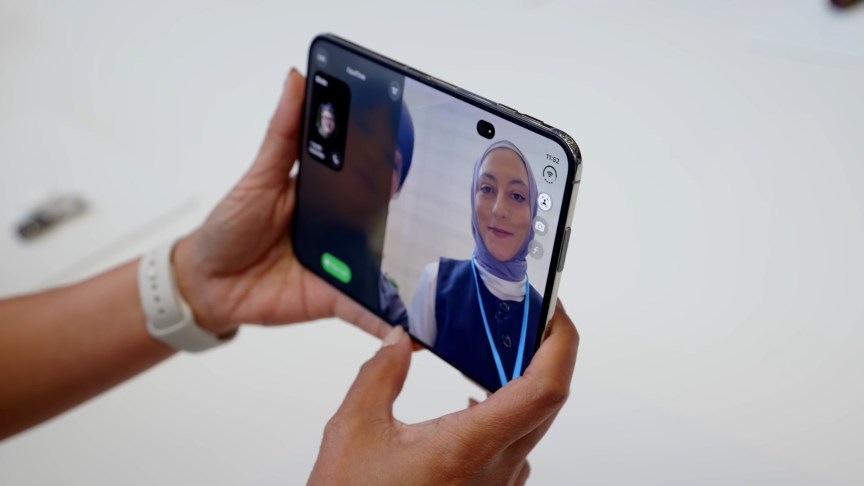
To be fair, apart from when I’m testing a foldable phone’s cameras, I rarely ever opt for the inner selfie camera because it doesn’t feel like a natural way to snap an image, especially when the cover screen camera is right there. Plus, to get higher-quality images, you can use the Duo’s Smart Take feature to see a preview of your shot on the cover screen when using the rear cameras. So there are better options for taking a photo than using the inner selfie camera.
I look forward to seeing how all the Duo’s cameras perform once I take it out and about beyond the confines of Apple Park.
How good will battery life be?
For some people, battery life will be the make or break element. How long will the iPhone Duo last as you endlessly scroll, stream and snap photos?
Apple says the iPhone Duo will give you up to 31 hours of video playback on the inner display, and 44 hours when using the outer screen. When equally spilling your time between both, the company says you’ll be able to go 24 hours before needing to charge.
With more traditional book-style foldables such as the Galaxy Z Fold 8 Ultra and Pixel 11 Pro Fold, I tend to stick to the cover screens because they’re so similar to the dimensions of slab phones that I forget there’s a larger display inside. Palm-sized phones such as the Z Fold 8 help to remedy that by giving me more incentive to unfold the device and use a larger canvas, and the Duo falls in that camp.
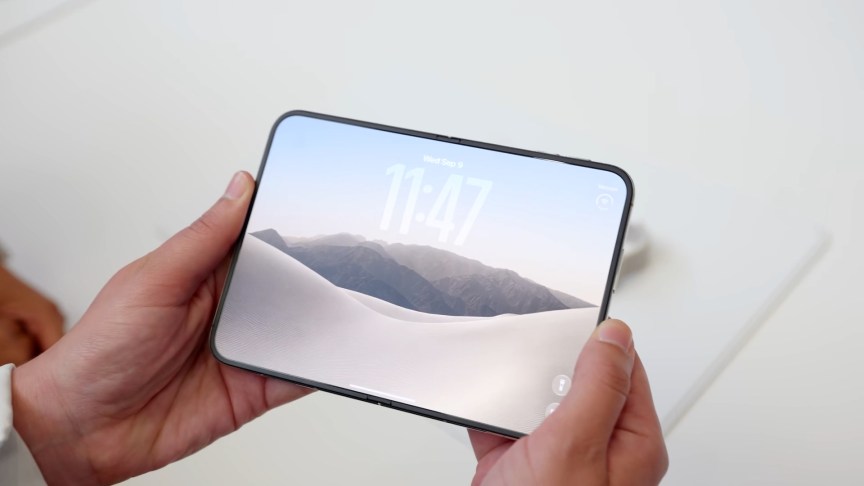
With that in mind, I’m curious how well the Duo’s battery will hold up as I frequently hop between the cover and main displays. Unlike Samsung’s latest foldables, the iPhone Duo doesn’t have a silicon-carbon battery, which can increase energy density and speed up charging time. Still, Apple says the iPhone Duo can charge up to 50% in around 20 minutes with a 60-watt adapter or higher.
The Duo does have the advantage of MagSafe support with Qi2.2 wireless charging up to 25 watts, like the Pixel 11 Pro Fold. By comparison, the Z Fold 8 and 8 Ultra don’t have built-in magnets, so you’ll need a Qi2-compatible case to tap into wireless charging. While it’s probably smart to slap a case on your nearly $2,000 iPhone Duo, it’s nice to know it’s not necessary for painless wireless charging.
Now, the countdown is ticking. Until I can put the Duo through its paces in the real world, the verdict on this — and the many other questions that are bound to arise — remains out.

See full bio
Read the full article here