


Depending on where you live and what comes out of your tap, you may need to do damage control with the water that goes into your coffee machine, kettle, or French press. Water quality can greatly affect coffee outcomes, both by preventing off-flavors and aromas and by providing the right mineral composition to interact with the coffee’s aroma and flavor compounds.
When I previously spoke with Jose Lepe, director of sourcing and quality control for Sightglass Coffee, about whether you might need to use filtered water for coffee, he pointed out that “water hardness is part of what is going to make your coffee taste right, so you need some of that minerality in coffee to help pull out the actual flavors.”
The Best Drip Coffee Makers for 2026
High-end coffee shops typically use a water system that relies on reverse osmosis, which distills local water into its purest H2O form, then remineralizes it for the perfect balance. Not every major coffee city relies on a system like this, but in places like Los Angeles, which (according to Lepe) has famously terrible water for coffee, this is definitely in play.
Believe it or not, you can re-create this exact process at home without any five-figure specialized equipment.
Why consider making water for coffee?
There are a few good reasons to tackle bespoke coffee water recipes. Consider the mineral composition of New York City tap water, often upheld as the liquid gold standard. NYC’s water is soft, with low concentrations of dissolved minerals such as calcium and magnesium and trace amounts of sodium, according to NYC.gov.
I spend much of the year in London, where the tap water ultimately tastes fine, but the mineral composition can quickly choke the life out of any coffee machine with narrow water conduits if it isn’t treated with a descaler. (Do I know this firsthand? I do. RIP steam wand.) London’s water has about eight to 10 times the calcium content of New York’s. Las Vegas, Indianapolis and San Antonio are just a few US cities where the water is almost as hard as London’s and considered extremely hard.
Best Water Filters and Dispensers, Lab-Tested by CNET
Water hardness can be somewhat fixed with filtered water, but filtering water removes most minerals without putting any back in. It’s not as bad as pure, distilled water (more on that below), but you’re not getting the most out of your coffee experience. The real reason to try a “water recipe,” frankly, is to save your devices while nerding out for the best possible cuppa. We’re into that kind of thing here.
What is remineralized water?
Rather than relying on filtered water, remineralized water is simply distilled or reverse osmosis water that has certain minerals added back in, specifically sodium bicarbonate and magnesium sulfate, according to a precise ratio. You can easily find distilled water in your grocery store or pharmacy shelves, but the other two? You can also find them in the same place. Sodium bicarbonate is commonly known as baking soda, and magnesium sulfate is sold as Epsom salt.
We’ll get into the ratios later, but if you’re not in the mood to turn your kitchen into an ersatz chem lab, brands like Third Wave Water and Lotus also offer simple mineral packets to add to distilled or reverse-osmosis-filtered water.
An actual recipe for coffee water
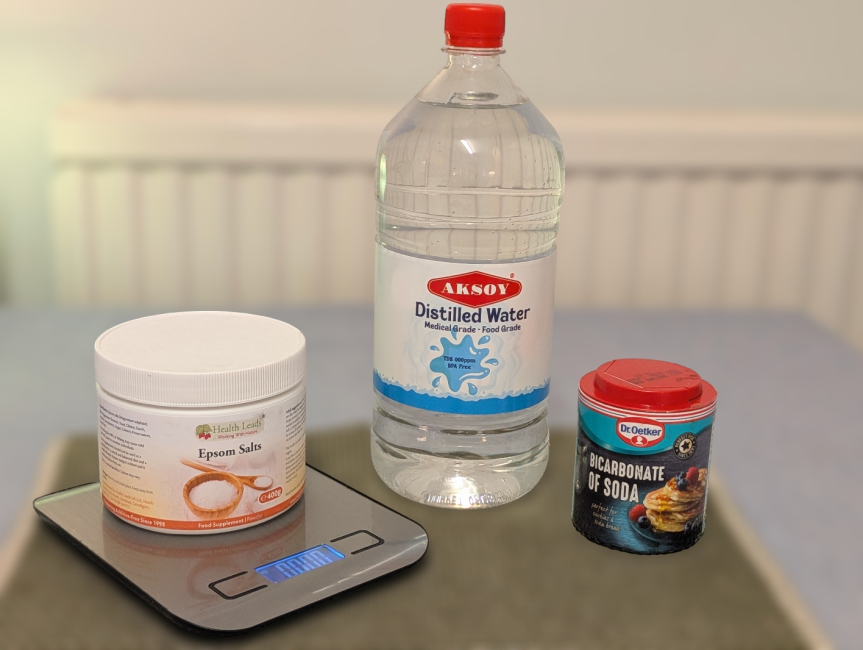
Digging into Reddit reveals a common DIY water recipe: add 0.25 grams of baking soda and 0.76 grams of Epsom salt to 1 gallon of distilled water. (This is the ratio the Specialty Coffee Association suggests.) You’ll notice this recipe relies on a kitchen scale that measures to the hundredth of a gram, unless you can scale up to 10 gallons of water at a time.
Without that particular piece of equipment, another potentially simpler method that doesn’t rely on a scale at all involves using standard measuring spoons to make liter-size batches of mineral water concentrates, one with Epsom salt and one with baking soda, and then adding easier-to-measure portions of the liquid concentrates to a larger quantity of distilled water. (If this is sending you back several paragraphs to look into those ready-to-use packets — I concur.)
The perfect coffee water taste test
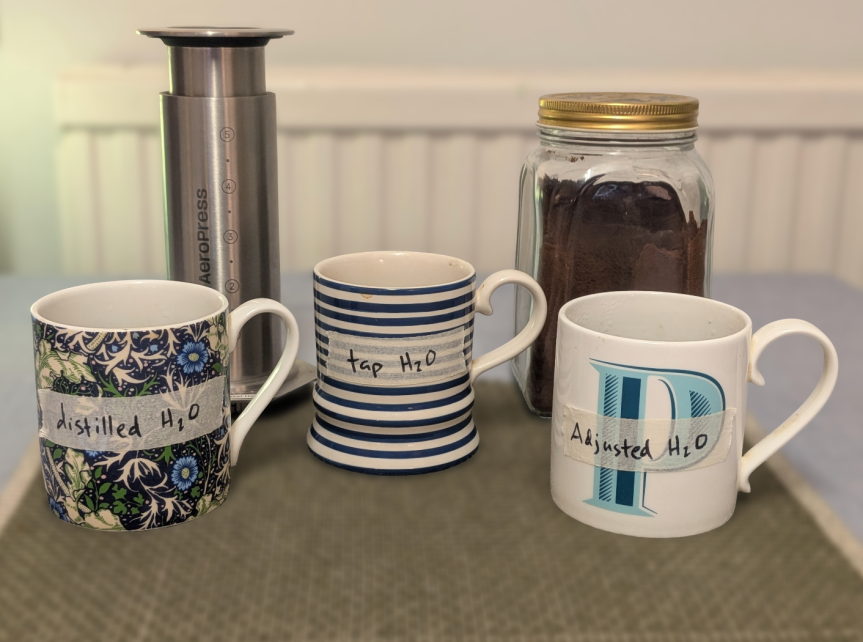
To assess the actual flavor difference with remineralized water, I made three cups of coffee in succession, using precise ground and water measurements and an AeroPress: one with pure distilled water, one with regular tap water, and one with remineralized water. I tasted each black once, freshly brewed, then several more times as it cooled. I eventually splashed a little milk into each, since that’s how I normally drink coffee.
First things first, coffee made with pure distilled water was truly terrible. I was already forewarned and therefore forearmed for this, but I was honestly shocked at how bad it was, somehow both hollow in body and with a pronounced tang that was somewhere between acidic and metallic. Do not recommend.
The tap water cup, which I already knew I liked, soared by comparison next to the distilled water version, but was also noticeably heavier in body.
After mixing the remineralized water with microdoses of both baking soda and Epsom salt for the amount of distilled water I was using, I was somewhat dubious that so little could do so much, but I have to admit, it really did. I believe the resulting cup had what can reasonably be described as balance: good body, strength, and brightness, without the weird tang of the distilled water version, or the thud of the tap water.
Does this mean I would go through the trouble regularly? To save my electric coffee makers and enjoy the outcome a little bit more? You know what, I might.

See full bio
Read the full article here