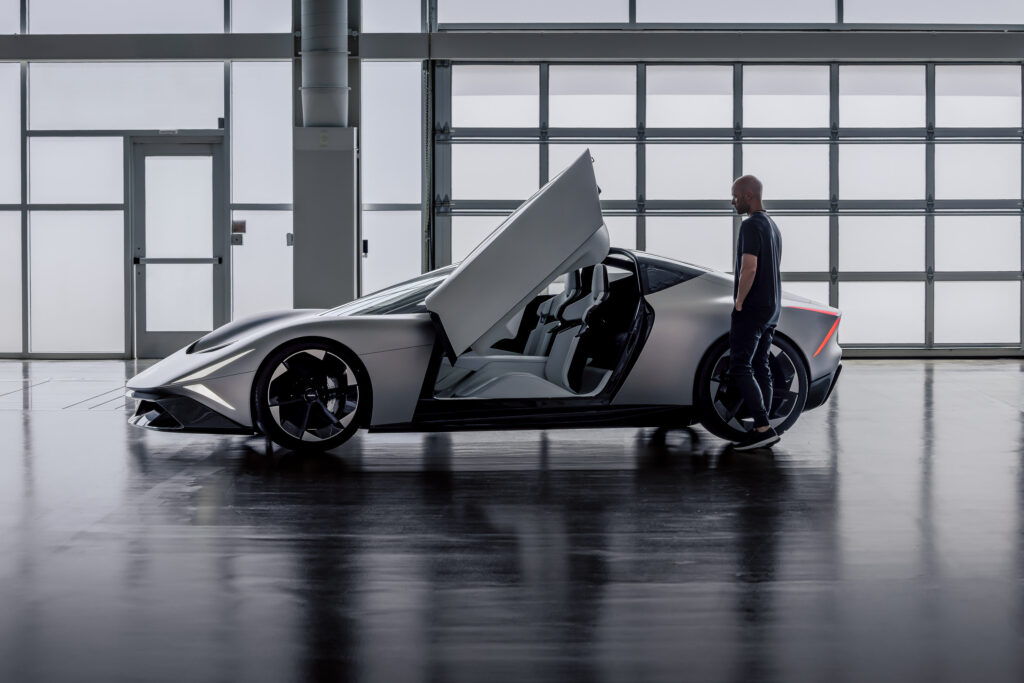
Acura unveiled the Nexera Vision concept this weekend during Monterey Car Week in California. The low-slung GT coupe blends motorsports and racing hardware with high-end materials and design — but the element most likely to trickle down to dealerships isn’t the bodywork. It’s the light signature, which Acura says will grace future models starting with the upcoming RDX Hybrid.
The concept lands as Acura works to refocus on hybridization. The automaker recently canceled its upcoming RSX SUV as part of Honda’s broader North American EV retreat.
The new face of Acura
The Nexera Vision was designed at the Acura Design California studio in Los Angeles under the direction of Yasutake Tsuchida, Acura’s creative director and vice-president of auto design. Acura says the concept will influence the styling of future models beginning with the fourth-generation RDX Hybrid.
“To reinforce the new Acura styling identity, we developed a unique lighting signature inspired by the Acura ‘A’ mark,” Tsuchida said. “The Nexera Vision sets the course for the next generation of Acura design, and we are committed to evolving that direction with clarity, consistency and purpose across future Acura products.”
At the front and rear of the concept, you’ll find what Acura calls “phantom lighting” — angular slashes of ultra-thin headlight and taillight strips that disappear into the bodywork, only appearing when illuminated. The result is uninterrupted sculpted surfacing when parked, but a high-contrast highlight of the coupe’s more aggressive aerodynamic elements when it’s time to drive. The main A-shaped lights are complemented by vertical light strips marking the vehicle’s centerline and illuminated “Acura” lettering at the rear.

Motorsports-inspired proportions
Following that fascia is a low-slung GT coupe chassis with dual-hinge butterfly doors, active aerodynamic elements and a wide, sporty stance, all finished in matte titanium paint. Acura points to the concept’s long dash-to-axle ratio as a hallmark of classic race car proportions, though the “aero-channel” front end — designed to route air through a small grille, up and over the hood — gives it an oddly long front overhang. Personally, I think this long nose leaves the concept’s proportions looking a bit wonky and awkward.
I do like the way the concept’s silhouette flows in a single continuous curve from the hood to the windshield, roofline and rear deck, reinforcing the aerodynamic theme. Rear visibility looks nonexistent, with the trunk lid stretching up onto the rear glass like a popped collar — but that’s forgivable, since this is a concept and not something anyone has to parallel park.
Out back, an active spoiler extends to manage airflow over the rear deck, aiding aerodynamic efficiency, high-speed stability and braking performance. Carbon-ceramic Brembo brakes are visible through 22-inch centerlock wheels — the sort of hardware you’re more likely to find on a racing Porsche, rather than an Acura — with forged carbon fiber inserts. Forged carbon also makes up the aero-channel’s leading surface, the rear diffuser, rocker panels, inner door structures and other trim.

High-end materials inside
The cabin blends sports-car minimalism with sustainable materials. The front seats are fixed and integrated into the floor, lowering both the seating position and the car’s center of mass. Instead of the seats moving, the steering wheel and pedals adjust to the driver. Ahead of the F1-inspired steering yoke, a visor-shaped curved OLED display is the only screen I could spy in the cockpit.
The rear seats lift to reveal a small titanium sculpture of the Nexera Vision alongside cubic samples of the materials that compose the concept and its interior — recycled aluminum, forged carbon fiber, Alcantara microfiber incorporating certified postconsumer recycled polyester and CircuLeather, a genuine leather made from materials that can be used as fertilizer — set against bright pink upholstery.

Since this is a design concept, Acura didn’t specify any powertrain details, pricing or availability plans. The small front grille and the absence of a tailpipe or large cooling intakes suggest it was at least conceived as an EV, though it hardly matters. This is basically a chance for Acura’s designers to stretch their creative legs before working these broad design themes and A-shaped lighting signature into tamer, more marketable future Acura models.
Read the full article here