


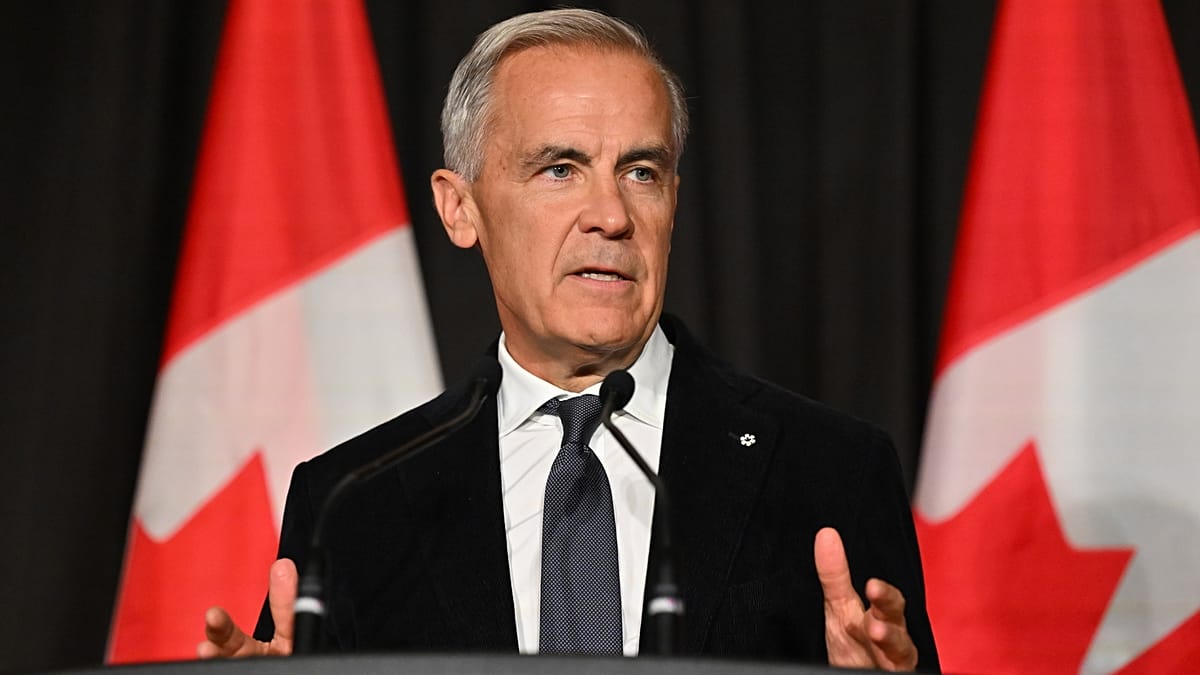
Carney’s EU courtship: Expectations are rising ahead of Mark Carney’s appearance at the European Parliament later this week, with the Wall Street Journal (WSJ) reporting on Sunday that he’s seeking “associate” membership of the EU.
‘Unique Alliance’: Speaking overnight, Carney denied that Ottawa was seeking to become a fully-fledged EU member, but said that it was looking to “begin discussions for (a) unique alliance with the European Union”.
‘Associate Membership’: The status doesn’t currently exist but may ring a bell: German Chancellor Friedrich Merz floated the idea for Ukraine in May, pitching a seat at the table in summits and ministerial meetings without voting rights, coverage under the bloc’s mutual assistance clause, and eligibility for funding under EU programmes.
The Trump effect?: Carney’s overture is perhaps the clearest sign yet that Ottawa sees Europe as part of the answer to its increasingly fraught relationship with Washington. Trump has made Canada a prime target in his tariff war while repeating threats to make the country the US’s 51st state.
But, while Canada shares the EU’s values, translating that alignment into closer cooperation has proved difficult. A decade after the EU-Canada trade deal, CETA, was signed, it is still not fully ratified by all EU member states, meaning several chapters of the deal are still not in force.
Carney is expected in Strasbourg later this week and will meet President Emmanuel Macron in Saint-Pierre-et-Miquelon next Sunday for talks on deepening France-Canada ties.
Latvian PM wants to prepare for the ‘worst’: Meanwhile, amid mounting signs that the Kremlin is escalating its hybrid offensive against the Baltic states, Latvia’s Prime Minister Andris Kulbergs has told Europe Today that Europe needs to “prepare for the worst” to guarantee peace — even though he does not believe Russia has the capacity to open a “second front”.
“The one who prepares for the worst has peace,” Kulbergs told my colleague Angela Skujins in Riga. “There cannot be any weakest link. We all have to remain strong.”
Asked about Ukrainian President Volodymyr Zelenskyy’s warning of a €23 billion gap in Ukraine’s defence budget, Kulbergs argued that the West was fuelling a vicious cycle: Western-made components find their way into Russian ballistic missiles, while Western governments then spend billions helping Kyiv defend itself against them.
He argued Russia should be “fully banned” from accessing the technology it needs to produce the missiles in the first place. Watch.
His warning comes as the war creeps uncomfortably close to NATO’s eastern flank, with a Russian drone striking a passenger train just two kilometres from the Polish border on Sunday. More on that in our top stories below.
Trump reignites Irish reunification debate: Meanwhile, US President Donald Trump’s apparent backing of Irish reunification during his visit to Ireland over the weekend is causing ripples on both sides of the Irish Sea.
While it’s unclear whether his remarks reflect his administration’s official position, Trump raised eyebrows when he said he “would love” to see a united Ireland, adding that “it would happen eventually”.
Trump first made the remarks following a bilateral meeting with Taoiseach Micheál Martin in Dublin, before travelling on to the Irish Open at a golf course he co-owns in County Clare. He has since doubled down on the remarks, while also pledging to remove a 15% US tariff on Irish whiskey.
Asked by Euronews for an official response, a UK government spokesperson pointed to a previous statement by Prime Minister Andy Burnham, who said he was unaware of majority public support for a referendum and that, “until that changes, there will not be one.”
The response from the UK opposition has been fierce, with Conservative leader Kemi Badenoch accusing Trump of “shooting from the hip as usual, just like he did with Greenland and Canada becoming the 51st state”, and describing the comments as “deeply unhelpful”.
Sanctions push: Meanwhile, EU ambassadors reconvene in Brussels this morning in an eleventh-hour bid to renew the bloc’s sanctions regime against Russia – with a looming deadline in just 48 hours.
‘Frustration’: As scooped by my colleagues, France has joined Slovakia in seeking the delisting of Russian-Uzbek businessman Alisher Usmanov from the regime, causing “huge frustration” among other EU countries, four EU diplomats told Euronews.
A French diplomatic source told my colleague Peggy Corlin that the issue was related to “national security” and assured that France was committed to upping the pressure on the Russian war machine.
Back without a bang: In other news, my colleague Sándor Zsiros reports that former Hungarian Prime Minister Viktor Orbán made a return to politics with an annual closed-door speech to his supporters in the small village of Kötcse, vowing to step tp the resistance against Péter Magyar’s government.
Orbán reportedly denied allegations of corruption and accused Magyar of helping Brussels to “colonise” the country. Polls suggest Magyar still enjoys broad support despite his approval ratings dipping recently. Orbán is often surveyed as the most unpopular politician in Hungary – but seems to bet that frustration with rising energy prices and the budget deficit will spark public anger and create an opening for him once more, Sándor writes.
Sweden’s centre-left bloc edges ahead by three seats in close preliminary election results
Sweden’s centre-left opposition bloc, which backs Social Democrat leader Magdalena Andersson for prime minister, was leading Sunday’s parliamentary election early on Monday, with the Social Democrats on 28.1% of the vote in preliminary results from the Swedish Election Authority.
Based on early results, the Swedish Election Authority’s preliminary seat distribution gave the centre-left bloc 176 seats, three more than the right-wing bloc’s 173 in the 349-seat parliament.
The narrow margin leaves the race finely balanced and could make negotiations over the next government difficult.
Although the Social Democrats remained Sweden’s largest party and could lead the next government, their roughly 28% share would mark one of their weakest results in more than a century, down from 30.3% in 2022.
Our reporters Roselyne Min, Malek Fouda and Ioannis Karagiorgas have more on this fast-moving story.
Russian drone strikes Kyiv-Warsaw train shortly after European delegation passes
A jet-powered Russian drone struck the locomotive of a Kyiv-Warsaw passenger train about 2km from the Polish border on Sunday, with no passengers injured, my colleague Sasha Vakulina reports.
The strike came during a massive overnight attack in which Russia launched 453 Shahed and Gerbera drones, including some jet-powered Shaheds, according to Ukraine’s Air Force.
“This is (Vladimir) Putin’s terror, ‘knocking’ directly on the doors of the EU and NATO. Russian barbarians are at your gate, dear partners,” Foreign Minister Andrii Sybiha said.
Shortly before the strike, a diplomatic train carrying former British prime minister Boris Johnson, former Swedish prime minister Carl Bildt, Günter Sautter, one of German Chancellor Friedrich Merz’s closest advisers, and other European security officials had passed through on the same route. Ukrainian Railways said it was “entirely plausible” that the diplomatic train could also have been the drone’s target.
Former CIA director David Petraeus was on another train at the targeted station at the time of the attack.
More from our newsrooms
Le Pen vows to put French citizens first, tackle housing and cost-of-living crisis at first campaign speech. Marine Le Pen put housing and the cost-of-living crisis at the heart of her presidential campaign on Sunday, using her first major speech in the former northern mining town of Hénin-Beaumont to promise French citizens that they would come “first in their own country” — regardless of skin colour, religion or origin. Estelle Nilsson-Julien hasthe details.
EU to further tighten migration policy after Ceuta crisis. Pushed by member states, the EU Commission is set to further harden its migration policy in the wake of the Ceuta crisis. Three major changes could be adopted in the coming months and potentially announced by Ursula von der Leyen in her State of the Union (SOTEU) speech this week. Vincenzo Genovesehas more.
Péter Magyar to relax child adoption rules for singles and same-sex couples. The Hungarian Prime Minister announced on Saturday that his government will ease adoption rules for gay couples and single persons in a new law, in a move that will reverse the effective ban introduced by his predecessor Viktor Orbán in 2020.More.
We’re also keeping an eye on
- Finland hosts the European Arctic Summit in Rovaniemi. EU leaders including German Chancellor Friedrich Merz and Polish Prime Minister of Poland Donald Tusk are expected to attend. Also attending are European Council President António Costa and EU foreign policy chief Kaja Kallas.
- The European Parliament’s plenary session kicks off in Strasbourg later this afternoon ahead of the much-anticipated State of the Union speech on Wednesday. European Commission President Ursula von der Leyen will meet the presidents of the main three political groups this evening.
That’s it for today. Sasha Vakulina, Angela Skujins, Jorge Liboreiro, Sándor Zsiros, Shona Murray and Vincenzo Genovese contributed to this newsletter.
Read the full article here