


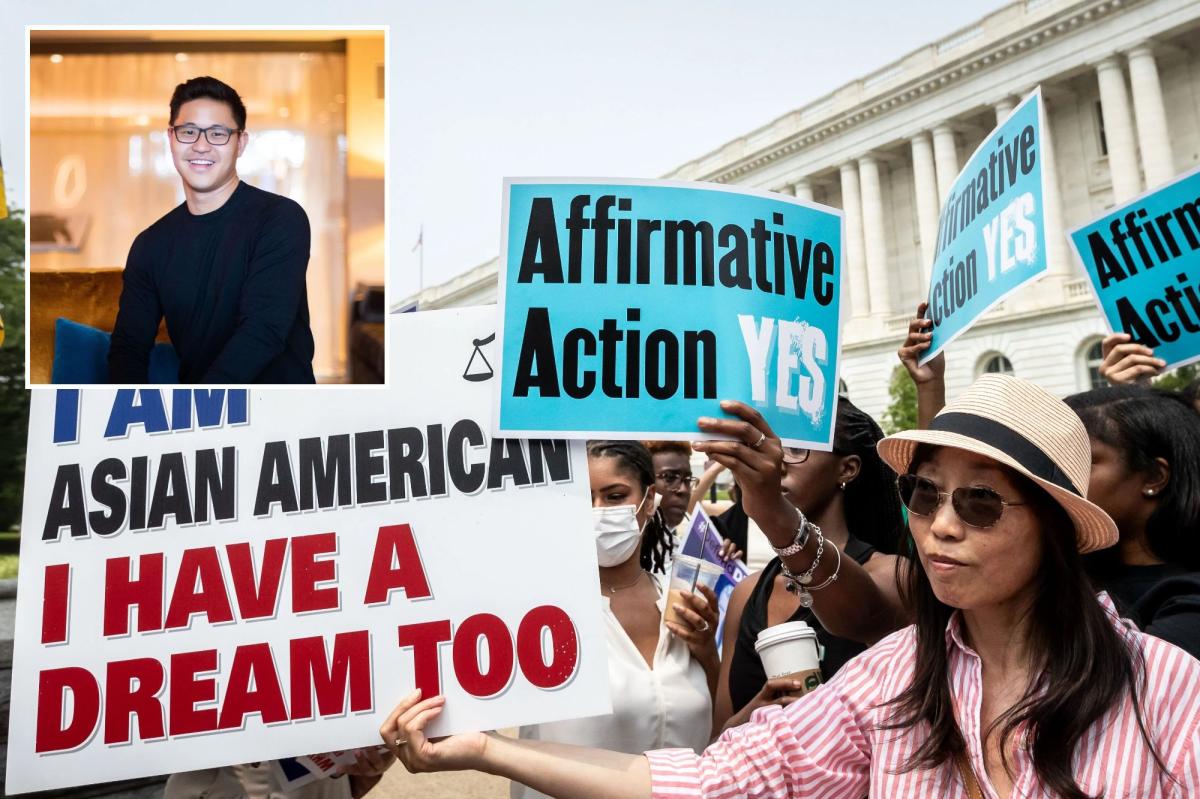
If we needed further proof affirmative action wasn’t working for some groups – look no further than admissions of Asian students to elite colleges.
Two years after the Supreme Court banned use of race in deciding college admissions, the percentage of Asian American freshmen has nearly doubled to 45% at Johns Hopkins University, according to newly compiled data.
“I was like, wow, that’s a big one,” Yiatin Chu, a Queens mother who’s soon to start preparing to go through the college process with her teenager, told The Post.
“This was always about the civil rights of Asian parents, having fairness in the system, and not being discriminated against.”
According to data released by the Baltimore school, the percentage of Asian American students rose from 26% to 45% between just 2023 and 2025.
Other minorities fell. Over that same period of time, the proportion of Black students fell from 10% to 4%, and Hispanic students from 21% to 10%.
White students held relatively steady, rising slightly from 19% to 21%.
Edward Blum, president of advocacy group Students for Fair Admissions (SFFA), believes stats like those coming out of Johns Hopkins are a victory for all students.
“Every student admitted to Johns Hopkins this admissions cycle will know that their academic qualifications and extracurricular accomplishments were the reason they were accepted to this competitive institution, not their race or ethnicity,” he told The Post.
Opponents of race-based affirmative action have long argued that the system discriminates against Asian American applicants, who tend to be disproportionately high-achieving students and are not considered an “underrepresented minority” by most schools.
Johns Hopkins said in a statement that it counted its highest percentages of students from underrepresented backgrounds in 2023.
“That changed after the US Supreme Court’s June 2023 decision to restrict the use of race in admissions,” Johns Hopkins wrote. “According to that data, Hopkins admitted significantly fewer students from underrepresented groups in fall 2024 and that was the case again this fall.”
The reported racial demographics do not include international students, who are counted separately and represented 14% of the student body in 2025. The school also reported large increases in the proportion of students who are first generation (20%) or receiving Pell Grants (24%).
The Post reached out for further comment and did not hear back.
Harvard reported similar increases in Asian American students — from 30% in the class of 2027 to 41% in the class of 2029.
Changes in Black and Hispanic populations were more modest than at Johns Hopkins. The percentage of Hispanic students barely dropped from 11.3% to 11%, and Black students from 15% to 11% of the incoming class.
College admissions consultant Christopher Rim says his Asian clients are celebrating gains at elite universities: “They reinforce what many Asian American families have long felt, that admissions decisions should be evaluated on merit and individual achievement, not race.”
Rim has noticed his Asian American clients are more optimistic about their prospects after the Supreme Court ruling and are applying to more selective colleges.
“In the past, some of my Asian-American clients applied to only a handful of Ivy League and top tier colleges because many assumed the odds were stacked against them,” Rim, CEO of Command Education, said. “They were like there’s no way I’m gonna get in.”
He says his clients are notably more optimistic about their prospects now. “If a school like Johns Hopkins is their dream school, they might apply there early because they know that they’re going to get a fair review of their application,” he added.
Meanwhile, Yiatin Chu has noticed more of her daughter’s friends of Asian descent getting early admissions offers from elite universities, including both Harvard and Johns Hopkins.
“For many years Asian parents were very pessimistic about these top schools,” she said. “But I think that’s starting to change, as these numbers get published in mass media and you hear more parents in your circle sharing good news.
“As for my daughter, I just want her to be treated fairly, and to be able to know the fact that she’s an Asian American is not going to put her in a separate pile.”
Read the full article here