


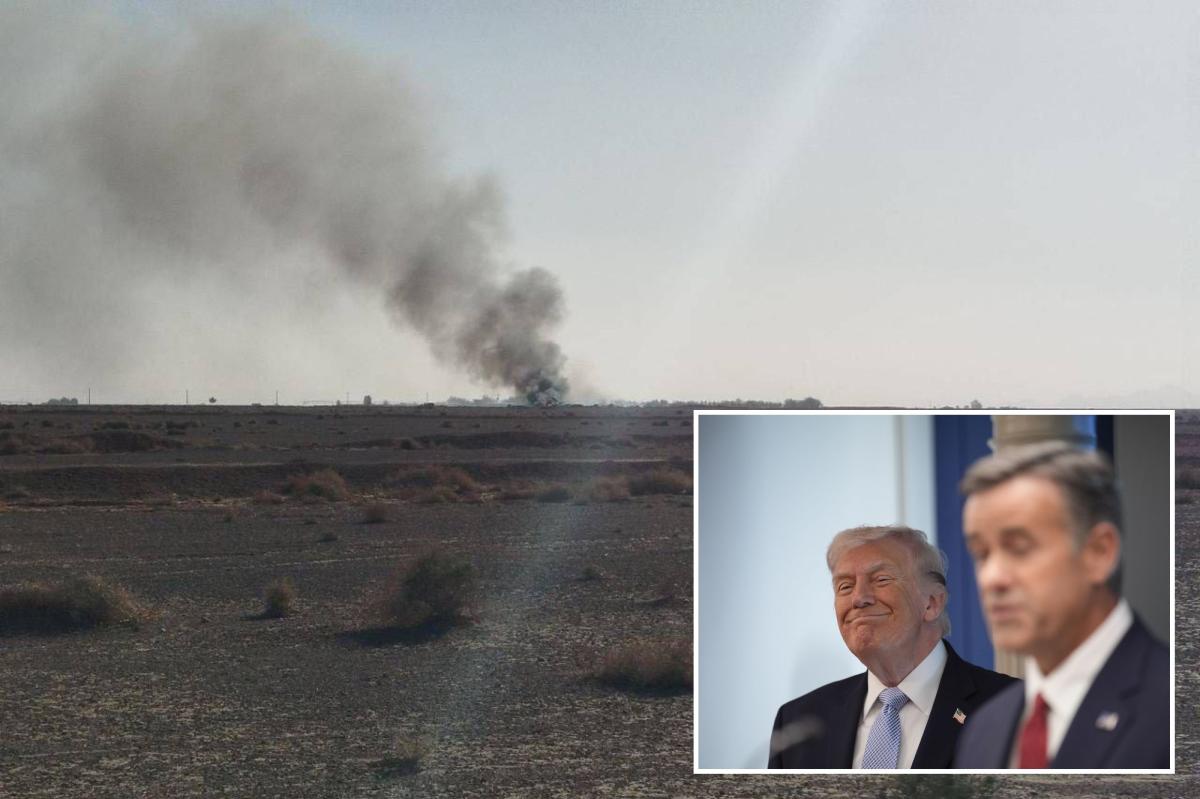
WASHINGTON — President Trump told The Post the CIA’s secret new “Ghost Murmur” tool was “very important” to rescuing a downed airman inside Iran this weekend — as leading physicists and engineers debate how the futuristic technology, said to detect heartbeats at great distance, might work.
“It was very important. The CIA was fantastic,” Trump told The Post in a phone interview Wednesday.
“Nobody even knows what it is. Nobody ever heard of it before,” Trump said.
“Everybody’s surprised,” he said. “We have many other things that nobody has ever heard about. We have equipment the likes of which nobody has ever even thought about.”
The surprise extended to the academic community — with experts saying it would be a massive scientific leap in harnessing nitrogen-vacancy center (NV) diamonds to measure magnetic fields.
Many experts believe the detection may have happened at relatively close range or differently than initially thought — after two sources told The Post that Lockheed Martin’s Skunk Works paired NV diamond sensors and artificial intelligence to filter out background noise, making heartbeats detectible from the air.
“Assuming the description of the technology is accurate, my best guess is that this is a drone-mounted NV center magnetometer, probably a magnetometer array,” said University of Wisconsin-Madison physics professor Thad Walker.
“It is essential to get the magnetometer close to the source” and “even mounted on a drone, it would be astounding to detect a heartbeat with NV centers at even a distance of 100 meters,” Walker said.
“At 100 meters, an adult heartbeat… is not impossible to detect in a very magnetically quiet background with plenty of time to do advanced signal processing.”
“However,” he added, “the best NV magnetometers I have heard of… would take days of signal averaging for an array of such detectors to reach the detection limit at a distance of 100 [meters].”
“The Lockheed-Martin detectors would realistically need much better noise performance,” he said. “I am not aware of any published studies that come close to the performance needed to detect a human heartbeat at 100 [meters].”
Trump and CIA Director John Ratcliffe alluded to the tool at a Monday White House briefing — with the president saying the spy agency spotted the pilot from 40 miles away, though it was unclear if he was referring to the Ghost Murmur tool or subsequent observations.
A source briefed on the rescue told The Post the Iranian countryside was “about as clean an environment as you could ask for” because of low electromagnetic interference, “almost no competing human signatures, and at night the thermal contrast between a living body and the desert floor,” which “gave operators a secondary confirmation layer.”
What to know about the daring rescue of the US airman in Iran:
“Normally this signal is so weak that it can only be measured in a hospital setting with sensors pressed nearly against the chest,” that source said. “The capability is not omniscient. It works best in remote, low-clutter environments and requires significant processing time.”
Patrick Maletinsky, chairman of the physics department at the University of Basel, said publicly known technologies can detect heartbeats at only short distances no more than centimeters.
“The key limitation is how quickly the magnetic field from the heart decays with distance,” he said.
At a distance of tens of kilometers, the expected signal strength is “about 10 to 20 orders of magnitude below the sensitivity of even the most advanced magnetometers, including quantum sensors,” he said.
“If such a system were to exist, it would represent a breakthrough far beyond anything reported in the scientific literature,” he said.
“A more plausible interpretation is that quantum sensors could play a role at short range or as part of a broader multi-sensor system.”
One such multisensor system is marketed by SandboxAQ’s AQNav program, which the company says “delivers assured navigation using quantum sensors, AI, and Earth’s magnetic field, enabling positioning when GPS fails due to jamming, spoofing, or denial.”
The military’s Defense Advanced Research Projects Agency (DARPA) has publicly worked on improving magnetometry sensing with its AMBIENT program, whose acronym stands for Atomic Magnetometer for Biological Imaging In Earth’s Native Terrain.
“The goal of the [AMBIENT] program is to develop novel gradient magnetic sensors that can detect biological signals while operating outside of specialized facilities and in the noisy ambient field of the Earth,” according to a public description.
Lockheed Martin last year disclosed it was working on DARPA’s Robust Quantum Sensors (RoQS) program “to develop next-generation quantum sensors for navigation on advanced defense platforms” after prior related work.
Chris Duncan, who wrote his 2025 engineering doctoral dissertation at Capitol Technology University on advanced magnetometry, said it is possible Ghost Murmur works as described.
“It’s just a matter of how well they filter out all the noise,” said Duncan, who says he has worked with the intelligence community on classified government projects.
“There’s a lot in the open about it. And I’m not surprised there’s a bunch of stuff we don’t know,” said Duncan, who leads a steel manufacturing firm.
Duncan said “I would say a mile or two or three” is likely the maximum detection distance. “And it would be a very hard max.”
But Dmitry Budker, who teaches at the University of California at Berkeley and at Germany’s Helmholtz Institute Mainz, was skeptical and floated alternative theories, including that the airman’s movements, if he was wearing electrical equipment, might be picked up.
Sources who initially described the tool say it worked in tandem with the rescue beacon he activated. One source said he was detected by Ghost Murmur when he emerged from a mountain crevice to use a standard-issue Boeing-made beacon, which was only used sporadically to avoid detection.
Modern magnetometers can detect soldiers moving with an AK-47 through a shallow tunnel and magnetic communication is used by miners deep in shafts where radios function poorly, Budker said.
But Budker said that in the Iran rescue scenario, he believes the pilot would have needed a source producing magnetic fields other than merely his beating heart to make distant detection likely.
Other tools would be much more efficient, such as using an infrared camera to detect breathing from a distance or using satellites capable of extremely close-up imaging.
“I’m not knowledgeable about classified things, but I would be very surprised,” Budker said. “This would be a very significant breakthrough.”
Read the full article here