


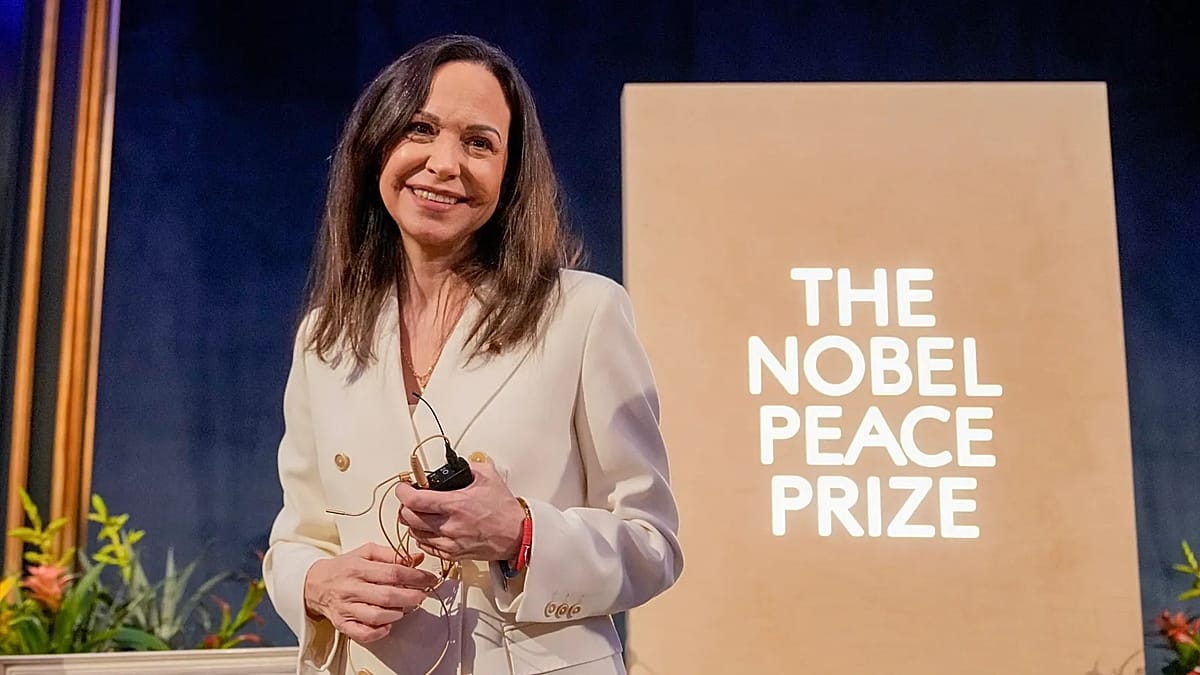
Over the course of 2025, US President Donald Trump was consistently vocal about his desire to bag the Nobel Peace Prize, claiming to have ended eight wars since returning to office — an assertion which has been contested by war experts.
Fast-forward to 2026, and the frenzy around the topical matter has already resurfaced, after Venezuela’s opposition leader Maria Machado said she wanted to “share” her award with Trump following the US’s capture of Venezuela’s President Nicolás Maduro on 3 January.
“I certainly would love to be able to personally tell him [Trump] that the Venezuelan people […] want to give it [the Nobel Peace Prize] to him and share it with him”, Machado — who was awarded the prize for promoting the democratic rights of Venezuelans — told Fox News on 5 January.
Trump initially said it would be “very tough” for Machado to play a role in Venezuela’s future government due to a lack of “support or the respect within the country”, instead supporting acting President Delcy Rodríguez, who served as vice president under Maduro.
However, Trump began to change his tune after Machado offered to share the Nobel Peace Prize, qualifying her willingness to share the prize as a “great honour”.
What are the facts?
In reality, only the Nobel Prize Committee can decide if a prize is shared, and this can be for up to a maximum of three individuals. Meanwhile, the peace prize specifically can also be given to organisations, as well as individuals.
On 9 January, the Nobel Prize Committee issued a statement honing in on the facts: once a Nobel Prize is announced, the decision is final. After this point, it cannot be revoked, shared or transferred.
Ahead of Machado’s trip to the US to meet with Trump on Thursday, journalists asked Trump whether her role in a future Venezuelan government could be influenced by the offer to share the Nobel Peace Prize. In response, Trump indicated that it could be.
In theory, nothing is barring Trump from being nominated and potentially receiving the prize.
The Norwegian Nobel Committee, typically made up of five members appointed by Norway’s parliament, shortlists nominations and consults experts before awarding the peace prize.
Swedish chemist Alfred Nobel said in his will that it should go to the person who has done the most for “fraternity between nations” and the abolition of standing armies.
Trump has received nominations in the past, and other US presidents have won it before.
Most recently, Barack Obama received it in 2009 “for his extraordinary efforts to strengthen international diplomacy and cooperation between peoples” — a decision Trump has repeatedly criticised.
Read the full article here