Fix market fragmentation or miss the AI train, Lagarde warns the EU

News Room
4 Min Read

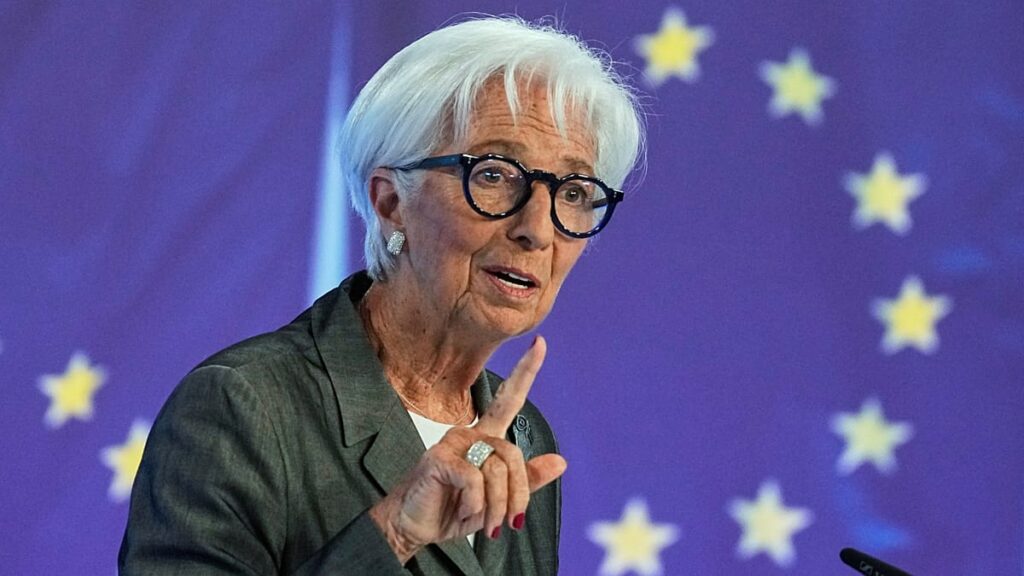
Europe missed the first digital revolution and cannot afford to miss out again with AI, as it has the full potential to compete, Christine Lagarde, president of the European Central Bank (ECB), said on Wednesday.

To win the AI race against giants such as the US and China, Lagarde told the International Business Council of the World Economic Forum (WEF) in Geneva, the EU needs to complete its single market and integrate capital markets that remain too fragmented.

“Europe largely missed out on the first digital revolution, as the commercial gains from the spread of information and communication technologies were captured disproportionately elsewhere. We cannot afford to repeat that experience with artificial intelligence (AI), the second digital revolution,” she said in Geneva.

Lagarde’s analysis largely echoes that of her predecessor, Mario Draghi, who in 2024 delivered a seminal report on relaunching the EU’s economic competitiveness, which pointed to AI as the last chance for Europe to rejoin the international tech race.

Following Draghi’s advice, the European Commission has put forward several initiatives to promote the uptake of AI in strategic sectors as well as the financing of massive data centres in an effort to develop new generations of the technology.

In her speech, Lagarde stressed that access to capital is limiting Europe’s AI investments, notably because EU businesses get most of their funding through bank credit, while capital markets — the spaces where investors invest and firms raise capital — remain too limited at the national level.

Legal fragmentation creates practical barriers for firms in terms of costs, timings and their ability to operate across borders, she said. As a result, a company in Europe faces more hurdles to scale up than a US-based rival, and may end up turning to non-EU capital markets to solve the problem.

“Scale is particularly important as new technologies reshape the sources of productivity growth,” Lagarde said.

The president added that Europe has the full potential to “make the most of new technologies”, and that there are already “encouraging signs that European firms are investing in AI”.

“The EU accounts for around 6% of the world’s population but as many as 15% of its researchers. It also produces almost one-fifth of the world’s most-cited scientific publications,” the ECB president pointed out.

“Survey evidence suggests that firms in the euro area expect to allocate an average of around 9% of their total investment to AI this year,” Lagarde said.

The challenge, she argued, is turning this knowledge into “commercial success” that spreads the technology across the economy. “Too often, the barriers that prevent firms from scaling also hold back that diffusion,” she added.

The ECB president called for speeding up key reforms currently under negotiation in Brussels, namely the Savings and Investment Union (SIU) and single market integration reforms such as EU Inc.

The SIU is a package of legislation aimed at creating more integrated capital markets. Legislators hope to reach a deal by the end of the year, though significant divisions remain among EU member states, particularly over reform of the centralised supervision of capital markets.

EU Inc. is the Commission’s proposal for an optional, EU-wide company structure designed to make it faster and cheaper for firms — especially startups — to incorporate and operate across borders and grow, sidestepping the current patchwork of 27 national systems. This file, too, falls under the single market integration umbrella and is expected to be approved by the end of the year.

Read the full article here

Share This Article
Leave a comment

Leave a Reply

Your email address will not be published. Required fields are marked *