The Creative XF1 in white. / Creative
Creative XF1 Desktop Speakers
Pros & Cons
-
Compact, elegant design -
Impressive sound for the size and price, with ample bass and good clarity -
Detachable cork stands -
Good wired and wireless connectivity -
Can add subwoofer for more bass -
Volume control on front
-
They look nice but don’t feel that premium -
No HDMI eArc or optical input
Creative is known for its value PC speakers, including its popular orb-shaped Pebble speakers, which start at $20. In recent years, the company has dabbled in more premium models, such as the $280 Pebble Nova, which sits at the top of our best PC speakers list. Its new XF1 desktop powered speaker set is a slightly different animal in that it has a subdued, straightforward boxy design and a more midrange price of $180. But it still follows the same value formula, delivering very good sound for the price along with pretty robust connectivity options.
Creative XF1 design and connectivity
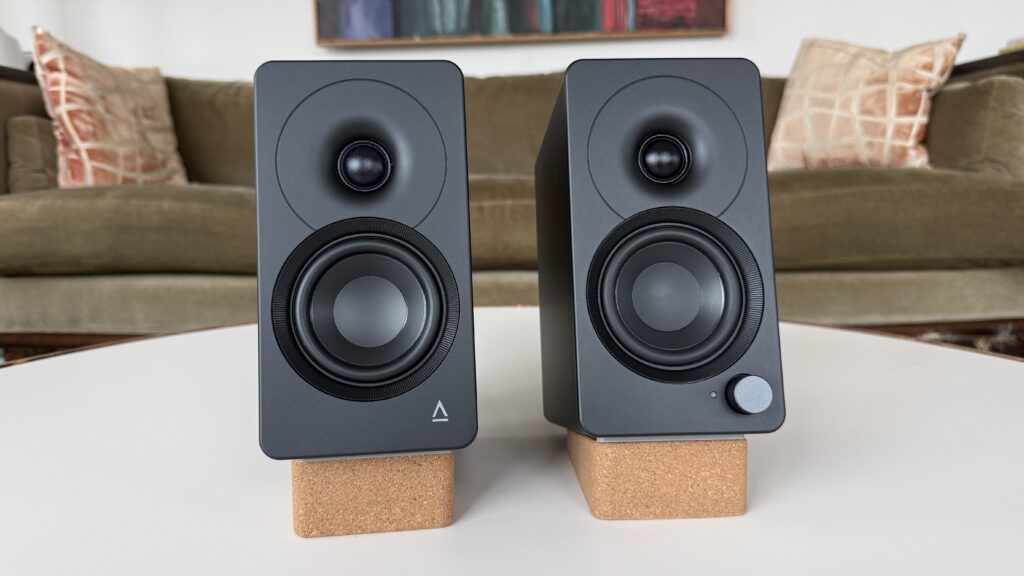
Measuring 7.5 inches tall, 6.1 inches deep and 3.9 inches wide, the speakers are fairly compact and won’t take up too much room on a desk. Available in matte black or white finishes, the XF1s have an appealing, understated, elegant design that gives off a mini-studio-speaker vibe and lends them a bit of seriousness. Each speaker has a 3-inch woofer and a 3/4-inch tweeter, and the drivers are fully exposed, as the speakers have no grilles. They sit on detachable cork stands that tilt the speakers upward at a 15-degree angle.

With a rated continuous power output of 72 watts and a frequency range of 55 hertz to 40 kilohertz, the XF1s require an external power adapter. They are wired together with a detachable speaker interconnect cable. There’s a volume knob on the front-right speaker (you hold it down to enter Bluetooth pairing mode), and around back, you’ll find a 3.5-millimeter line-in, a USB-C port and a dedicated subwoofer output, so a subwoofer can be added to produce bigger sound with more bass. Bluetooth 6.0 is on board for wireless streaming, whether that’s from your phone, tablet or PC. I connected an iPhone 16 Pro and Google Pixel 9 to the speakers, but for most of my testing, I used a HyperX Omen gaming desktop.
While the speakers have some decent heft to them (the left speaker weighs 2.8 pounds, the right is 3 pounds), they just don’t look or feel as premium as some more expensive models, including the Audioengine A2 that cost about $100 more (the newer Audioengine HD3 cost around $360) and even pricer KEF speakers like the LSX II LT that retail for well over $500. I’d put these somewhere between Edifier’s similarly styled M60 ($170) and M90 speakers ($300), with Edifier’s recently introduced MR4.5 near-field studio monitors ($250) also being a close competitor. The M90 is a larger speaker that’s also equipped with an optical input and a TV-friendly HDMI eArc port (you don’t get either with the XF1s) to go along with Bluetooth 6.0, and it comes with a remote. But it costs significantly more than the XF1.

Creative XF1 sound quality
My initial impression out of the box (without jumping into the EQ settings) was that the speakers were slightly bass-forward, but were quite pleasant overall, with good detail and a nice warmth and natural quality to the sound. The speakers are intended for near-field listening — and they sound best when you sit about 3 to 5 feet away, with them angled slightly toward your ears — although they can fill a small room with sound if you crank the volume up to around 80%. They would be pretty ideal for a dorm room or home office.
You’re not going to get the deep, harder-hitting bass you’d get from larger speakers or from adding a separate subwoofer, and they lack a bit of refinement and clarity compared to more expensive powered speakers. However, the speakers do produce a fairly rich, full sound with decent depth, and they maintain a good tonal balance with minimal distortion, even at higher volumes. Their sound quality exceeded my expectations for the price.

Creative says the XF1 carries “dual hi-res audio certification,” supporting playback up to 40kHz over USB audio and analog line-in, as well as wireless hi-res audio over LDAC with Bluetooth 6.0 (many Android devices support LDAC streaming, while Apple devices use the AAC audio codec). The sound quality improves slightly with a wired connection, but these aren’t high-end speakers, so it won’t make a huge difference.
Previous Creative speakers I’ve tested linked up with Creative’s Acoustic Engine software to customize the sound, but the XF1 supports Creative’s new Nexus app, which offers a 10-band parametric EQ along with more than 120 EQ presets. It’s a bit plain-looking, but it’s well-designed and offers robust fine-tuning options that are easy to understand and dial in. The default music profile has a bit of a V-shaped curve, which is not surprising given my initial listening experience. But Creative says the EQ presets cover over 20 types of music and close to 100 games, so there are plenty of sound customization options to choose from. The app is available for Windows, MacOS, Android and iOS.
Creative XF1 final thoughts
I’ve reviewed more affordable speakers from Creative, like the $90 Pebble X, which also comes in a version with a subwoofer that gets high marks for its $120 price, and I’ve been pretty happy with the sound quality. The XF1 gets you a nice boost in sound quality from the Pebble X, and while the step-up Pebble Nova delivers bigger bass, the XF1’s tonal balance and treble performance measure up well to the Nova’s and may even be slightly better, particularly after tweaking the EQ settings to your liking with the Nexus app.
Due to their compact size, the speakers have some sonic limitations, and yes, adding a subwoofer would help. However, their small size, combined with the sound they can produce, is what I found quite appealing about them. They deliver good bang for the buck and are a fine option for someone looking for an entry-level audiophile desktop speaker with some power.
Read the full article here