


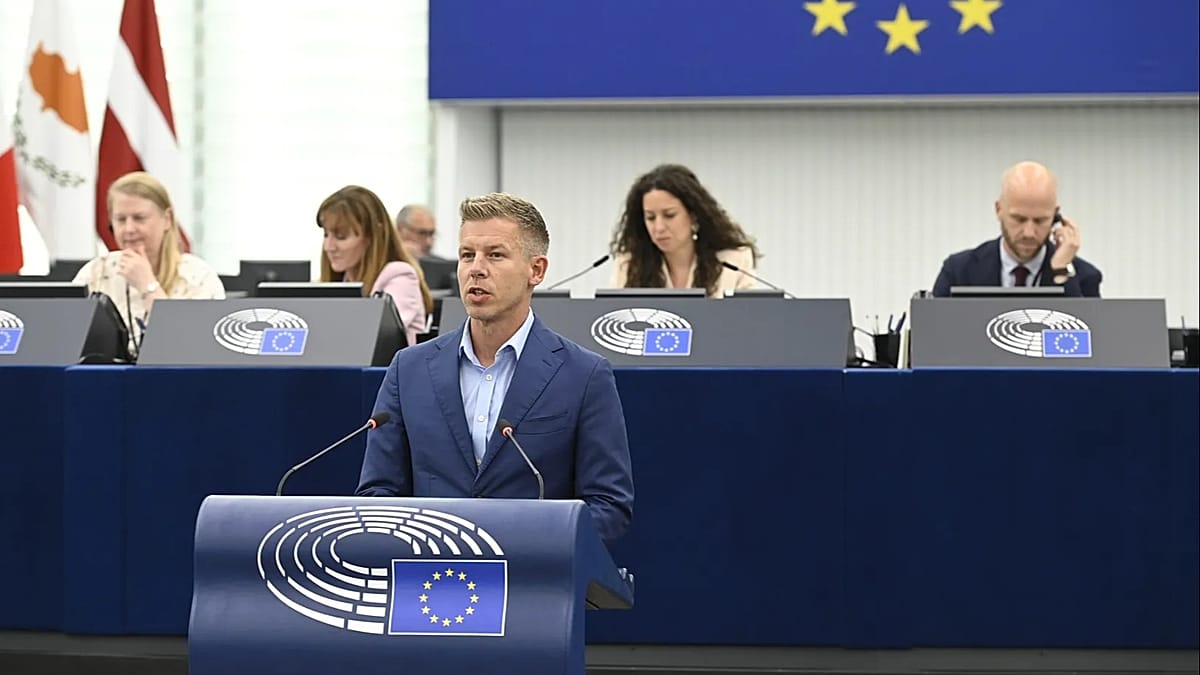
MEPs from Hungary’s main opposition party, Tisza, voted against a resolution at the European Parliament on safeguards related to the EU’s Mercosur trade deal, breaking with the European People’s Party (EPP) for the third time in a month.
On Tuesday, the Tisza delegation said it rejected the Mercosur safeguards to protect Hungarian farmers.
“Tisza stands by Hungarian farmers even when it means going against the mainstream in Brussels,” a party statement said after the vote in Strasbourg.
In January, Tisza supported a resolution to refer the Mercosur agreement to the European Court of Justice. Tisza MEPs also failed to appear at a vote supporting fellow EPP politician Ursula von der Leyen during a motion of censure initiated by the far right.
Following this, the political group sanctioned all seven Tisza MEPs, barring them from speaking at plenary sessions for the next six months.
“We accept the sanctions. Because Hungarian interests are more important than any compromise in Brussels,” the party statement said.
An EPP source who spoke to Euronews on condition of anonymity said that the fact that Tisza does not want to be associated with Manfred Weber or Ursula von der Leyen was “worrying”.
The source added that the political group has discussed Tisza’s non-alignment with the EPP position on Ukraine, which raises concerns.
While the EPP Group supports Ukraine’s speedy accession to the EU, the Tisza party rejects fast-track accession and has promised to hold a referendum in Hungary on the issue if it forms a government.
Brussels puppet allegations dominate campaign
Under its leader Péter Magyar, Tisza is campaigning to unseat Viktor Orbán’s nationalist government at elections on 12 April, and currently leads Orbán’s Fidesz Party in the opinion polls. The current government claims an opposition election victory would undermine Hungary’s sovereignty.
Tisza joined the EPP Group in 2024 after securing 30 per cent of the Hungarian vote at the European elections. Orbán frequently claims Magyar is subservient to EU leaders, particularly Commission President Ursula von der Leyen and EPP chairman Manfred Weber.
Speaking at a press conference in Strasbourg, Weber distanced himself from the campaign developments in Hungary.
“I’m wondering why I, Manfred Weber, play such a prominent role there. This is not my choice; it is solely Hungary’s choice about its future. And when I look at the debate there, I see the Tisza Party is very much focused on the daily lives of citizens and on the concrete issues on the table,” he said.
An electoral strategy
According to Roland Freudenstein, a co-founder of the Brussels Freedom Hub who previously worked for the EPP think tank Wilfried Martens Centre, Tisza faces a difficult position so long as the Orbán government can portray the centre-right EPP as an anti-Hungarian force.
“Tisza constantly has to defend itself against the accusation of being a traitor to the nation,” Freudenstein said. In that context, I think it is understood that they will, just like other national delegations, sometimes break ranks with the EPP.”
Freudenstein added that everyone understands that before the April elections, Tisza is not going to say anything related to Ukraine.
“After that, it’s a new game, it is a new debate, and we shall see.”
Hungarian political analyst Szabolcs Dull, meanwhile, said Tisza is subordinating all its decisions to the domestic political situation – and that until the elections in April, Weber and the EPP will overlook this approach.
Read the full article here