


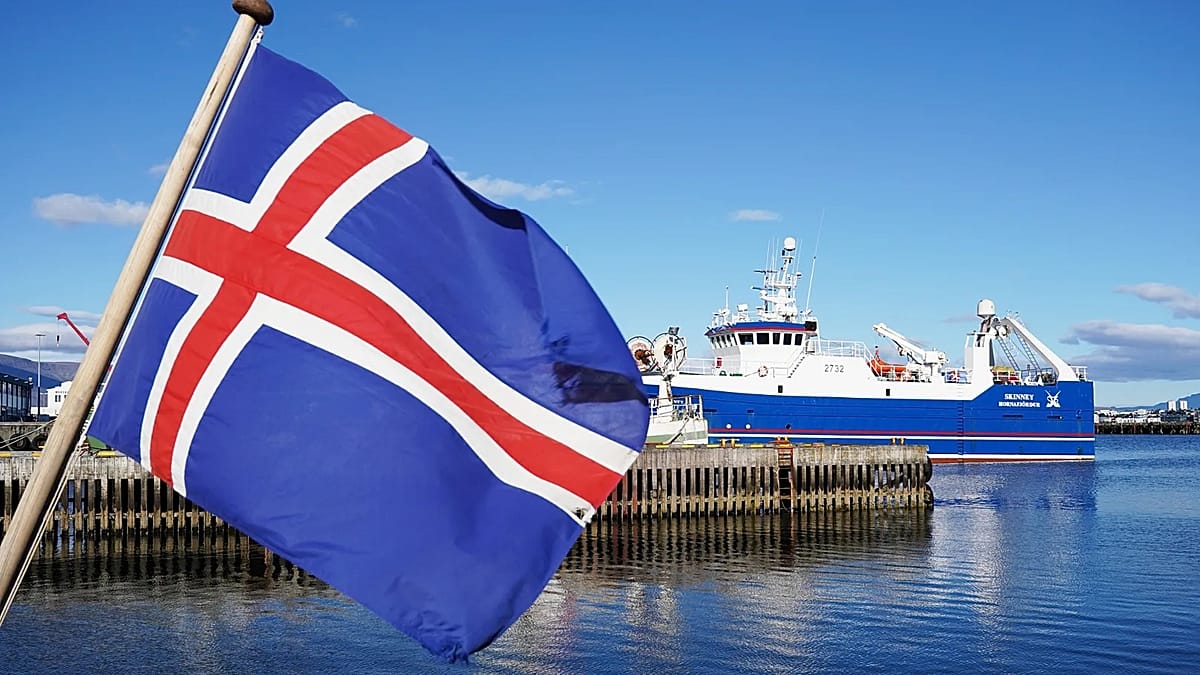
“Should Iceland resume accession negotiations with the European Union?”
This is the question being put to 270,000 Icelanders on Saturday 29 August. From 9am local time, eligible voters will head to the polls to chart their nation’s course closer to the European Union — or further away.
The results from the referendum will determine whether the island of 400,000 people should restart negotiations to join the 27-member bloc, or place the revived idea on the backburner for the foreseeable future.
Early polling shows that the results will most likely be down to the wire. An August survey by polling agency Maskína showed a narrow lead, with 51.3% of respondents in favour of restarting talks and 48.7% opposed.
The split indicates tensions over the upcoming plebiscite, which has exposed political fault lines in Iceland covering matters from security to the seas.
Defence remains a particular flashpoint. Iceland is wary of being caught in the crosshairs by Russia’s growing economic and strategic interest in the area, on the one hand, and statements made by US President Donald Trump, who has repeated threatened to annex Greenland, on the other.
But locals are pointing to far more domestic issues that could determine the knife-edge result, from the soaring cost of living to fishing and farming.
Icelandic Prime Minister Kristrún Frostadóttir told Euronews in April that there must be a “balanced discussion” regarding the referendum.
So, what is being discussed, what are the major sticking points, and why does it all matter? Ahead of the vote, Euronews answers your most pressing questions.
What is Iceland voting on?
Saturday’s referendum question will be: “Should Iceland resume accession negotiations with the European Union?” The options will be simply “yes” or “no”.
Crucially, the referendum will decide only whether the government of Iceland should restart accession negotiations with the EU; it is not a vote to determine whether the country should join the EU. That decision would need to be put to a second referendum, as well as being ratified by the 27 EU member states.
Polling stations in Reykjavík will open at 9am on Saturday and close at 10pm that evening. Results are expected to roll through in the hours following.
What is the back story?
Iceland first applied to join the EU in 2009, a year after it and other countries were rocked by the 2008 financial crisis. Formal negotiations began in 2010, with membership seen by the Icelandic government as a possible means to shoring up the Icelandic króna.
Yet after two years of lobbying by a Eurosceptic government, the bid was put on hold in 2013.
In the years since, security priorities have shifted dramatically, with Russia’s full-scale invasion of Ukraine in 2022 reshaping vulnerabilities across the High North.
Financial calculations have also altered, with many officials such as the Iceland’s Finance Minister Daði Már Kristófersson telling Reuters he is hopeful that Iceland joining the EU could boost the country’s economy, rocked by high inflation.
Trump’s re-election has also sown discord within the transatlantic alliance and thrown question marks over the US-Iceland 1951 defence agreement. This is a treaty committing the US to support Iceland’s defence on behalf of the North Atlantic Treaty Organisation (NATO), with Iceland accommodating US bases and forces.
Iceland’s shift back toward the EU path came in 2024, following Frostadóttir’s centre-left government vote into power. After the win, the EU executive confirmed that Iceland’s EU application — submitted more than a decade earlier — remains valid.
In early 2026, the country’s prime minister made good on her promise. She announced there would be a referendum to decide whether EU negotiations should restart, with the vote scheduled for 29 August 2026.
What have the campaigners said?
While not a member of the EU, Iceland is a participant in the European Economic Area (EEA). As with Norway, this means Iceland is granted access to the EU’s single market.
EEA membership means Iceland has already adopted a majority of the EU’s rules, equating to roughly 9,000 legal acts. Proponents of a “yes” vote argue that restarting EU negotiations, with the outcome of eventually joining the bloc, would give Iceland a seat at the table when it comes to negotiating these files.
Proponents of “no” argue that Iceland’s EEA membership and access to the single market should be enough, and full membership is not required.
Haraldur Ólafsson, the chairman of Eurosceptic platform Heimssýn,previously told Euronews that since Iceland already adheres to 75% of EU rules, “there is no need for more”.
Foreign Minister Þorgerður Katrín Gunnarsdóttir has remarked that fisheries are the other major issue among “no” voters. Iceland’s fisheries industry body, Fisheries Iceland, has raised concerns over a range of EU fish rules, arguing that EU membership would leave Iceland without “the power to act as an independent coastal state”.
The EU’s Common Fisheries Policy sets catch limits and quotas across member states – a policy that has long strained relations between Reykjavík and Brussels.
The notorious so-called “mackerel wars” stemmed from Iceland adopting a unilateral position on mackerel quotas that the EU considered excessive, putting strain on the country’s former EU accession bid.
This slice of Icelandic history is expected to loom large in the mind of most voters, as its fish industries makes up 6.5% of the country’s GDP and employs thousands.
What has the European Union said?
“We share values, we know each other very well, we are like-minded, so we are close partners,” European Commission President Ursula von der Leyen said during her visit to Iceland in July 2025.
She used her visit to the Nordic island to trumpet its assets — it shares the same values as the EU, is a member of the single market, and for a mostly pacifist country, maintains robust defences.
It is von der Leyen’s enlargement official, European Commissioner Marta Kos, however, who spelled out Iceland’s EU prospects in more concrete terms. As first reported by Politico, Kos said that Iceland could formalise accession negotiations by 2027, as its former bid remains valid.
When Iceland put its application on hold in 2013, 27 negotiating chapters had been opened. Eleven of those chapters were provisionally closed. The segment on fisheries, however, remained a major thorn in the side of the country’s negotiation talks.
However, Kos recently hinted on social media platform Bluesky that Brussels may be ready to find common ground on the delicate issue. “Accession negotiations always reflect the specific realities of each candidate country,” she wrote.
How much do foreign threats loom over the ballot?
Magnús Magnússon chairs a platform advocating for closer ties with the EU. He previously told Euronews that the country’s critical infrastructure is under “constant attack” by Russian actors, and it needs to be secured. “There’s a lot of things that the EU can help with in that respect,” he said.
NATO has also acknowledged Russia and China’s growing appetite for power in the High North. The alliance in response has since stepped up activity in the region, such as air policing and greater submarine surveillance.
Another boon to the push is to appease Trump, who has argued the US needed the autonomous territory of Greenland for national security reasons, citing increased activity in the area by both Russia and China.
He has often mistaken Iceland for Greenland when repeating his threats, with experts telling Euronews this has sent alarm bells ringing in Reykjavík. It is also no secret that Washington wants to Europeanise NATO and review its security presence across the continent, something that the European Commissioner for Defence Andrius Kubilius estimates could cost Europe €500 billion.
The EU’s foreign policy chief Kaja Kallas also acknowledged that the EU and Iceland’s security situations are intertwined amid interest from the Kremlin to Beijing.
“From Russian threats to seabed infrastructure to China’s growing interest in the Arctic, addressing these together gives us greater leverage,” Kallas said at a joint press conference from March conference celebrating Security and Defence Partnership between Iceland and the EU.
At the meeting celebrating the pact, aiming to boost defence cooperation between the entities, the country’s foreign minister Þorgerður Katrín Gunnarsdóttirreportedly said that the EEA agreement has provided the strong foundations for this relationship, but that the world is changing. “We must face these changes,” she added.
European Policy Centre senior advisor Tobias Etzold has opined that growing doubt over US reliability in the region, paired with an increasingly adversarial Russia, is what reignited the EU referendum debate in Iceland.
And it is the theatre of geopolitics is what has injected “fresh dynamism” into a discussion that had lain dormant for more than a decade.
Read the full article here