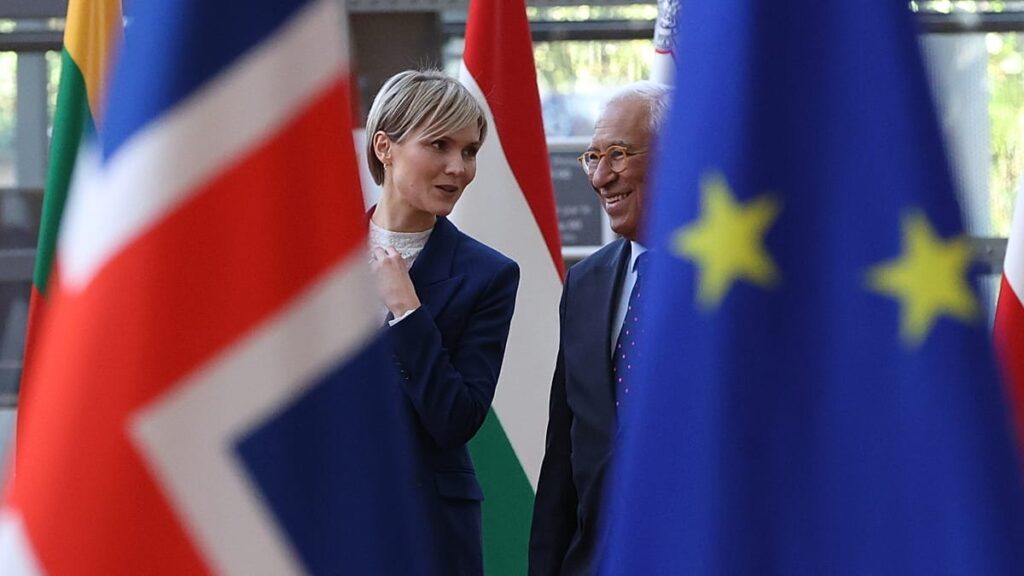
Icelanders have been called to vote on whether to resume negotiations to join the European Union, or shelve the prospect of full membership for the foreseeable future.
The August 29 vote has been framed by the Icelandic government as a “now or never” opportunity to embrace the prospect of EU membership, or maintain the country’s status quo in the European Economic Area, a position that guarantees Reykjavík access to the European single market but not a seat at Brussels’ table.
Crucially, the referendum will only decide whether Iceland resumes talks with Brussels. Any decision to formally join the EU could require a second referendum, potentially as early as 2028.
“It is quite clear that this vote is about getting a mandate to negotiate,” Prime Minister Kristrún Frostadóttir said in the national parliament in May. “I do not think we should be getting hung up on rhetoric here. We are going to conclude a good agreement. The people will have the first say in this and they will have the last say in this.”
Euronews breaks down what happens in both scenarios.
Why now?
Iceland’s relationship with the EU has been far from linear. The island country applied to join the bloc in 2009, following a deep financial crisis. Accession negotiations were eventually suspended when a Eurosceptic coalition came to power in 2013.
By then, Iceland’s economy had recovered strongly, removing one of the main incentives for joining, and public support for EU membership had faded as negotiations got stuck on the sensitive issue of fisheries.
As a result, in 2015 the Icelandic government told Brussels it had no intention of resuming the accession talks, and that Iceland was no longer to be regarded as a candidate country.
The reversal came in 2024, when a pro-EU coalition government took office. Its coalition agreement included a commitment to hold a referendum on whether to resume the accession talks before 2027.
Since then, major geopolitical developments have reshaped the international landscape, with US President Donald Trump threatening to seize Greenland — at times mistaking it for Iceland — and the Arctic becoming a hotspot for rare earth minerals and new trade routes.
In a report published earlier this year, Foreign Minister Þorgerður Katrín Gunnarsdóttir wrote that “the international system we have lived with since the end of the Second World War is shaking,” adding that deeper cooperation with the EU was “a key variable” in safeguarding Iceland’s interests.
Still, the decision to hold a referendum was made before these shifts in international politics, and considerations regarding Iceland’s defence alliances and security have yet to make their way into a campaign that remains largely focused on economic issues.
How is the referendum campaign going?
Opinion polls suggest the vote could go down to the wire.
A July poll by Maskína put support for “Yes” at 53% and “No” at 47%, suggesting that turnout could be pivotal in determining the outcome.
Another poll by Gallup earlier this month found that 46% of voters supported ‘Yes’, 46% supported ‘No’ and 8% were undecided.
While the vote has been framed as crucial against the backdrop of a shifting geopolitical landscape, bread-and-butter issues such as farming and fishing have emerged as voters’ top concerns.
Fishing has become a central and sensitive part of the debate, not only for economic reasons — fish and marine products account for around 40% of Iceland’s exports — but also because control over the country’s territorial waters is deeply tied to national sovereignty and identity.
The main sticking point in any future negotiations would likely be Iceland’s relationship with the EU’s Common Fisheries Policy (CFP), which sets catch limits and fishing quotas among EU member states.
Iceland’s main fishing industry federation, SFS, has said that EU membership would leave Iceland without “the power to act as an independent coastal state”.
Icelandic government figures have acknowledged that the chapters covering agriculture and fisheries are likely to be the most difficult to close. The accession process was suspended in 2013 before a formal negotiating position on fisheries had been adopted.
An Icelandic government report on the matter points to “issues such as formal authority over marine resources, limitations to investments and advocacy at international level.”
The dispute was particularly acute over mackerel, the so-called “mackerel wars,” because Iceland had adopted a unilateral position on mackerel quotas that the EU considered excessive, while Iceland objected to arrangements reached between the EU, Norway and the Faroe Islands.
What happens if ‘Yes’ wins?
Crucially, a “Yes” vote would not mean Iceland joins the bloc; it would jump-start intense negotiations with Brussels on the conditions under which the Nordic country would become a new member state.
In practice, that would require the European Commission to establish a task force similar to the one already in place for the current frontrunner in EU accession talks, Montenegro, putting further pressure on an already strained enlargement machinery.
“Should Icelanders choose to pursue EU membership, Iceland would certainly be a frontrunner in this process,” EU foreign policy chief Kaja Kallas said, commenting on the referendum.
Iceland has already closed 11 of the 33 chapters that make up the accession negotiations, with Brussels expecting the process to conclude within one or two years since the country is already deeply integrated in the European single market.
Still, the main sticking point — fisheries — is bound to remain.
“Accession negotiations always reflect the specific realities of each candidate country,” European Commissioner for Enlargement Marta Kos wrote on Bluesky, suggesting Brussels might be open to finding common ground on the sensitive issue.
Reykjavik is highly likely to seek special arrangements or exemptions from the CFP, which Brussels may be forced to contemplate in the negotiations. Yet this could also open a Pandora’s box, with Irish fishing organisations now calling for the same exemptions for its industry as any granted to Iceland under future accession talks.
The Commission has made enlargement a top political priority. Iceland’s formal decision to resume accession talks would give the enlargement agenda welcome momentum, adding geographical and economic balance to the roster of prospective members — and possibly making the ratification process easier to swallow for the most sceptical member states.
What happens if ‘No’ wins?
A “no” vote would be a setback for the EU’s expansion drive, which has gathered momentum over the past four years following Russia’s invasion of Ukraine and the Trump administration’s erratic foreign policy agenda that projected Brussels as an anchor of stability.
EU officials reined back public commentary on the referendum in order to avoid appearing to interfere in Reykjavík’s affairs. But privately, there is acknowledgement that a green light to negotiations would be a major boost to its policy of enlargement.
A “No” vote would also suggest that the prospect of EU membership remains insufficiently attractive to wealthier, northern states, especially as a coalition of Nordic countries is seeking to reduce Brussels’ budget as part of intense negotiations.
Unlike Iceland, the EU’s other candidate countries are poorer than the bloc’s existing members, with markedly lower GDP per capita levels.
Iceland itself has also framed the vote as a pivotal decision, meaning a “no” vote would silence the debate around the country’s prospective EU membership for years or even decades, as PM Frostadóttir and the ruling pro-European parties would suffer a major defeat, whilst anti-EU forces would be bolstered.
A negative response would be particularly burning, since voters would not reject EU membership, but even to find out what a membership deal would look like.
For Brussels, it would mean a major setback in its enlargement momentum and also close off a strategic opportunity to expand its positioning in the North Atlantic and Arctic region for generations.
A “No” vote would also raise fresh questions about how Reykjavík can use the current frameworks to deepen cooperation with the EU on issues like security and defence in a shifting geopolitical landscape.
Read the full article here