


At Mobile World Congress 2026, Lenovo debuted a set of computers to join its Yoga and Legion lineups in the coming months. These devices are jam-packed with the latest technology, providing a cutting-edge experience for creatives and gamers (or at least the ones who have a lot of money).
The star of the show is the Yoga Book Pro 3D concept, which is designed to bridge 2D and 3D art through Lenovo’s AI software capabilities. I question whether the technology is ready to support the company’s ambitions — and I’m also unsure whether this is something the core audience of artists will actually want to use.
In addition to the Yoga Book concept, Lenovo refreshed a wide range of its laptops and tablets. Here are the highlights from Lenovo’s MWC showcase.
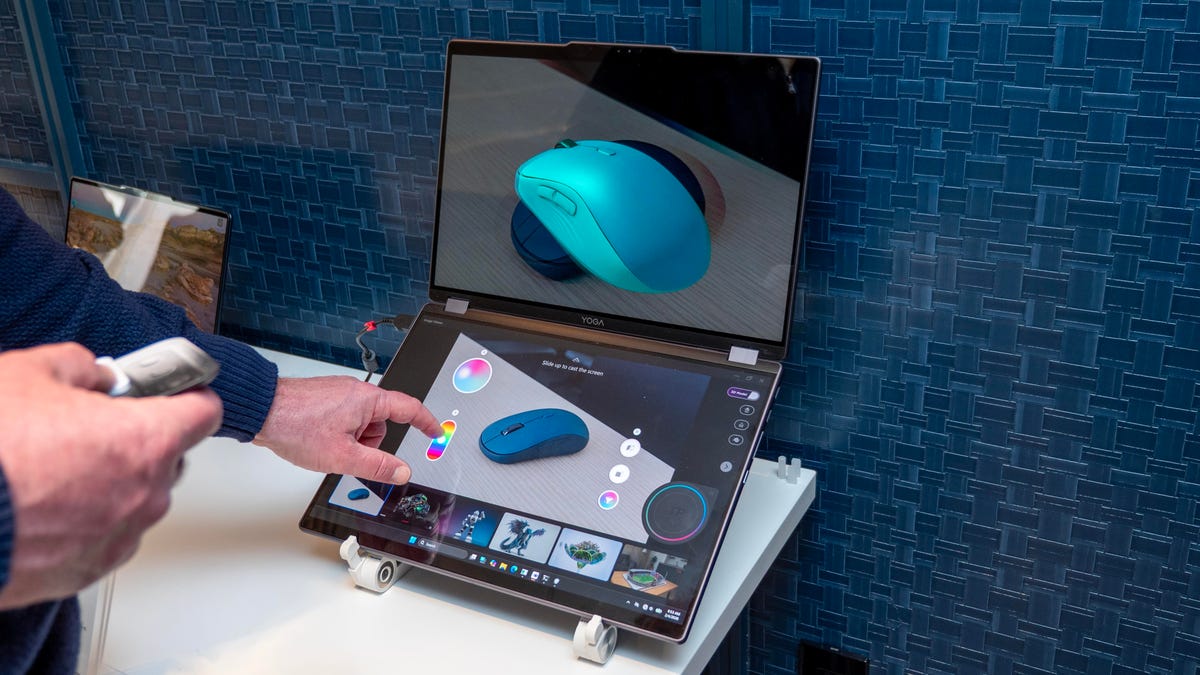
Clip-on tools let users place the light, color and resize sliders anywhere on the prototype’s bottom screen.
Yoga Book Pro 3D concept
The most interesting development from the Yoga line is this new concept computer that combines AI technology with glasses-free 3D technology to make flat images pop. Lenovo’s AI software powers the Yoga Book Pro 3D concept, which strives to streamline the process between sketching out pictures and creating three-dimensional models.
The clamshell laptop has two screens — images opened on the bottom screen can be altered with different lighting and color tools (which can be pulled up by placing real snap-on tools onto the screen) and then converted into fully 3D renders on the top screen. While standing in front of the computer’s camera, you can turn and resize the newly generated model to your liking with simple hand gestures, using two hands to pinch and sculpt the model as needed.
It’s a bit wonky and unresponsive, but so is the 3D effect of the screen itself — if you aren’t standing directly in front of the computer, the projection feels less impressive and more headache-inducing.
What I really like is being able to export 3D models directly into Blender. This concept provides a use case where AI is purportedly being used to aid creatives in the pursuit of a larger project rather than cut humans out of the process entirely.
Even still, I think this is an ethical gray area. What happens to the human animators who make 3D models now? Maybe they don’t even have to worry about losing out on work — all of the 3D models I saw generated during my time with the concept computer were finely-detailed but perfectly symmetrical. Can Lenovo’s AI technology even sculpt an asymmetrical model with the same detail and precision that a human can? Call me a doubter, but I don’t foresee this concept replacing 3D modeling work anytime soon.
The current iteration of the Yoga Book Pro 3D concept is powered by an Intel Core Ultra 7 series processor and an Nvidia GeForce RTX 5070 GPU.
The American market got skipped over by the Legion Tab Gen 4, but we’ll be getting our hands on the Legion Tab Gen 5 very soon.
Legion Tab Gen 5
Lenovo’s 8.8-inch Legion gaming tablet is getting a refresh, and it should be a pretty big technological leap for the American market, considering we’re jumping forward from the Legion Tab Gen 3 and its Snapdragon 8 Gen 3 processor. The Legion Tab Gen 5 features a 3K display with a 165Hz refresh rate and up to 600 nits of brightness to support on-the-go gaming under the sun.
The latest iteration of the Legion Tab is powered by a Snapdragon 8 Elite Gen 5 Mobile Platform chipset, up to 16GB of RAM, up to 512GB of storage space and a 9,000mAh battery. Legion Tab fans will be happy to know that one of the defining features of the Legion Tab Gen 3 — a dual USB-C port setup that supports simultaneous charging and external peripheral device connectivity — is still included in this design.
The Legion Tab Gen 5 will be available in May starting at $849.
In Canvas Mode, this convertible laptop is propped up off of a flat surface, letting users doodle and sketch with increased precision.
Yoga 9i 2-in-1 Aura Edition Gen 11
Lenovo’s premium convertible laptop is going all in on the display technology. The 14-inch Yoga 9i 2-in-1 Aura Edition Gen 11 is outfitted with a 2.8K OLED touchscreen that can reach 1,100 nits of brightness.
The Yoga 9i 2-in-1 Aura Edition Gen 11 is compatible with the Yoga Pen Gen 2, which will help users take advantage of the laptop’s new Canvas Mode, which uses the pen’s case to add a slight incline to the display when the computer is sitting on a flat surface. This is likely to be a solid work computer and top-shelf drawing tablet for creatives who can afford to shell out a four-figure sum.
The Yoga 9i 2-in-1 Aura Edition Gen 11 will be available in May. It will retail starting at $1,949.
The Legion 7a will be an incredibly powerful (and incredibly pricey) gaming laptop, despite the fact it lacks a discrete GPU.
Legion 7a Gen 11
Lenovo’s 11th generation lineup of Legion 7a laptops is getting bigger with the addition of a 15.3-inch model. This is a gaming laptop that costs more than some low-end PCs, and it promises high-performance gaming without a discrete GPU.
This is thanks to the integrated Radeon graphics cores built into the Legion 7a Gen 11’s AMD Ryzen AI Max Plus series processors, which are top-of-the-line hardware for gaming and online multitasking alike. The OLED display is contained within a lightweight and durable aluminum chassis, which means this laptop should feel portable (and it shouldn’t feel cheap).
The 15-inch Legion 7a Gen 11 will be available in July starting at $2,299.
The Yoga 7a Gen 11 is one of the most powerful consumer laptops in Lenovo’s lineup. It’s also absurdly expensive.
Yoga Pro 7a Gen 11
The 15.3-inch Yoga Pro 7a Gen 11 is without a doubt one of the most powerful commercial laptops Lenovo has on the market. A gorgeous display, high-performance hardware and a terrifying price tag unite in this sleek product.
The Yoga Pro 7a Gen 11 has a 2.5K PureSight Pro OLED display and comes outfitted with an AMD Ryzen AI Max Plus series chipset and up to a whopping 128GB of RAM. There’s no two ways about it: In a world where RAM is scarce, this is the type of computer targeted toward “AI power users,” for better or worse.
A Yoga Pen Gen 2 and Lenovo Force Pad are included with the Yoga Pro 7a Gen 11. The Yoga Pen is compatible with the computer’s touchpad (turning the laptop into a drawing tablet with a big screen, but not much tactility), but the Force Pad peripheral provides a much bigger sketchpad for higher precision annotations and line manipulation.
The 15-inch Yoga Pro 7a Gen 11 will begin shipping in August starting at $2,099.
Read the full article here