


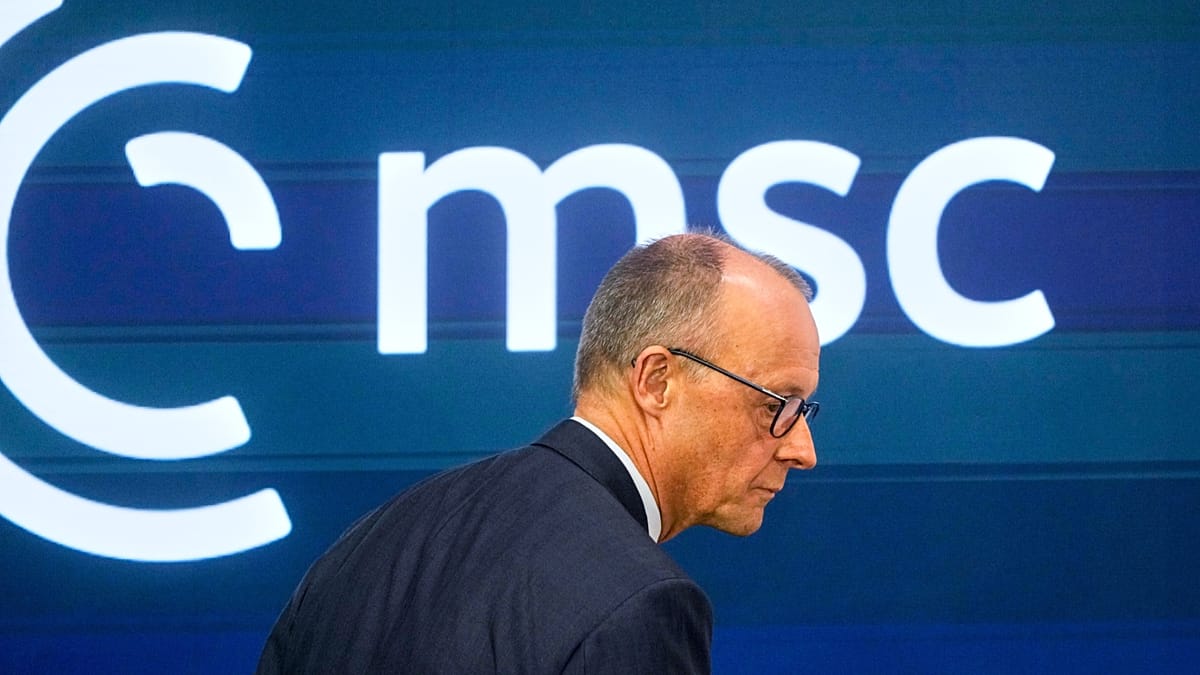
Friedrich Merz has told the Munich Security Conference that the world order as it has stood for decades “no longer exists” – and warned the United States that it will not be powerful enough to “go it alone” in the new age of great power politics.
The German Chancellor alluded to the title of the gathering, “a world under destruction”, suggesting that the old rules-based order has already disappeared and countries like Germany will have to completely rethink its approach to security and self-defence.
“You’ve chosen a grim motto for this conference, ‘under destruction’, and it probably means that the international order based on rights and rules is currently being destroyed,” he said on the opening day of the conference on Friday.
“But I’m afraid we have to put it in even harsher terms: This order, as flawed as it has been even in its heyday, no longer exists.”
Declaring that the “unipolar moment” that existed after the fall of the Berlin Wall with the rise of United States as world’s superpower has passed, Merz warned that the new global order of power politics puts even the strongest nations in greater danger.
“The return to power politics is not only rooted in the rivalry between great powers,” he said, suggesting that it reflects the restlessness and agitation of pre-revolution times.
“It is an expression of a wish in many democratic states for strong leadership in a globalised world in which democratic states in particular are coming very close to the limits of their ability to act,” he added.
This new context, he argued, marks the end of the “rules-based order” that democratic powers have used to prevent or mediate conflict since the end of the Second World War.
“Great power politics, it seems, offers strong and easy answers – at least to the big players, and at least at a first glance,” he said.
“Under this illusion, big power politics turns away from a world in which increasing connectivity translates into the rule of law and peaceful relations between states. Big power politics has its own rules. It is fast, harsh, and often unpredictable.”
‘An inconvenient truth’
Merz also directly addressed what he called an “inconvenient truth”: the transatlantic relationship between the US and Europe that has underpinned western security for decades is now in doubt.
In a particularly striking passage, he referenced an incendiary speech given by US Vice President J.D. Vance at the Munich Security Conference last year, in which Trump’s second-in-command accused European democracies of dooming themselves to destruction with censorious laws and mass immigration from other cultures.
“A divide has opened up between Europe and the United States,” Merz said. “Vice President J.D. Vance said this very openly here at the Munich Security Conference a year ago, and he was right.”
However, Merz said he does not subscribe to Vance’s diagnosis, speaking instead of European values – including those in direct disagreement with the Trump administration’s decisions and beliefs, in particular its withdrawal from multilateral organisations and abandonment of efforts to combat the climate emergency.
“The culture wars of MAGA in the US are not ours,” he insisted.
“Freedom of speech here ends where the words spoken are directed against human dignity and our basic law. We do not believe in tariffs and protectionism, but in free trade. We stick to climate agreements and the World Health Organization because we’re convinced that global challenges can only be solved together.”
‘Russia is not yet willing to talk seriously’
One of the main themes of Merz’s speech was the importance of western allies’ support for Ukraine in the face of Russia’s full-scale invasion, which will soon mark its fourth anniversary.
He alluded to the fact that since Donald Trump returned to the White House, Europe has had to double down on its support for Kyiv and strengthen its approach to penalising the Kremlin.
“For a year, Germany and Europe have assumed the most important leading role,” Merz said. “We have imposed unheard losses and costs on Moscow. And if Moscow finally agrees to make peace, it will also be for that reason, because this is an expression of European self-assertion.”
Going further in a brief question and answer session conducted by conference chairman Ambassador Wolfgang Ischinger after his speech, Merz insisted that Russia could not yet be trusted to negotiate in good faith on ending its assault – and called out Hungarian Prime Minister Viktor Orbán’s visit to Moscow in 2024, albeit without naming him.
“There was somebody from the European Union, a prime minister, who travelled to Moscow on his own,” Merz recalled. “He had no mandate; he went there, he achieved nothing. In the week after, we saw the heaviest attacks on civil infrastructure, and private homes, on hospitals, we had ever seen until this time.”
“So if it makes sense to talk, we are willing to talk,” Merz continued. “But as you can see with the American side, Russia is not yet willing to talk seriously. This war will only end when Russia is at least economically, potentially militarily, exhausted.”
“Russia has to give up this terrible war against Ukraine, and we have to do everything that is needed to bring them to the point where they see no further advantages for them to continue this terrible war.”
Pointing to Europe, Merz warned that freedom can no longer be taken for granted.
“Russia’s GDP is currently about €2 trillion. That of the European Union is almost 10 times as high – but still, Europe is not 10 times as strong as Russia today.
“Our military, political, economic, and technological potential is huge, but we haven’t tapped it to the necessary extent for a very long time. So the most important thing is to flick the switch in our minds now.”
“We have to understand that in the era of big powers, our freedom is no longer a given. It is at stake. We will need to show firmness and determination to assert this freedom,” he added.
Read the full article here