
NASA Astronaut Christina Koch’s Secret Trick to Decompress After Artemis II

News Room
10 Min Read

How do you recover from 10 days of traveling through outer space and around the moon? If you’re astronaut Christina Koch, you disconnect from being online and just journal.

“I spent that first week journaling about the mission without looking at any photos from the mission,” Koch told CNET on Monday during a visit to her alma mater, North Carolina State University, where an engineering building was being named after her. “I knew that, one day, the photos might define my memories, but initially, it was important to remember things as they were [with] fresh memories.”

Koch’s latest mission was NASA’s Artemis II, which sent her, commander Reid Wiseman, pilot Victor Glover and Canadian mission specialist Jeremy Hansen on a 10-day voyage in early April beyond the far side of the moon and back, becoming the first astronauts to go that distance in more than 50 years.

The NASA astronaut said she really “kept the blinders on” for the first two weeks. “The biggest fear I had when I landed was that I would forget it all so quickly.”

“The process of coming home is such an important one, whether you’ve done 328 days or nine days,” Koch said. She compared it to a kind of military deployment. “Reentering to Earth is a process, physical and mental. You’re coming back and, in some cases, coming into a routine [that] has gone ahead without you.”

Koch said she also came home to “quite a few” text messages, all congratulatory. But any emails she got from April 1 to April 10 are still unread; “I think people understand why,” she said with a laugh.

After a few weeks, Koch did look at the photos, and by then, the snaps were already world-famous. The photos the Artemis II team took — on off-the-shelf iPhones and Nikon cameras — came to be how the world experienced Artemis II. More than 18 million people tuned in to watch the crew’s takeoff, and their photos and live TV appearances spread in what became known as “Moon Joy.”

The Artemis II crew — (clockwise from left) Christina Koch, Jeremy Hansen, Reid Wiseman, and Victor Glover — take time out for a group hug inside the Orion spacecraft on their way home.

NASA

It was a record-breaking trip. As a whole, the Artemis II crew broke Apollo 13’s record for the furthest space travel, traveling over 700,000 miles total. Koch became the first woman to go beyond low Earth orbit; Glover, the first Black person; and Hansen, the first Canadian. 

Koch also holds the record for the longest-ever single spaceflight by a woman from her 2019 stint on the International Space Station, as well as taking part in the first all-female space walk.

One of the most popular photos from the trip is of Koch looking out the Orion spacecraft window, the planet Earth a bright sea of blue and green, her hair braided and iconic curls lit up. The image quickly went viral and became a rallying cry for women interested in science, technology, engineering and math, known as STEM.

Astronaut’s face in profile against the view of the Earth from the craft’s window. Her dangling braid is also visible.

Artemis II mission specialist Christina Koch looks out the window at Earth.

NASA

Launching an aerospace career

Being a role model isn’t new to Koch, and she considers it a big part of her job now, especially for women and girls.

“I had an experience meeting Sally Ride once,” Koch said, referring to the astronaut who became the first woman in space in 1983. “And in one moment, shaking my hand and her looking into my eyes, I felt like she said so much. She said, ‘Your dreams are valid. I see you. I believe in you.’ And I think that that’s really the job that’s before me, is to just look at people that might be looking after me, to tell them I see them, to tell them that their dream matters.”

A big part of Koch’s hometown visit was highlighting how her education was a launchpad for her aerospace career. Koch is a three-time NCSU grad, earning her Bachelor of Science degrees in electrical engineering and physics and a Master of Science in electrical engineering in the early aughts. 

But it wasn’t just the technical know-how that aided her on the moon mission. Koch said her time working for NCSU’s student newspaper, the Technician, sharpened her photography skills. She recalled learning how every photo should tell a story, something she thinks about “every single time I raise a camera to my eye,” whether the subject is the moon or her friends. 

The young engineers and space enthusiasts who turned out in droves to see Koch this week have more reason than ever to aim for the stars, literally. In many ways, Artemis II kicked off what space enthusiasts hope will be the beginning of a new space age. 

Four Artemis missions are slated to run before the end of the decade; Koch’s team was the first crewed mission. They stress-tested the new Orion spacecraft (which they named “Integrity”) and the Space Launch System that will be foundational to other missions.

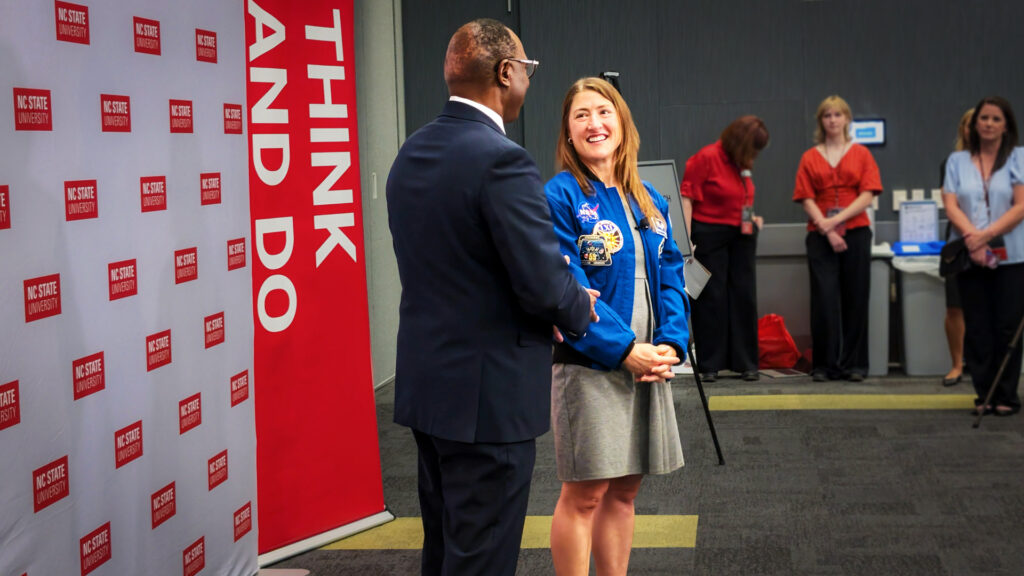
NASA astronaut Christina Koch (right) does the Wolfpack hand sign on stage next to NCSU chancellor Kevin Howell
North Carolina State University, led by Chancellor Kevin Howell (left), renamed one of its engineering buildings in honor of its alum, Christina Koch. Koch is making the university’s “Wolfpack” hand symbol.Katelyn Chedraoui/Rene Ramos/CNET

Artemis III is the next mission, slated for 2027. It plans to test docking procedures in a low Earth orbit, with NASA commander Randy Bresnik, mission specialists Andre Douglas and Frank Rubio, and European Space Agency pilot Luca Parmitano. Astronauts won’t step foot on the moon’s surface until Artemis IV in early 2028. 

Koch said she won’t be part of Artemis IV but will cheer on her friends who are. She spoke briefly about the “revolutionary” role of new technology in powering these future explorations and discoveries, specifically generative AI. But she also called out the need to address fundamental issues with the tech.

“I think the biggest challenge with AI is still preserving truth in our world,” Koch said. “If you find the thing that you can do the longest, for the slowest, and still love every day, you’re doing the right thing, no matter what people predict about AI or what it may do or not do.”

The upcoming Artemis missions have already stirred controversy. The all-male Artemis III crew sparked outrage and criticism, particularly after so many women and girls watched Koch break new records with Artemis II. The name “Artemis” even comes from the Greek goddess of hunting. NASA’s 2025 astronaut class also had, for the first time ever, more women than men (six versus four).

NASA administrator Jared Isaacman said in an X post in June that staffing decisions “tak[e] into account many factors, including the background and expertise of the astronauts,” and that the Artemis III astronauts are “experienced, qualified and deserve to be celebrated.”

Koch remains steadfastly optimistic that there will be room for many young people as we invest in future aerospace missions and science, both at NASA and with “commercial ventures” like Blue Origin and SpaceX. She hopes to be an active role model for students, ones like she was at NCSU and beyond — in her self-described “ripped jeans [and] pink hair” with an “inexplicable love of rockets.”

“For the students in the fourth row who think they’re the only ones in the room who don’t understand, and maybe haven’t been told yet, that’s not a disqualification,” Koch said. “Students of every kind, walking by and into this building, are my ‘why.’ Because it’s not the record for miles you travel away that really matters. It’s the impact you make, we make, right here at home.”

Read the full article here

Share This Article
Leave a comment

Leave a Reply

Your email address will not be published. Required fields are marked *