


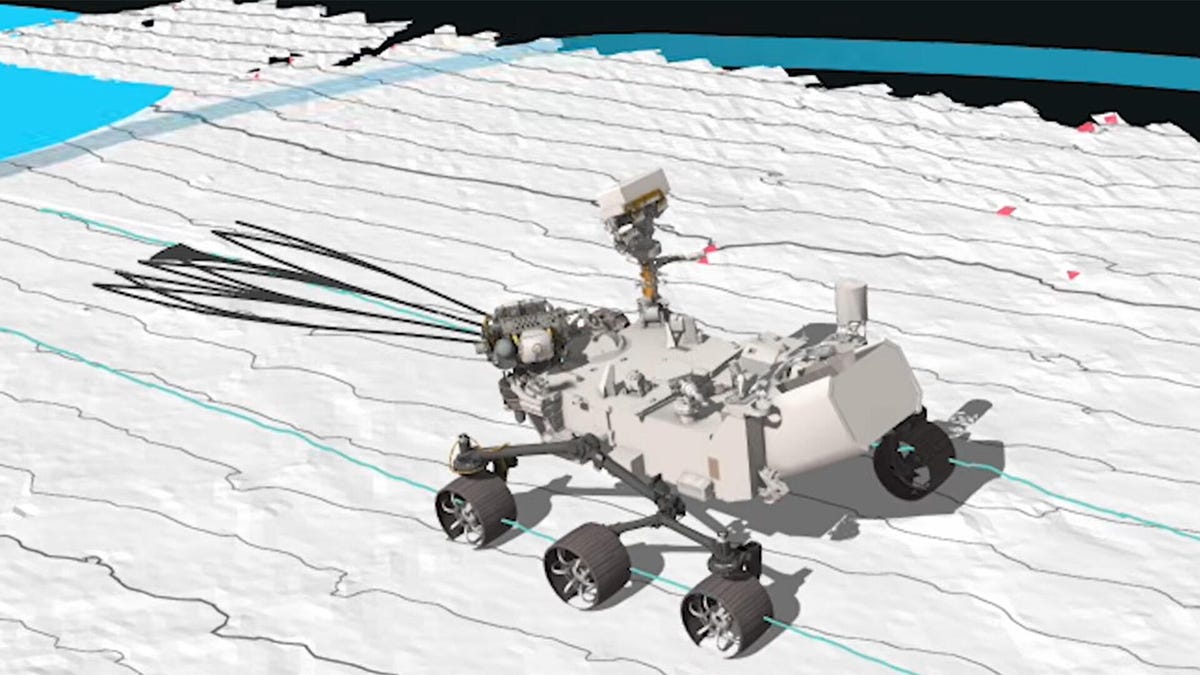
Plotting a course for NASA’s Perseverance rover, 140 million miles away on Mars, is significantly more difficult than setting a driving route here on Earth, where we can punch an address into Google Maps and be on our way in seconds. The rover’s course is usually plotted by a team at NASA’s Jet Propulsion Lab to account for terrain, obstacles and potential hazards, lest the rover tip over or get damaged.
For the first time, NASA’s JPL used AI to plot a course for Perseverance, and it seems to have worked out.
The two demonstrations, which took place on Dec. 8 and 10, were plotted by Anthropic’s Claude AI models and double-checked by JPL to ensure that the AI didn’t accidentally drive the rover into a ditch. Perseverance drove just under 1,500 feet across the two drives with no documented issues.
NASA took a similar approach with plotting the waypoints as it would with human operators. Claude was fed the same satellite imagery and data from NASA’s Mars Reconnaissance Orbiter that JPL scientists would use, and then asked to plot waypoints that Perseverance could handle safely.
The resulting path was slightly modified by NASA and then shipped to Perseverance, which then drove the path autonomously.
“This demonstration shows how far our capabilities have advanced and broadens how we will explore other worlds,” said NASA Administrator Jared Isaacman. “Autonomous technologies like this can help missions to operate more efficiently, respond to challenging terrain and increase science return as distance from Earth grows. It’s a strong example of teams applying new technology carefully and responsibly in real operations.”
You can watch the Dec. 10 drive on NASA’s YouTube channel, which has been condensed into a 52-second video.
The route planned by Claude is shown in magenta, and the actual path taken is in orange. NASA scientists only had to make minor adjustments to the AI’s pathing.
A more efficient way to do it
While AI is largely known as a provider of slop, which has been blamed for rapidly degrading people’s internet experience, it can be useful in some scientific pursuits. It takes time to parse years of imagery and data, plot the Perseverance waypoints, and then execute them.
Per NASA, waypoints are usually set no more than 330 feet apart, which means Perseverance is exploring the red planet one football field at a time. Take its epic climb out of the Jezero Crater in 2024. The journey took Perseverance 3.5 months and, all told, the rover climbed a total of 1,640 vertical feet. As of December 2025, the rover has driven a total of just 25 miles in roughly four years.
The goal, according to JPL space roboticist Vandi Verma, is to let Perseverance (and other Mars rovers) travel much farther while “minimizing operator workload.”
Verma also notes that AI could be used to flag interesting features on the planet, saving the human science teams time by eliminating the need to manually check “huge volumes of rover images.”
“This demonstration shows how far our capabilities have advanced and broadens how we will explore other worlds,” said Isaacman. “Autonomous technologies like this can help missions to operate more efficiently, respond to challenging terrain and increase science return as distance from Earth grows. It’s a strong example of teams applying new technology carefully and responsibly in real operations.”
Read the full article here