


Talk about a sugar rush!
NASA may have just come a little closer to cracking one of science’s most enduring mysteries — how life on Earth got started.
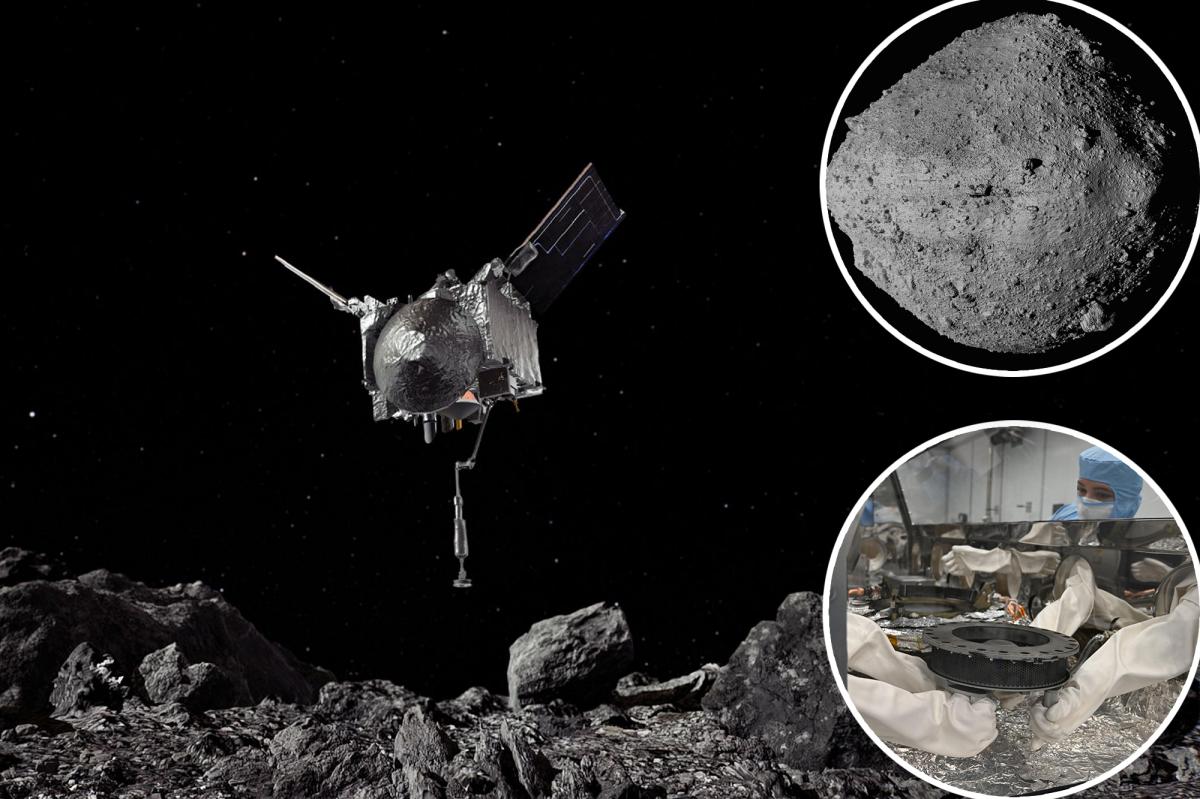
The space agency has reportedly discovered life-giving essential sugars on the asteroid Bennu, a 500-meter-wide rock hurtling through space, some 200 million miles from our planet.
Scientists found ribose — a five-carbon sugar crucial for RNA — and glucose, the six-carbon energy booster that fuels the human existence.
This is the first time ribose has been confirmed in a sample collected directly from an asteroid — though it’s been spotted in a few meteorites before.
Don’t panic — no aliens here. Instead, experts say these sugars are a key ingredient to the origin of life billions of years ago.
“All five nucleobases used to construct both DNA and RNA, along with phosphates, have already been found in the Bennu samples brought to Earth by OSIRIS-REx,” said study leader Yoshihiro Furukawa of Tohoku University in Japan.
“The new discovery of ribose means that all of the components to form the molecule RNA are present in Bennu.”
Furukawa said today’s life depends on the three-way teamwork of DNA, RNA and proteins — but the earliest life on Earth probably kept things simpler.
RNA, he said, is something of an early Swiss Army knife, able to hold genetic code and jump-start key reactions without any help.
Scientists say Bennu’s samples are hiding a bizarre bonus: a never-before-seen “space gum” that may have helped kickstart life on Earth.
The goo — once squishy, now stiff — is packed with nitrogen- and oxygen-rich polymers that likely formed as Bennu’s ancient parent rock heated up in the early solar system.
Researchers think this cosmic chewing gum was built from carbamate, a compound that managed to link itself into complex chains before the asteroid got warm and watery enough to wash it away.
In other words: Bennu’s been carrying around the universe’s oldest stick of gum, and it might just be holding some serious scientific clues.
Scott Sandford of NASA’s Ames Research Center in California’s Silicon Valley who led another relevant study said that the strange, gummy material may be Bennu’s oldest chemical makeover, a relic from the solar system’s wild youth.
“We’re looking at, quite possibly, one of the earliest alterations of materials that occurred in this rock,” the astrophysicist said — adding that “we’re looking at events near the beginning of the beginning.”
Scientists also found that Bennu’s samples contain six times more supernova dust than any other known space rock — ancient stardust that predates our solar system.
In other words, Bennu’s parent body formed in a cosmic neighborhood rich in the ashes of dying stars, giving scientists a rare peek at the galaxy’s original recipe mix.
And Bennu’s no stranger to Earth’s neighborhood. Formed nearly 4.6 billion years ago, it swings by every six years, coming closer than the Moon.
NASA’s OSIRIS-REx mission snagged samples during a 2020 flyby, bringing them home in September 2023 for some serious lab scrutiny.
The findings back the so-called “RNA world” idea: before DNA, RNA likely carried the genetic playbook and drove the chemistry needed for life.
And that glucose discovery? It shows that early solar system snacks for life were already on the menu.
Bonus plot twist: while Bennu is now helping us figure out our origins, it’s not exactly harmless.
Scientists say there’s a one-in-2,700 shot it could slam into Earth in the year 2182.
Read the full article here