Even before Donald Trump returned to the White House, Washington had indicated its intention to pivot resources away from Europe – but over the last year and a half, that pivot has accelerated.
The second Trump administration has made frequent announcements of troop withdrawals and cuts to crucial military capabilities made available to the alliance, while Trump himself has repeatedly derided NATO itself as a “paper tiger” – even threatening to pull the US out of the alliance altogether.
To fill the gaps being created by the ongoing US drawdown, Europe and Canada have significantly increased core defence expenditure with an agreement to spend 5 percent of GDP on defence by 2035.
Known as “NATO 3.0”, this is effectively the implementation of Washington’s plan for a fundamental reduction in its military contribution to NATO’s defence of Europe. As the US steps back from the continent, Europe will need to step up and attempt to fill the resultant gaps.
Crucially, the concept of NATO 3.0 was developed in the US, specifically by Under Secretary of War Elbridge Colby, who has long advocated a complete overhaul of the US’s Europe policy.
Critics argue that NATO 3.0 is effectively a diminution of Washington’s commitment to European security and represents a fundamental shift from the founding idea that the security of Europe is interchangeable with the security of the US.
Colby does concede that the US should retain a presence in Europe, and US membership of NATO still enjoys bipartisan support in the US Congress. Nonetheless, the US has already withdrawn key capabilities and forces required to deter future attacks on NATO territory, all whilst Russian aggression rages in Ukraine and allies face frequent drone incursions and hybrid attacks.
“Times have changed,” Colby told NATO defence ministers in Brussels in February. “We are reprioritising the defence of our homeland and the protection of our interests in our hemisphere,” he said.
And as NATO countries grapple with Washington’s revised strategic considerations and the uncertain future this brings, the administration’s frequent hostility to Europe doesn’t inspire confidence that NATO 3.0 is really about a more integrated, unified alliance.
As soon as he returned to the White House, relations between Trump and his allies began to deteriorate. The president’s ongoing insistence that he wants to “acquire” Greenland, a semi-autonomous territory of NATO ally Denmark, has badly undermined European trust in Washington, perhaps irrevocably.
Then came Trump’s ongoing military campaign in Iran. NATO allies’ reluctance to get involved has strained relations further, with Trump accusing European countries of abandoning their obligations to Washington.
Italy and Spain denied US forces access to bases on their territories, and France refused Israel the right to use its air space to transport US weapons for use in Iran.
Trump’s claims don’t hold up to scrutiny, however, particularly since NATO states were not consulted prior to the first strikes on Iranian targets. The UK, Germany and Romania – which recently approved additional US military capabilities on its territory in support of the war of Iran – all allowed the US basing and refuelling rights since the conflict began, albeit with conditions attached.
Moreover, a Franco-British-led coalition has pre-positioned a range of assets, including de-mining vessels, personnel and warships, to assist in reopening the Strait of Hormuz, the vital global shipping route that has been mostly closed since the US began its campaign. Prices for oil, gas and other commodities such as fertilisers have shot up as a result.
Despite these efforts, Washington’s ire against European states hasn’t subsided.
In June, US Secretary of War, Pete Hegseth lashed out at his allies over their “shameful” response to the Iran conflict, describing his country’s partners as “free riders”. During an address to his fellow defence ministers at NATO HQ in June, Hegseth then announced a review of US military troops in Europe with a view to drawing down troop numbers.
“The review is intended to both improve US force posture…and to strengthen NATO 3.0,” Hegseth told ministers in Brussels. “This is the right thing to do by the American people.”
“Europe can and must take primary responsibility for its conventional defence.”
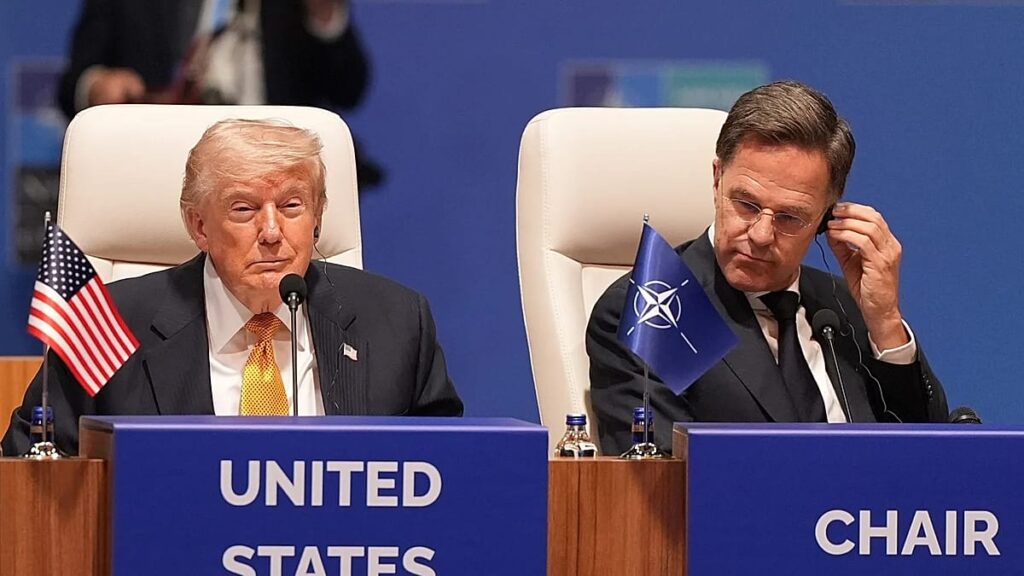
NATO Secretary General Mark Rutte has hailed NATO 3.0 as a strengthening of the alliance, crediting Trump for finally pressuring European states to assume more responsibility for their own defence: European and Canadian spending increases have combined over the last decade into what Rutte has dubbed “the Trump trillion”.
And Martin O’Donnell, Chief of Public Affairs at NATO’s Supreme Headquarter Allied Forces Europe, welcomed Hegseth’s force review, telling Euronews it allows NATO “plan better and more realistically in the even that, for example, a war would break out in the Pacific what forces can be relied upon from the United States.”
“That’s a good thing for the Supreme Allied Commander,” he said.
But a key question remains: is the withdrawal of US capabilities diminishing NATO’s overall deterrent power? On this matter, Rutte is an optimist.
“The US has adjusted its pledged contributions – and other allies have stepped up to contribute more,” he told journalists last June. “And this is fair. This makes us stronger, and this is what NATO 3.0 is all about. A stronger Europe in a stronger NATO,” he said.
The blunt signalling from Washington has been heard loud and clear by Europe and Canada. Between them they’vespent a record $139 billion defence last year – including $60 billion on American weapons, according to US–NATO figures.
And more than $50 billion in defence procurement and contracts were agreed at NATO’s Defence Industry Forum in Ankara in July.
One of the standout announcements was a joint procurement of up to 10 Swedish Saab GlobalEye aircraft to replace aging American Boeing Airborne Warning and Control System – a demonstration of the alliance’s growing European influence, as well as a commitment to expanding military spending.
In another demonstration that Europe is edging towards greater strategic autonomy and management of its own security, last July, ten European countries committed to creating an integrated, multi-national Anti-Ballistic Missile Coalition.
**”**We aim to build a shared anti-ballistic missile capacity for Europe,” read a statement from the founding members: Denmark, France, Germany, Italy, the Netherlands, Norway, Spain, Sweden, Ukraine and the United Kingdom.
“We believe that the protection of Europe requires a global solution of integrated missile defence architecture to deter and defeat future missile threats,” the statement said.
And at the same time, in perhaps one of the most explicit indicators of Washington’s waning commitment to NATO, the Pentagon confirmed to the alliance’s top military strategists in June that it wasshrinking the pool of military capabilities available to assist European nations in the event of a war or attack on NATO territory.
Among the numerous assets being withdrawn are B52 bombers, submarines and fighter jets, with the number of F-16 and F-15E combat aircraft made available to be reduced from roughly 150 to 100.
So, what will NATO 3.0 actually mean for the future of the 77-year alliance? At this point it’s too early to say for sure, but Euronews has spoken to NATO experts to get their assessment.
The new order
“It really is like putting lipstick on a pig,” former US Ambassador to NATO Ivo Daalder told Euronews, saying the Trump administration is “signalling that the security of Europe is no longer important to the security of the United States.”
“Alliances at their core are based on a shared perception of the threat, and on the idea that the security of all the members is indivisible; Donald Trump and his administration have abandoned both of those ideas,” he said.
“The US doesn’t see Russia as a threat that matters to the United States anymore,” said Daalder.
“Naming it ‘NATO 3.0’ is putting the lipstick on the pig because there’s at least hope that Trump doesn’t completely abandon NATO,” said Daalder.
Ian Brzezinski, Former Deputy Assistant Secretary of Defence for Europe and NATO Policy, agrees that the second Trump administration ultimately does not sees Europe as a vital interest, and is therefore stepping back not only from its position as external security guarantor, but from its former mitigating role when it comes to intra-European conflicts.
“Your vital interests are things you’re willing to fight and die for, and there are many in this administration that do not see Europe with the same interest as before,” Brzezinski told Euronews in an interview from his home in Washington D.C.
“The administration’s National Security Strategy and National Defence Strategy reflect an abandoning of the post-Cold War settlement. I’m a NATO 3.0 sceptic,” he said.
In withdrawing from European security, the White House is also unwinding decades of “defence-forward” Cold War era foreign policy, where the US invests in robust deterrence abroad in order to prevent aggression spreading to America.
Brzezinski also warned that without a committed US to act as a mediator, tensions among European nations could re-emerge.
“I worry about Europeans without US leadership,” he said. “Let’s face it, before NATO and the US’s positive interference in the continent, Europe was tearing itself apart with two world wars.”
Read the full article here