A new proposal in the California Legislature could make it more difficult for public agencies to use automated license plate readers, the cameras employed by controversial surveillance company Flock.
Privacy advocates argue the systems allow for mass surveillance, while law enforcement agencies say they are among the most important tools available for investigations.
Senate Bill 1013, authored by Sen. Sabrina Cervantes, would require public agencies using license plate readers to provide officer training, maintain logs of database searches, undergo annual audits by the California Department of Justice and delete license plate reader data after 30 days unless it is tied to an active criminal investigation.
SB 1013 has already passed the state Senate and is now under consideration in the Assembly. The bill would need to pass both chambers before reaching Gov. Gavin Newsom’s desk to become law.
Its prospects remain uncertain. Last year, Newsom vetoed a similar bill that would have required license plate reader data to be deleted after 60 days, arguing the restriction could be detrimental to law enforcement investigations.
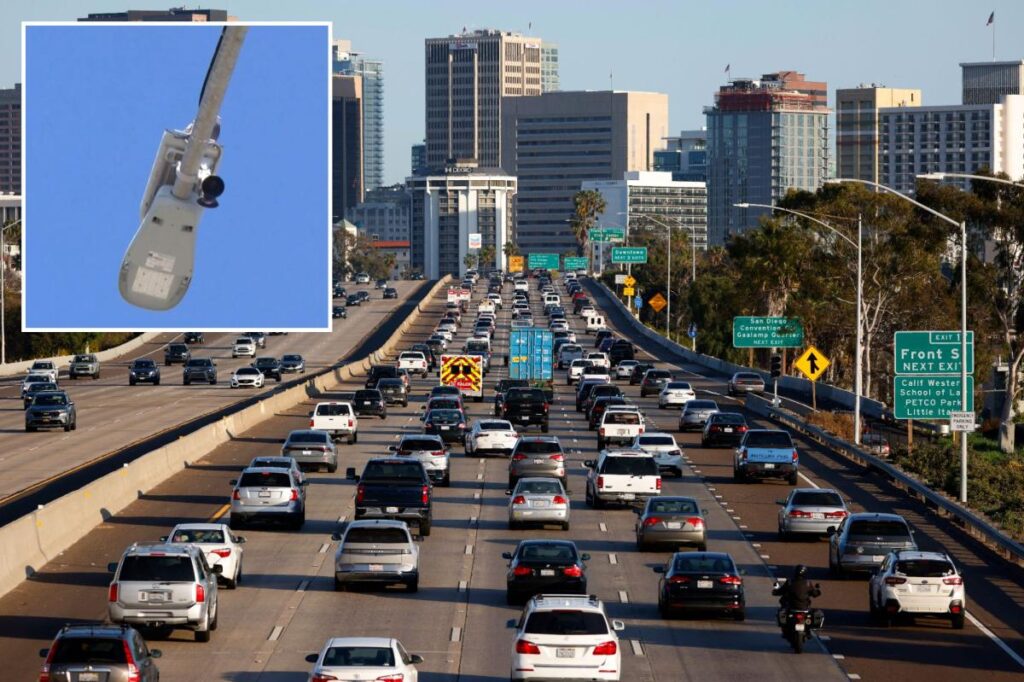
Currently, Flock Safety has more than 120,000 automated license plate readers installed across the US, according to the company’s online map. California has more than 16,000 of those cameras, giving the state the highest concentration of the devices in the nation.
If approved, Cervantes’ bill would establish uniform statewide standards governing license plate reader systems operated by public agencies throughout California.
Privacy advocates say the bill would provide greater oversight of how license plate readers are being used.
“People are bothered by mass surveillance,” Seth Hall of the Trust SD Coalition, a network advocating for greater oversight of surveillance technologies, told CBS News 8.
Hall said the cameras are constantly collecting information on vehicles, raising concerns about the extent of government surveillance.
Cervantes said the bill is meant to balance privacy concerns with the use of the readers in law enforcement investigations.
“This bill is about one simple principle: protecting the privacy and safety of Californians while ensuring law enforcement tools are used responsibly,” Cervantes told CBS 8.
State Sen. Kelly Seyarto, a Republican whose district includes part of San Diego County, opposes the proposal because he believes it could limit investigative tools used by law enforcement.
“To me, that is not a very long timeline in the big scheme of things,” Seyarto told CBS 8 of the proposed 30-day data retention limit.
He added that the limit on data retention could pose public safety risks by restricting investigators’ ability to solve crimes.
The San Diego Police Department has about 500 Flock Safety cameras throughout the city and has said the technology has become an important investigative resource.
Lt. Kristopher McAndrew told CBS 8 that ALPR technology regularly allows officers to conduct their investigations.
“This thing’s helping us every single day,” he told CBS 8. “It’s helping us recover those stolen vehicles, it’s helping us get people into custody.”
McAndrew noted that the department already has its own 30-day limit on license plate reader data retention but is waiting to see what happens with SB 1013.
Read the full article here