


Hello from Brussels. I’m Mared Gwyn, back holding the newsletter pen.
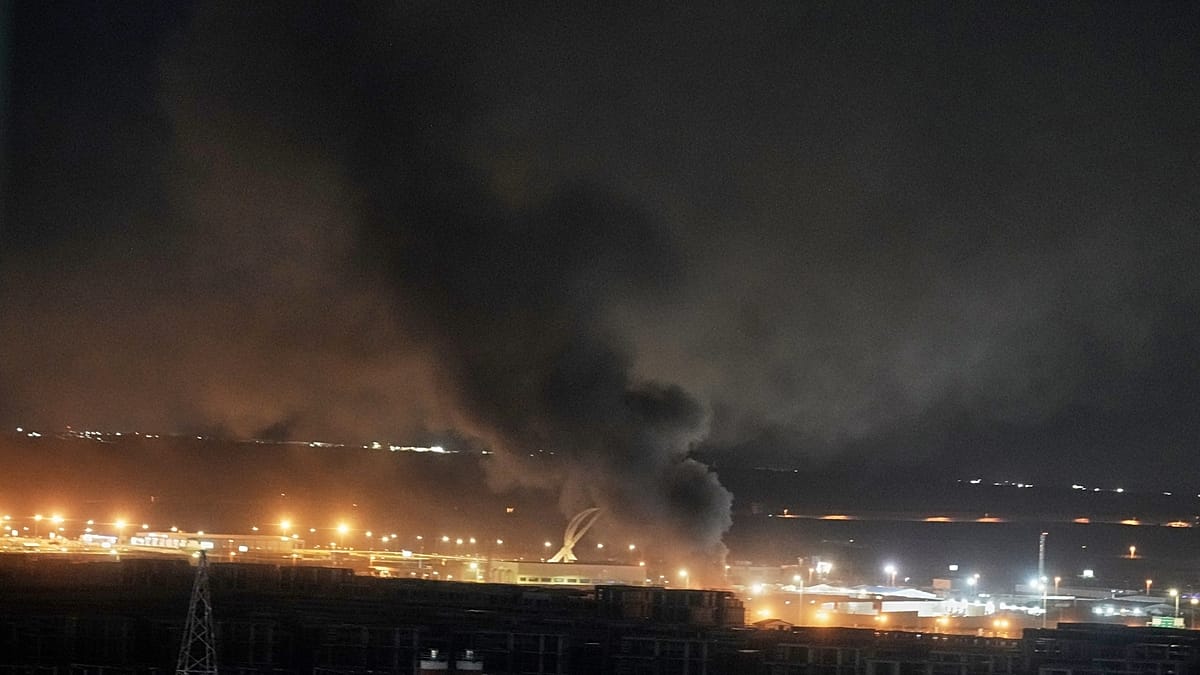
Oil prices have topped the $100 a barrel benchmark again this morning as Tehran intensifies attacks on energy infrastructure across the Middle East – this despite governments stepping up efforts to shield consumers, businesses and their economies from the repercussions of the Iran war.
Several tankers have been hit overnight in the Strait of Hormuz and the waters close to it, with Iraq halting operations at oil terminals after an attack on its Basra port earlier on Thursday. The Iranian retaliation has cast doubt over the mitigating impact that decisions taken by governments on Wednesday to curb the recent spiral in oil prices will have.
Speaking live on our flagship morning show Europe Today earlier, the European Commissioner for the Economy, Valdis Dombrovskis, warned that a prolonged and escalating conflict could create a “stagflationary shock for Europe”.
“The economic impact of the current crisis in the Middle East will to a large extent depend on how long the conflict will continue, how wide it will spread. So in a sense, if we manage to achieve quick de-escalation the impact may be limited. If it gets protracted (…) that indeed can create a stagflationary shock for the European economy, where due to the elevated energy prices, it brings in a broader inflation and also negatively affects growth,” Dombrovskis said in an interview with our EU Editor Maria Tadeo.
Asked about the failure of the decision to release strategic oil reserves to immediately calm market volatility, Dombrovskis pointed out that those reserves have not reached the market yet. Watch
All 32 members of the International Energy Agency (IEA) agreed Wednesday to jointly release a record-breaking 400 million barrels of oil from strategic reserves. It’s the largest emergency distribution in history, and more than double the 182 million barrels released in the wake of Russia’s war on Ukraine. My colleagues from our business team have the details in full.
G7 leaders – including US President Donald Trump – also held a virtual meeting on Wednesday during which French President Emmanuel Macron called for the swift restoration of navigation through the Strait of Hormuz, and hinted at diplomatic outreach to prevent restrictions on oil and gas exports.
“I want to engage with third parties to avoid any type of export restrictions for oil and gas which could destabilise the market and create more volatility,” Macron emphasized. Yet the renewed pounding of energy sites by Iran on Thursday has cast a shadow over Macron’s pleas.
Macron also said that G7 partners agreed that the situation “does not justify lifting any sanctions” on Russia, despite the US last week granting a 30-day waiver on the sale and delivery of sanctioned Russian oil to India from tankers already at sea.
US Treasury Secretary Scott Bessent described the move as a “deliberately short-term measure” – but there are signals of mounting concern in Europe that further escalation in the Iran war could threaten sanctions on Russia.
Commission President Ursula von der Leyen cautioned against a return to Russian oil and gas in a speech in the European Parliament in Strasbourg yesterday morning, warning that it would be a “strategic mistake.”
Later on Wednesday, Ukrainian President Volodymyr Zelenskyy also said the easing of sanctions would equate to “forgiving Russia” for its crime of aggression.
“As the President of a country that is a victim in this war, and as someone who fundamentally understands that aggression cannot go unpunished, I consider this absolutely unjust,” Zelenskyy said.
Meanwhile, the escalating feud between Hungary and Ukraine over the flow of Russian energy is deepening again, with Hungarian Foreign Minister Péter Szijjártó yesterday accusing Ukraine of “attacking” the infrastructure of the TurkStream natural gas pipeline in Russia, which serves Hungary.
It adds to boiling tensions over the Druzhba pipeline, which has been out of operation since it was hit in a strike on Ukraine in late January. Hungary and Slovakia, both landlocked countries exempt from some EU restrictions on Russian oil and which are served by Druzhba, have vetoing fresh sanctions on Russia and a financial package to Kyiv until the flow through the pipeline is restored.
“Ukraine’s oil blockade through the Druzhba pipeline and this strike against TurkStream are serious attacks on our sovereignty,” Szijjártó wrote on X last night. We have more on the pipeline dispute in our top story below.
Meanwhile, Kyiv is seeking help from the EU to recover money and gold seized by Hungary from two vehicles belonging to Ukraine’s state-owned Oschadbank last week. Prime Minister Viktor Orbán ordered his government to hold the valuables seized – which Budapest says amounts to €70 million in cash and 9 kilograms of gold – for up to 60 days amid an ongoing investigation.
Speaking to Europe Today earlier, Sergiy Nikolaychuk, the First Deputy Governor of the National Bank of Ukraine, weighed in on what Kyiv – and the EU – can do to ensure the return of the money and valuables. Watch.
Hungary sends fact-finding mission to Druzhba pipeline as Budapest and Bratislava resist renewal of sanctions on Russia
A Hungarian government delegation entered Ukraine on Wednesday to inspect the Druzhba oil pipeline, my colleagues Ádám Magyar and Sándor Zsiros report.
Ukraine’s Ministry of Foreign Affairs has rejected the mandate of the Hungarian group, which includes oil industry specialists and Gábor Czepeka, a deputy minister at Hungary’s Ministry of Energy.
“On the territory of Ukraine, this group of individuals has no official status and no scheduled official meetings — it is therefore wholly incorrect to describe them as a ‘delegation’,” the ministry said in a statement. “Citizens of other states who treat Ukraine with respect and observe the general rules of entry, including for tourism, may remain on Ukrainian territory.”
The pipeline has become a flashpoint in Hungarian domestic politics ahead of parliamentary elections in April, in which Viktor Orbán’s Fidesz party faces a significant challenge from Péter Magyar’s Tisza Party.
Orbán has made energy security a central campaign theme, accusing Ukrainian President Volodymyr Zelenskyy of exploiting the pipeline dispute to destabilise his government.
Kyiv denies that the pipeline is operational and maintains that any repairs would require a ceasefire with Russia. Ukraine’s President Volodymyr Zelenskyy said repairs could take up to six weeks, and has indicated he sees little reason to prioritise them.
Meanwhile, my colleague Jorge Liboreiro reports from Brussels that Hungary and Slovakia are resisting the renewal of EU sanctions on over 2,700 individuals and entities in response to Russia’s invasion of Ukraine, just days before the 15 March deadline.
Under EU rules, sanctions have to be prolonged every six months by unanimity. Both the Hungarian and Slovakian leaders are wielding their veto power in response to what they have described as Ukrainian “blackmail” in relation to the flow of Russian energy through Druzhba.
A first attempt to roll over the individual restrictions on Wednesday afternoon during a meeting of ambassadors in Brussels failed to reach a conclusion, with Hungary and Slovakia opposing the decision after their requests to remove a handful of individuals from the sanctions list were denied, several diplomats told Jorge.
The Slovak demand, involving businessmen Mikhail Fridman and Alisher Usmanov, proved particularly controversial in the room. The talks ended without resolution.
Another meeting is scheduled for Friday, when the stakes will be significantly higher as the clock ticks towards the March 15 deadline. Jorge has more.
NATO needs to be ‘prepared for war’ in High North, Norwegian commander says
Our correspondent Shona Murray reports for us this morning from NATO’s Cold Response military exercise in Norway’s Arctic region. She hears from a Norwegian air force commander who says NATO has to be ready for war at all times, especially in the Arctic.
“We need to be prepared for war. So, every day we are making sure that we are taking the right decisions”, so that if Putin decides he wants to attack, maybe he’ll think twice because NATO is well prepared’, Commander Hans-Martin Steiro tells Euronews.
Cold Response involves 20-30,000 soldiers from 14 NATO countries. It’s incorporated into the Arctic Sentry military activity launched in February after NATO was thrown into political chaos in January when US President Donald Trump said he would “take” Greenland.
Shona reports that NATO preparedness and capabilities are being tested in several theatres, whether in the High North or in the Middle East where NATO’s second largest army, Türkiye, has intercepted two ballistic missiles fired from Iran. NATO has deployed a Patriot Defence system to the south of Türkiye in defence of the Alliance’s territory.
More from our newsrooms
Cutting off Iranian lifeline for Hezbollah is critical, Lebanese minister tells Euronews. As Israel continues to pound Hezbollah’s strongholds in South Lebanon and parts of Beirut to root out the Shia militia, Euronews’ Sophie Claudet spoke exclusively to the Lebanese energy minister Joe Saddi who urged for mediated talks. Watch.
Iran war: Is the EU a mere spectator or diplomatic player? MEPs debate on The Ring As the Iran war persists, can the EU continue to stand back and limit the damage, and is it facing a moment of reckoning as the guardian of the rules-based order? MEPs debate on The Ring. Watch.
Spain to launch new tool to measure hate on social media. Prime Minister Pedro Sánchez has unveiled HODIO, a system to analyse how hate speech is spread on social networks and to evaluate the impact of algorithms on digital polarisation. Christina Thykjaer has more.
Spain formally dismisses ambassador to Israel amid tensions with Tel Aviv. Ambassador Sálomon had been recalled for consultations in September 2025 amid deteriorating relations between the two countries. Her dismissal now formalises the absence of a Spanish ambassador to Israel, Christina Thykjaer reports.
We’re also keeping an eye on
- European Commission Vice-President Teresa Ribera delivers keynote speech at the International Conference on Competition in Berlin, Germany
- European Parliament plenary session concludes in Strasbourg
Sasha Vakulina, Shona Murray and Jorge Liboreiro contributed to this newsletter. Remember to sign up to receive Europe Today in your inbox every weekday morning at 08.30.
Read the full article here